

If you have spent any time comparing cloud providers, you have run into OVHcloud. It is the largest hosting company in Europe, one of the biggest in the world by number of physical servers, and one of the very few global players that owns and builds its own data centers, designs its own server hardware, and runs its own fiber backbone. That vertical integration is the whole story behind OVHcloud: it is why the prices are low, why the DDoS protection is free, and also why the experience can feel more industrial and less hand-holding than the polished American clouds.
This review looks at OVHcloud honestly, from the perspective of someone deciding where to put a real workload. We cover the full product range, current pricing where we can confirm it, the genuinely good parts, and the parts that will frustrate you, including the 2021 Strasbourg data center fire and what it means today. If you want the short version, OVHcloud offers some of the best raw price-to-performance in the industry, backed by strong European data-sovereignty guarantees, but it asks you to be comfortable managing infrastructure yourself.
AnalyzeBench Score: 8.2 / 10
Best for: developers, sysadmins, and technically capable businesses that want powerful, affordable infrastructure in Europe (or a European provider globally) and do not need a lot of managed hand-holding.
What we loved:
- Excellent price-to-performance across VPS, bare metal, and public cloud
- Free, always-on anti-DDoS protection on every product
- Unlimited or very generous bandwidth on most VPS and dedicated plans
- Genuine European data sovereignty, protected from extraterritorial laws like the US CLOUD Act
- Huge product catalogue, from cheap Kimsufi servers to managed Kubernetes and GPU instances
- Owns its own hardware, data centers, and network backbone in 30-plus locations worldwide
Watch out for:
- Support is the most common complaint: slow first-response times and uneven quality
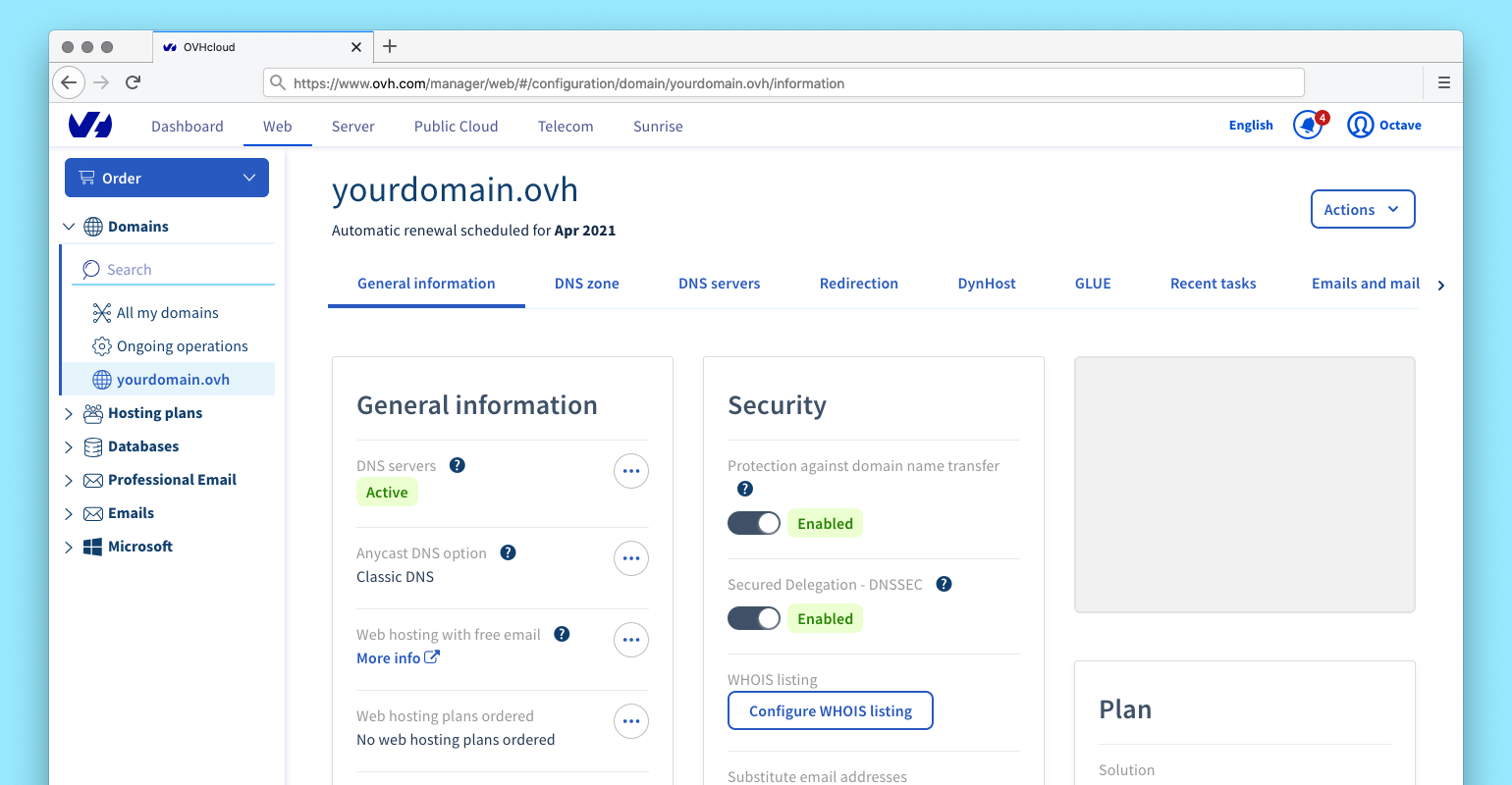
- The control panel is powerful but dated and can feel confusing to newcomers
- Very little managed hand-holding; you are expected to run your own server
- The 2021 Strasbourg fire is a real reminder to design your own backups and redundancy
What makes OVHcloud different
Most cloud providers you have heard of are, underneath, resellers of a few hyperscale platforms or operators who rent space in someone else’s data centers. OVHcloud is not. Founded in France in 1999, the company manufactures a large share of its own servers, builds and operates more than 30 data centers on several continents, and runs one of the largest private network backbones in the world. When a company controls the whole stack from the copper to the control panel, it can strip out the middleman margins. That is the single biggest reason OVHcloud pricing looks aggressive compared with the household-name clouds.
The second differentiator is water cooling. OVHcloud has used custom water-cooling on its servers for well over a decade, which lets it run dense, high-performance hardware at lower energy cost. That efficiency feeds back into the price you pay and into the company’s sustainability story.
The third, and increasingly important, differentiator is data sovereignty. OVHcloud is a European company that has deliberately built its governance so that European customer data is not subject to extraterritorial data-sharing laws such as the US CLOUD Act. For public-sector bodies, healthcare, finance, and any organization bound by GDPR, that is not a marketing line; it is a procurement requirement. OVHcloud has leaned into being the credible European alternative to the American hyperscalers, and it holds certifications such as ISO/IEC 27001, SOC 1/2/3, PCI DSS, and healthcare-focused attestations to back it up.
Finally, there is the free anti-DDoS. OVHcloud’s VAC mitigation system is included on every product at no extra charge and is designed to absorb very large volumetric attacks automatically. On most competitors you either pay for that protection or bolt on a third party like Cloudflare. Here it is simply part of the deal.
The core products
OVHcloud’s catalogue is one of the widest in the industry. It can be overwhelming, so here is the map. VPS are managed virtual private servers aimed at single-project hosting, running from a few dollars a month. Bare Metal (dedicated servers) range from the budget Eco lines, Kimsufi, So You Start, and Rise, up through Advance, Scale, and High Grade servers for heavy production workloads. Public Cloud is the on-demand, API-driven platform: virtual machine instances, cloud GPUs, block and S3-compatible object storage, private networking, load balancers, managed Kubernetes, a managed private container registry, and managed databases for PostgreSQL, MySQL, MongoDB, Valkey, plus data tooling like Kafka and OpenSearch.
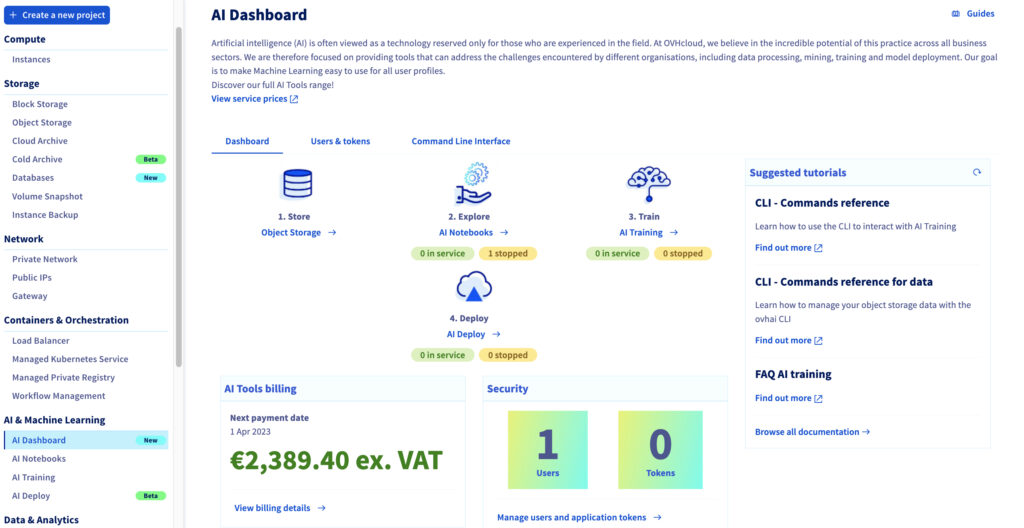
Hosted Private Cloud covers managed VMware and Nutanix environments for enterprises that want dedicated, single-tenant infrastructure. Web Hosting and domain registration round out the low end for people who just want to run a website or a WordPress install without touching a server. On top of all that sit networking and security extras: the vRack private network, additional IPs, load balancers, IAM, a key management service, and the anti-DDoS infrastructure mentioned above. There is also a growing AI and machine-learning range with AI Notebooks, AI Training, and AI Deploy, plus GPU instances for heavier work.
The takeaway is that OVHcloud can host almost anything, from a hobby site to a multi-rack sovereign-cloud deployment. Very few providers span that range under one account.
Plans & pricing
Pricing varies by region and currency, and OVHcloud periodically refreshes its ranges, so always confirm the live figure before you buy. The numbers below reflect US pricing at the time of writing and are meant to show the shape of the offer rather than a permanent quote.
VPS
The current VPS range is straightforward. The entry VPS-1 starts around $4.54/month with 2 vCores, 4 GB of RAM, and 40 GB of SSD. VPS-2 steps up to roughly $8.50/month with 4 vCores, 8 GB RAM, and 75 GB of NVMe storage. VPS-3 lands near $12.32/month (6 vCores, 12 GB RAM, 100 GB NVMe), and VPS-4 sits around $23.37/month with 8 vCores, 24 GB RAM, and 200 GB NVMe. Every VPS includes a daily automatic backup of the previous 24 hours, unlimited traffic in the standard regions, anti-DDoS protection, a dedicated IPv4, IPv6, and one-click vertical scaling. That combination of NVMe storage, free backups, and unlimited traffic at these prices is very competitive.
Bare Metal
Dedicated servers are where OVHcloud’s ownership model really shows. The Eco brands, Kimsufi, So You Start, and Rise, offer genuine dedicated hardware at prices that undercut most of the market, ideal for budget projects, labs, and storage boxes. The mainstream Advance, Scale, and High Grade lines target production workloads, hyperconverged infrastructure, big-data, and high-performance computing. Bare Metal pricing is quoted on a one-month commitment, with additional discounts when you prepay for 12 or 24 months. If you have a steady, predictable workload, a dedicated server almost always beats renting equivalent virtual capacity month after month.
Public Cloud
Public Cloud is billed pay-as-you-go, typically by the hour, with Linux instances priced per hour and Windows licensing available at extra cost. For predictable workloads you can switch to monthly-committed instances or a Savings Plan to bring the effective rate down. The platform covers general-purpose, CPU-optimized, RAM-optimized, and GPU instances, and it includes a free trial and free tiers on some managed databases so you can test before committing. This is the part of OVHcloud that competes most directly with AWS, Azure, and Google Cloud on model, if not on ecosystem breadth.
Web Hosting
For people who do not want to manage a server at all, OVHcloud’s shared Web Hosting plans bundle storage, databases, email, and one-click application installs (including WordPress) at low monthly rates, with domain registration available alongside. It is the simplest on-ramp in the catalogue and a sensible choice for brochure sites, small blogs, and small-business pages.
How to choose the right product
The decision usually comes down to how much control you need versus how much management you want to do. If you just need a website online and do not want to touch a command line, start with Web Hosting. If you want your own isolated server with full root access but without managing physical hardware, a VPS is the sweet spot, and it is the product most people should start with. If you have a heavy, steady workload, a database that needs consistent I/O, or you simply want the best raw performance per dollar, move to Bare Metal. And if you need to spin resources up and down on demand, automate through an API, run containers on managed Kubernetes, or build a multi-server high-availability architecture, that is what Public Cloud is for. A useful rule of thumb: VPS for one project, Bare Metal for maximum performance at a fixed cost, Public Cloud for elastic and complex systems.
Watch: OVHcloud in action
To see how the platform actually looks when you provision and deploy resources, this walkthrough is a helpful overview of getting started on OVHcloud.
OVHcloud vs alternatives
OVHcloud sits in a competitive middle ground: cheaper and more sovereign than the American clouds, but less bare-bones-cheap than Hetzner and less polished than DigitalOcean. Here is how the three most common comparisons shake out.
| Factor | OVHcloud | Hetzner | DigitalOcean |
|---|---|---|---|
| Entry VPS price | Low | Lowest | Higher |
| Product breadth | Very wide (VPS, bare metal, public cloud, private cloud, web hosting, domains) | Narrow (cloud and dedicated servers, basic networking) | Medium (droplets, managed DBs, Kubernetes, App Platform) |
| Global footprint | 30-plus locations worldwide | EU, US, and Singapore | Broad global regions |
| Free anti-DDoS | Yes, on every plan | Included | Add-on / third party |
| Dashboard & developer UX | Powerful but dated | Clean and simple | Cleanest, most beginner-friendly |
| EU data sovereignty | Strong, CLOUD Act protected | Strong (German/Finnish) | US-headquartered |
In practice: pick Hetzner if your only goal is the absolute lowest price for cloud or dedicated servers and you are fine with a smaller footprint. Pick DigitalOcean if developer experience, documentation, and managed services matter more to you than saving a few dollars. Pick OVHcloud if you want the widest product range under one roof, genuine European sovereignty, free DDoS protection, and strong price-to-performance, and you are comfortable being your own admin.
Performance, support & value
On raw performance, OVHcloud is strong. The move to NVMe storage across VPS, generous bandwidth, and dense, water-cooled hardware means you get real capacity for the money. Independent benchmark communities generally place OVHcloud’s compute and network performance in a solid, reliable band, and the free anti-DDoS is a meaningful uptime advantage for anything exposed to the public internet. Uptime SLAs of 99.9% are offered on VPS, and the owned backbone helps keep latency predictable across regions.
Support is the weak spot, and it is worth being blunt about it. Across review platforms, the most consistent criticism of OVHcloud is that first-response times on tickets can be slow and that the quality of help is uneven. You can reach experts by phone and email, and the documentation and community resources are extensive, but if you are the kind of user who expects fast, guided, hand-holding support, OVHcloud will test your patience. This is the trade-off for the low prices: the model assumes you can largely support yourself.
On value, though, the math is compelling. When you add up NVMe storage, unlimited traffic, daily backups, free DDoS mitigation, and sovereign hosting, the total package at OVHcloud’s price points is hard to beat, provided you can live with self-service support.
Who should use it — and who should not
OVHcloud is an excellent fit for developers, system administrators, agencies, and technically capable businesses that want to control their own infrastructure and stretch their budget further. It is especially strong for European organizations, and for anyone worldwide who needs a non-US cloud for sovereignty or compliance reasons. If you run game servers, self-hosted apps, databases, CI pipelines, or a fleet of dedicated boxes, the price-to-performance is genuinely excellent.
It is a poor fit if you are a non-technical beginner who wants a polished, guided experience with fast premium support, or if your business depends on managed services and a slick developer console more than on cost. In those cases a more hand-holding host, or a provider like DigitalOcean, will likely make you happier even at a higher price. OVHcloud rewards competence; it does not compensate for its absence.
Honest limits
Three things deserve a clear-eyed mention. First, the control panel. It is comprehensive, but it is also dense and occasionally unintuitive, with features tucked into menus that take time to learn. Power users grow to appreciate it; newcomers often find it intimidating. Second, support, covered above, remains the single most common source of frustration. Third, and most importantly, the March 2021 fire at the Strasbourg (SBG) campus destroyed the SBG2 data center and damaged part of SBG1, taking a large number of sites and services offline; official reports afterward noted the affected building lacked an automatic fire-suppression system and an electrical cutoff. OVHcloud has since invested heavily in fire safety and prevention across its sites. The lasting lesson for customers is not that OVHcloud is uniquely risky, every provider can have an incident, but that you must own your disaster-recovery plan: keep off-site backups, and for anything critical, deploy across more than one data center. Notably, some customers affected by that fire had assumed backups were automatic and geographically separate when they were not. Treat redundancy as your responsibility, not the host’s.
OVHcloud deals
OVHcloud runs regular promotions across its ranges, particularly on the Eco dedicated servers and seasonal Public Cloud credits, and prepaying for 12 or 24 months on Bare Metal unlocks additional discounts. Because the exact offers rotate, the best move is to check the current pricing and any live promotions before you commit, then match the plan to the product guidance above. If the value proposition, low prices, free DDoS, and European sovereignty, fits your project, it is one of the strongest options on the market.
Frequently asked questions
Is OVHcloud good for beginners?
Not especially. The VPS and dedicated products assume basic server-administration knowledge, and the control panel has a learning curve. Absolute beginners are better served by the shared Web Hosting plans, or by a more hand-holding host, until they are comfortable managing a server themselves.
Is OVHcloud reliable after the 2021 fire?
The 2021 Strasbourg fire was a serious incident that destroyed the SBG2 data center, and OVHcloud has since invested significantly in fire prevention and safety. As with any provider, reliability also depends on you: keep independent, off-site backups and, for critical workloads, spread across multiple data centers.
Does OVHcloud include DDoS protection?
Yes. OVHcloud’s anti-DDoS (VAC) mitigation is included free on every product, from VPS to bare metal to public cloud, with automatic mitigation and no extra charge.
How does OVHcloud pricing compare to AWS or Azure?
For comparable compute and storage, OVHcloud is generally considerably cheaper than the American hyperscalers, largely because it owns its hardware and data centers. What you give up is the enormous managed-service ecosystem and the polish of those platforms.
Is my data protected under European law?
OVHcloud hosts European data in GDPR-compliant, certified data centers and has structured its governance to shield that data from extraterritorial laws such as the US CLOUD Act, which is a key reason public-sector and regulated customers choose it.
Can I upgrade my VPS later?
Yes. You can scale a VPS up to a higher configuration with a single click from the control panel, with just a quick reboot and no manual data migration. Downgrading, however, requires subscribing to a new plan and transferring your data.
Does OVHcloud offer managed Kubernetes?
Yes. The Public Cloud range includes a CNCF-certified Managed Kubernetes Service, along with a managed private container registry and a load balancer for Kubernetes, so you can run containerized workloads without operating the control plane yourself.
How to choose a cloud provider: a short buyer’s guide
Whether or not you end up with OVHcloud, the same framework helps you choose any host. Start with workload type: a static site needs almost nothing, while a database-heavy application needs fast, consistent storage and predictable I/O. Match the product, shared hosting, VPS, dedicated, or elastic cloud, to that shape rather than to the headline price.
Next, weigh managed versus unmanaged. Unmanaged infrastructure is cheaper and more flexible but puts security patching, backups, and uptime on you. If you do not have the skills or time, pay for management or choose a more guided platform; the cheapest plan is expensive if it goes down and you cannot fix it.
Then look hard at support and SLAs. Read recent reviews specifically about response times, because when something breaks at 2 a.m. the quality of support is the only thing that matters. Check the guaranteed uptime figure and what compensation, if any, an SLA breach actually provides.
Consider data location and compliance. Where your data physically lives affects both latency and your legal obligations. If you are bound by GDPR or need to keep data out of reach of foreign jurisdictions, a sovereign European provider matters; if your users are all in one region, pick a data center near them.
Finally, plan for backups and redundancy from day one, and understand the total cost, including bandwidth overages, IP charges, backup add-ons, and renewal pricing after any introductory rate. Never assume backups are automatic or geographically separate unless the provider states it explicitly. A host that includes backups, generous bandwidth, and DDoS protection in the base price, as OVHcloud largely does, can be better value than a cheaper sticker price that nickel-and-dimes every extra. Weigh all of that together, and the right provider becomes clear.



