

If you have spent any time comparing budget-friendly hosting companies, you have almost certainly run into Hostwinds. It is one of those providers that quietly shows up on nearly every “best cheap VPS” and “best value hosting” list, yet it rarely gets the flashy marketing treatment that some of its louder competitors lean on. Founded in 2010 and headquartered in Seattle, Hostwinds has built a reputation as a hosting company for people who actually care about what is under the hood: full root access, hourly-billed cloud servers, genuinely fast support, and a menu of products that stretches from a $5 shared plan all the way up to enterprise dedicated hardware.
In this in-depth review we put Hostwinds under a microscope. We look at what it offers, how much it really costs once the promotional pricing expires, where it shines, and where it frustrates. This is an honest assessment, so you will find the weak spots called out just as clearly as the strengths. If you want to skip the reading and see current offers, you can always Check Hostwinds deals and come back.
AnalyzeBench Score: 8.4 / 10
Best for: Developers, agencies, and small-to-medium businesses that want flexible VPS and cloud hosting with strong support and transparent, resource-based pricing — without paying a premium for a big brand name.
What we loved:
- Fast, knowledgeable 24/7 support with a reputation for quick ticket resolution
- Extremely flexible VPS lineup — managed or unmanaged, Linux or Windows, billed hourly or monthly
- Hostwinds owns its own infrastructure, which keeps prices low and support in-house
- Nightly backups available as an inexpensive add-on across VPS plans
- Cloud servers with true hourly billing and scalable resources
Watch out for:
- Only a handful of data center locations (Seattle, Dallas, and Amsterdam)
- Renewal prices are noticeably higher than the introductory rates
- A short refund window compared with the industry standard
- Unmanaged plans assume real Linux and command-line comfort
What makes Hostwinds different
Plenty of hosts advertise cheap plans, so the first fair question is what actually sets Hostwinds apart. The clearest answer is ownership. Unlike a large chunk of the budget hosting market — where the company you buy from is really just reselling capacity from someone else — Hostwinds owns and operates its own servers, networking, and infrastructure. That vertical control matters for two practical reasons. First, it keeps costs down, and those savings are passed along in the pricing. Second, when something goes wrong, there is no third-party middleman to wait on; the same company that sells you the service also runs the hardware.
The second differentiator is flexibility. Hostwinds does not force you into a rigid tier system. Its cloud and VPS products let you choose your operating system, pick managed or unmanaged support, and pay either by the hour or by the month. For a developer spinning up a temporary staging environment, hourly billing means you only pay for what you use. For a business running a production site around the clock, monthly billing keeps things predictable. Few budget hosts offer that kind of granularity.
Finally, there is the support culture. Hostwinds has cultivated a reputation over the years for responsive, competent help. Support is available 24/7/365 via live chat, tickets, and phone, and the team is generally willing to dig into technical issues rather than deflecting with canned responses. For a company at this price point, that level of attention is genuinely unusual.
The core service
At its heart, Hostwinds is a full-spectrum hosting provider. Where many companies specialize in one niche, Hostwinds tries to cover the entire journey — from a hobbyist launching their first WordPress blog to a growing company that needs isolated dedicated hardware.
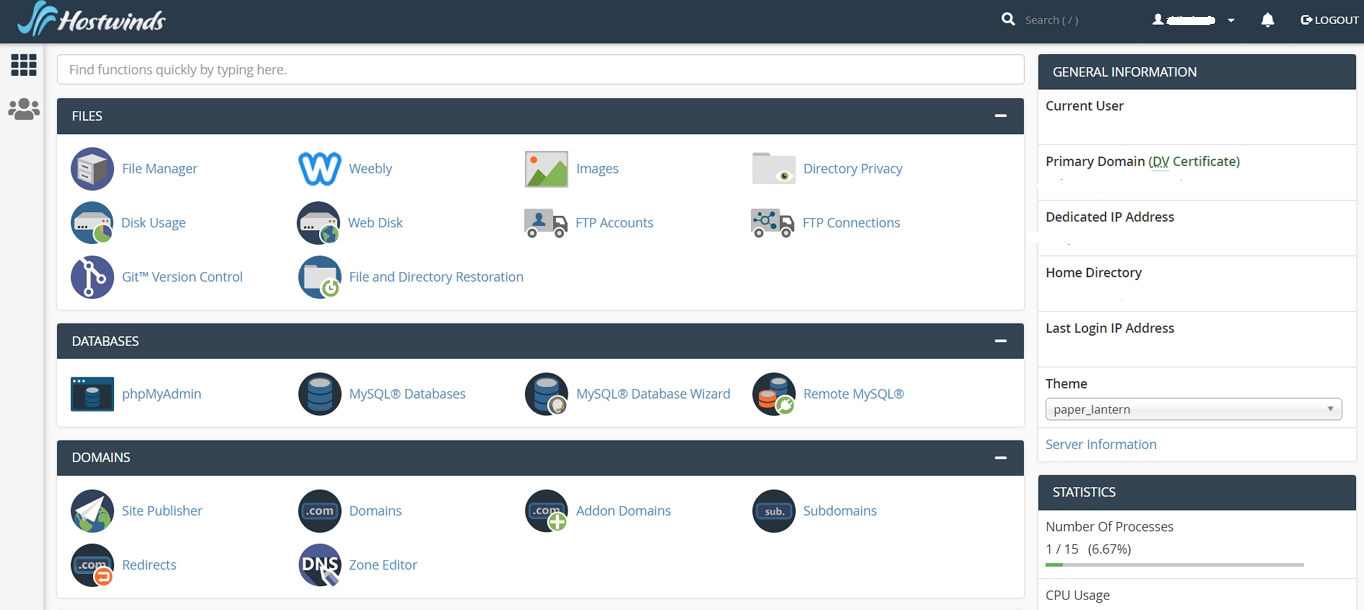
The lineup breaks down into a few main categories. Shared hosting is the entry point: inexpensive, beginner-friendly, and built on cPanel, which makes launching a website or installing WordPress a near one-click affair. Business hosting sits a step above, offering more resources and features aimed at sites that have outgrown the most basic shared environment. Reseller and white-label hosting cater to freelancers and agencies who want to sell hosting under their own brand.
Then comes the part Hostwinds is best known for: VPS and cloud servers. The VPS lineup covers both Linux and Windows, in managed and unmanaged flavors. Managed plans hand off routine server administration — OS updates, security scans, and troubleshooting — to the Hostwinds team, while unmanaged plans give you a bare server and full root access to do as you please. The cloud platform adds hourly billing, snapshots, and easy scaling, along with supporting products like load balancers, block storage, and object storage.
At the top of the stack sit dedicated servers, which give you an entire physical machine with complete isolation from other users. Across nearly all of these products, Hostwinds offers nightly backups as an add-on, a 24/7 support team, and the same underlying network it owns and controls.
Plans & pricing
Hostwinds prices are competitive at the entry level, but as with most hosts, the introductory rates are promotional and step up at renewal. Here is how the main product lines break down. Treat these as general ranges rather than exact quotes, since Hostwinds runs frequent promotions and configuration options change the final number.
Shared hosting
Shared plans typically start in the region of roughly $5 to $7 per month on longer terms, with unlimited disk space, bandwidth, and the ability to host multiple domains on the mid and upper tiers. This is the most affordable way onto the platform and the natural choice for a personal site, portfolio, or small WordPress project. Just be aware that shared resources are shared: a sudden traffic spike on a neighboring site can occasionally affect performance, and renewal pricing runs higher than the first-term rate.
VPS hosting
This is where Hostwinds earns most of its praise. Unmanaged Linux VPS plans start at a very low monthly figure, with cloud instances available on an hourly basis for those who prefer pay-as-you-go. Managed plans carry a premium over the unmanaged equivalents — you are paying for the Hostwinds team to handle OS updates, security, and server-level troubleshooting. Windows VPS options are also available, though they cost more due to licensing. As you climb the tiers, you add CPU cores, RAM, storage, and bandwidth, so pricing scales smoothly from a few dollars a month up into the hundreds for large configurations. Nightly backups are available as an inexpensive add-on.
Dedicated servers
For workloads that need an entire machine, dedicated servers start around the low three figures per month and scale up substantially depending on the hardware you configure. These are fully isolated, giving you 100% of the machine’s resources with no noisy neighbors. They suit high-traffic sites, resource-heavy applications, and businesses with strict performance or compliance requirements. To see the latest configurations and current pricing, you can Check Hostwinds deals directly.
How to get the best deal
Getting the most out of Hostwinds comes down to understanding how its pricing works and planning around it. A few practical tips:
- Commit to a longer term. As with almost every host, the lowest monthly rate on shared and managed plans requires signing up for a longer billing cycle. If you are confident in the service, a longer term locks in the introductory discount for more of its life.
- Know your renewal number before you buy. The promotional rate is real, but it is temporary. Check what the plan renews at so there are no surprises when the second term arrives. This is the single most important thing to verify.
- Match the product to the workload. Do not overbuy. If you only need a small site online, shared hosting is plenty. If you need control, an unmanaged VPS is far cheaper than a managed one — provided you are comfortable administering it yourself.
- Use hourly cloud billing for short-lived projects. For testing, staging, or temporary spikes, the hourly cloud model means you only pay for the hours you actually run.
- Add the backup service. Nightly backups are cheap insurance. For a small monthly fee they are almost always worth it.
When you are ready to compare live configurations and current promotions, you can Check Hostwinds deals and pick the plan that fits.
Watch: Hostwinds in action
If you would rather see the control panel and a hands-on walkthrough before deciding, this independent video review is a helpful overview of what to expect from the platform.
Hostwinds vs alternatives
No host exists in a vacuum. Hostwinds competes most directly with value-focused providers on one side and managed, hand-holding hosts on the other. Here is how it stacks up against two common alternatives.
| Feature | Hostwinds | Hostinger | InMotion Hosting |
|---|---|---|---|
| Best for | Flexible VPS & cloud, developers | Rock-bottom shared hosting, beginners | Managed business & VPS hosting |
| Entry shared price | Low, promotional | Among the cheapest available | Higher than budget rivals |
| VPS flexibility | Managed/unmanaged, hourly or monthly | Managed VPS, monthly | Managed VPS focus |
| Control panel | cPanel | Custom hPanel | cPanel |
| Data centers | Limited (US & Amsterdam) | Global network | US-based |
| Support reputation | Fast, technical, 24/7 | Good, 24/7 chat | Strong, US-based |
The short version: Hostinger tends to win on the absolute lowest headline price and a polished beginner experience, InMotion leans into managed, US-based business hosting with longer money-back guarantees, and Hostwinds sits in the middle as the flexible, developer-friendly option with excellent support and true hourly cloud billing.
Uptime, support & value
Hostwinds advertises a headline 99.9999% uptime commitment, backed by what it describes as fully redundant, 2N infrastructure — two of everything from routers to fiber paths. That marketing number is ambitious, and in real-world independent monitoring the measured figure tends to land a little lower, in the neighborhood of 99.98%. That is still very solid and comfortably in line with what a reliable host should deliver; just do not take the six-nines claim as a literal contractual promise.
Support is where Hostwinds consistently earns strong marks. The team is available around the clock through live chat, support tickets, and phone, and reviewers repeatedly highlight fast response and resolution times. For a company competing largely on price, having support that actually understands server-level problems is a meaningful advantage, especially for customers on unmanaged plans who occasionally need a hand.
On value, the picture is nuanced. At the introductory price, Hostwinds is a strong deal for the flexibility and support you get. The value proposition softens at renewal, when prices step up, so the calculus depends on how long you plan to stay and whether you locked in a longer term. For developers and businesses that will use the platform’s flexibility, the overall value remains attractive.
Who should use it — and who should not
Hostwinds is an excellent fit for a specific set of users, and a mediocre fit for others. Being honest about that is the whole point of a review.
You should strongly consider Hostwinds if: you are a developer or technically-inclined user who wants full root access and flexible billing; you run an agency or freelance business and want reseller or white-label options; you need a VPS or cloud server and value responsive technical support; or you want to spin resources up and down and only pay for what you use via hourly cloud billing.
You should probably look elsewhere if: you need a data center physically close to a region Hostwinds does not serve, such as Asia-Pacific, South America, or Africa, where latency will suffer; you are a complete beginner who wants the most guided, hand-held onboarding experience possible; or you require a long, generous money-back guarantee to test the service risk-free, since the refund window here is short.
Honest limits
Every host has trade-offs, and Hostwinds is no exception. The most significant limitation is geographic. With data centers concentrated in Seattle, Dallas, and Amsterdam, Hostwinds serves North America and Europe well but leaves large parts of the world far from a server. If your audience is primarily in Asia, Oceania, or the Southern Hemisphere, latency will be higher than with a host that has a presence in those regions.
The second limit is the refund policy. Hostwinds offers a notably short refund window compared with competitors that provide 30, 45, or even 90 days. That leaves little room to thoroughly test the service before committing, so you will want to be reasonably confident before you buy.
Third, renewal pricing climbs after the introductory term, which is standard across the industry but still worth factoring into your long-term budget. And finally, the unmanaged plans that make Hostwinds so appealing to developers are genuinely unmanaged — if you are not comfortable with Linux and the command line, an unmanaged VPS will feel more like an obstacle than a tool, and you will want to pay up for a managed plan instead. It is also worth noting that Hostwinds was acquired by HostPapa in 2026; as with any ownership change, it is reasonable to keep an eye on how support and product direction evolve over time.
Hostwinds discount codes & deals
Hostwinds runs promotions throughout the year, and the introductory pricing on shared, VPS, and dedicated plans is already competitive before any additional discounts. Because these offers change frequently and are tied to specific billing terms and configurations, the smartest move is to check the current live pricing rather than rely on a code that may have expired. Verify the renewal rate on whatever plan you choose, pick the longest term you are comfortable committing to, and add the low-cost nightly backup service for peace of mind.
To see the latest configurations, promotions, and pricing on any Hostwinds product, Check Hostwinds deals and choose the plan that matches your workload.
Frequently asked questions
Is Hostwinds good for beginners?
Yes, for shared hosting. Hostwinds shared plans are built on cPanel and make launching a WordPress site straightforward, and the 24/7 support helps fill in the gaps. Where beginners struggle is with unmanaged VPS plans, which assume you can administer a Linux server yourself. If you are new to hosting, start with shared hosting or a managed VPS.
Does Hostwinds offer a money-back guarantee?
Hostwinds does offer a refund window, but it is short compared with many competitors that provide 30 days or more. If a generous trial period is important to you, factor that into your decision and be reasonably sure before you commit.
Where are Hostwinds data centers located?
Hostwinds operates data centers in Seattle and Dallas in the United States, plus Amsterdam in Europe. This covers North America and Europe well but means higher latency for audiences in regions such as Asia-Pacific.
What is the difference between managed and unmanaged VPS at Hostwinds?
With a managed VPS, Hostwinds handles server administration such as OS updates, security scans, and troubleshooting. With an unmanaged VPS, you get a bare server with full root access and are responsible for managing it yourself. Managed plans cost more but save you the technical overhead.
Does Hostwinds include backups?
Nightly backups are available as an inexpensive add-on across VPS plans rather than being bundled in by default. For a small monthly fee it is well worth adding for the extra protection.
Can I pay by the hour with Hostwinds?
Yes. Hostwinds cloud servers support true hourly billing, so you can spin up resources for a short-lived project or traffic spike and only pay for the hours you actually use. Monthly billing is also available for predictable, always-on workloads.
Is Hostwinds reliable?
Hostwinds owns its own redundant infrastructure and delivers strong real-world uptime, typically measured around 99.98% by independent monitors. That is dependable for most sites, even if it falls a touch short of the marketed six-nines figure.
Managed vs unmanaged VPS: which should you choose?
Since the managed-versus-unmanaged decision trips up so many first-time VPS buyers, it is worth explaining in plain terms, because it applies well beyond Hostwinds.
A virtual private server gives you a dedicated slice of a physical machine — guaranteed CPU, RAM, and storage that is not shared with other customers the way it is on shared hosting. The question is who takes care of that server once it exists.
With an unmanaged VPS, the host gives you the raw server and full root access, and everything after that is your responsibility: installing and updating the operating system, configuring the web server, applying security patches, setting up firewalls, and fixing things when they break. Unmanaged plans are cheaper because you are providing the labor. They are ideal for developers, sysadmins, and anyone comfortable living in a terminal who wants complete control over their environment.
With a managed VPS, the host takes on the routine administration for you — OS updates, security monitoring, and server-level troubleshooting — often alongside a control panel like cPanel to make day-to-day tasks easier. You pay a premium for that help, but you avoid the steep learning curve. Managed plans suit business owners, agencies serving non-technical clients, and anyone who would rather focus on their website than on server maintenance.
The practical rule of thumb: if you can confidently secure and update a Linux server yourself, unmanaged saves you real money. If the previous sentence made you uneasy, pay for managed — the difference in cost is almost always smaller than the value of your time and the risk of a misconfigured, insecure server. Hostwinds makes this choice easy because it offers both, so you can start managed and move to unmanaged later as your skills grow. When you are ready to pick, Check Hostwinds deals to compare the managed and unmanaged tiers side by side.



