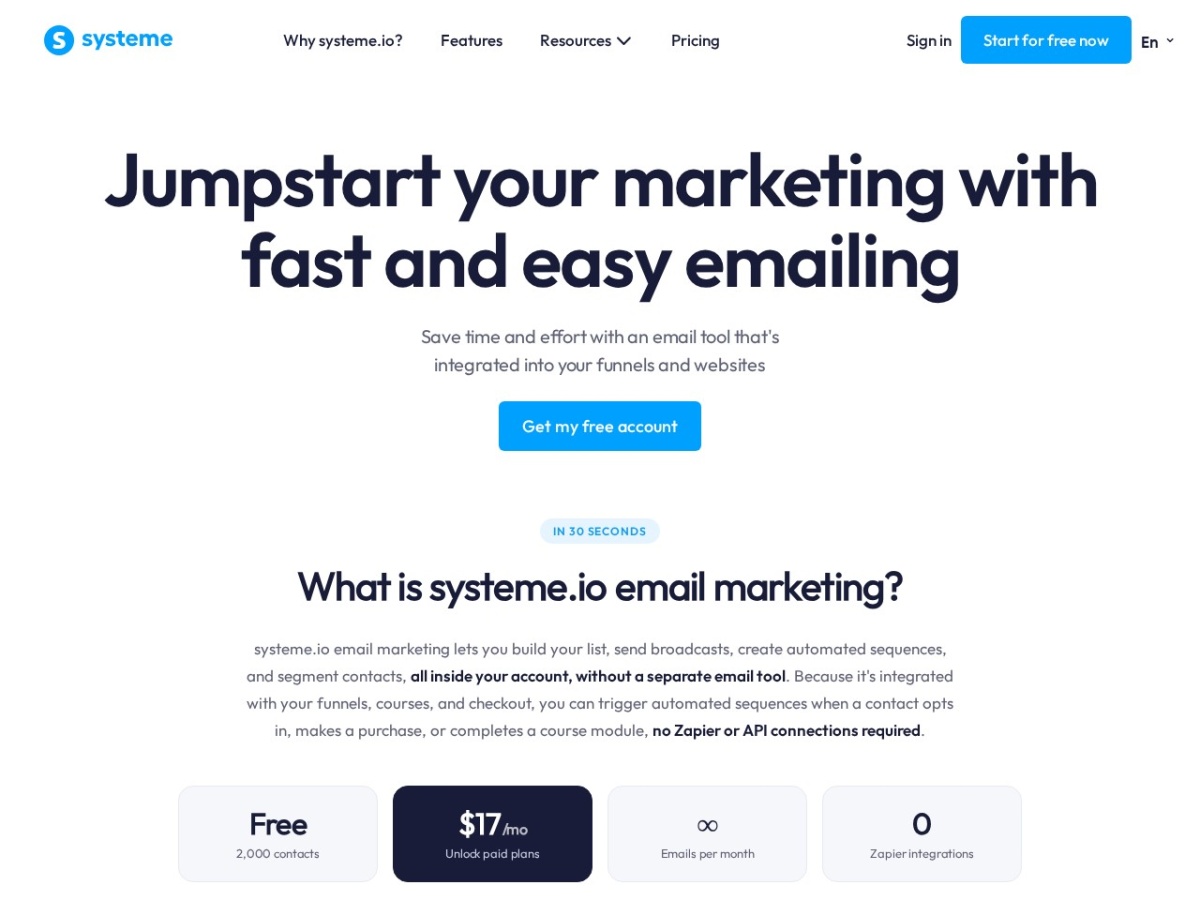
Systeme.io is the funnel builder for people who think ClickFunnels costs too much — which is most people. Funnels, email marketing, courses, automations, affiliate program management and a blog, in one interface, with the most aggressive free plan in the category: $0 for 2,000 contacts, unlimited emails, 3 funnels and a custom domain — permanently. Paid tiers run $17 (Startup), $47 (Webinar) and $97 (Unlimited), all with 0% transaction fees.
The catch most reviews bury: the tools are 80% versions. The funnel editor is simpler than ClickFunnels, the email automation simpler than ActiveCampaign, the course builder simpler than Kajabi. For the solo creator selling digital products, that 80% at a tenth of the stacked price is precisely the point.
Our verdict: the best value-per-dollar in the creator-funnel category, full stop — and the correct first platform for anyone monetising an audience under ~$10k/month. Power users will eventually feel the walls; by then the business has paid for the migration. Score: 8.4 / 10.
→ Try Systeme.io — see current pricing

What makes Systeme.io different
Integration-by-unification: the funnel page, the email sequence it triggers, the course it delivers and the affiliate who referred the buyer live in one database — no Zapier, no sync failures, no per-tool bills. The affiliate management deserves note: your own product's affiliate program (links, tracking, payout management) is included even on lower tiers, a feature the big names gate or price separately. And the free plan is not a trial: it is a permanently free micro-business stack, clearly sold as the top of Systeme's own funnel — which, credit where due, is the product demonstrating itself.
Pricing
| Plan | Price | Contacts | The unlock |
|---|---|---|---|
| Free | $0 | 2,000 | 3 funnels, 1 course, 1 automation, custom domain |
| Startup | $17/mo | 5,000 | Unlimited funnels, 5 courses |
| Webinar | $47/mo | 10,000 | Evergreen webinars, more automation |
| Unlimited | $97/mo | Unlimited | Everything, free migration service |
The comparison arithmetic writes itself: ClickFunnels alone starts near $97; add email and a course platform and the replaced stack runs $200-400/month. Systeme's Unlimited tier costs less than ClickFunnels' entry tier.
The builder experience
Templates are functional rather than fashionable — conversion-standard layouts you customise in an editor that prioritises speed over pixel control. Email deliverability holds up for a budget platform (authenticate your domain, warm sends, keep lists clean — the rules are universal). Automation covers the creator essentials: tag-based triggers, sequence enrolment, purchase behaviour. The occasional rough translation (the company is French) and sparse design flexibility are the visible costs of the price point.
Systeme.io vs ClickFunnels vs Kajabi vs the free-tool stack
Against ClickFunnels: CF's editor is prettier and its community louder; Systeme does the same job at 10-20% of the cost and includes the email platform CF charges extra for. Against Kajabi ($149+): Kajabi wins course polish and app; Systeme wins everywhere the invoice is read. Against stacking free tiers (MailerLite + Gumroad + Carrd): workable, but the integration tax — sync tools, disjointed data, three dashboards — is exactly what unification eliminates. The honest loser comparison: against GoHighLevel for agencies — different sport; Systeme serves creators, not client rosters.
Pros, cons and limits
Pros: unbeatable free plan; 0% transaction fees; unified data across funnel-email-course-affiliate; $97 ceiling for unlimited everything; migration service included at the top tier.
Cons: template design dated next to premium rivals; page editor lacks fine control; advanced automation logic hits walls; no native community feature (pair with Skool); support response tracks the price point.
Systeme.io deals
The free plan is the deal — no card, no clock. Annual billing discounts ~30%; launch promos on paid tiers recur through the year.
The funnel builder in daily use
The editor's philosophy is speed over spectacle, and a working session shows both sides. Building a squeeze page: pick a template, swap headline and image, connect the form to a tag, publish on your domain — eleven minutes, tested. The blocks cover conversion-standard needs (countdowns, testimonials, pricing tables, video embeds, order bumps, two-step checkouts), A/B testing runs natively on any page, and deadline funnels — evergreen countdowns per contact — handle the scarcity mechanics that usually require a $99/month specialist tool. The ceilings appear exactly where expected: pixel-level positioning, custom animation and ambitious brand systems exceed the editor's vocabulary, and designers accustomed to Framer-class control will feel gloved. The reframe that reconciles most users: funnel pages are measured in conversion rate, not design awards, and the template-to-published pipeline being minutes rather than days is itself a conversion feature — the fastest test wins the month.

The order-form details deserve credit: one-click upsells, order bumps, coupon logic and multi-step checkouts — the revenue mechanics that built ClickFunnels' reputation — all present, all included, all functional at every tier including free.
Email marketing: the 80% audit
Unlimited sends at every tier removes the volume anxiety that meters rival platforms, and the automation vocabulary covers the creator playbook: tag-triggered sequences, campaign broadcasts, behavioural rules (opened, clicked, purchased, visited), and visual workflow building on paid tiers. The segmentation reality check: tags and basic conditions handle audience-splitting for typical funnels; the complex boolean logic, predictive sending and revenue-attribution dashboards of ActiveCampaign-class ESPs are absent, and sophisticated lifecycle marketers will notice within a week. Deliverability, the perennial budget-platform question, holds in practice when fundamentals are respected — authenticate your domain immediately, warm new sending gradually, prune cold subscribers quarterly. Operators report inboxing comparable to mid-tier ESPs on clean lists; the platform's shared infrastructure punishes list-buying sinners faster than premium ESPs would, which is arguably a feature.
Courses, memberships and the digital-product engine
The course builder ships the essentials: modules and lectures, video hosting, drip scheduling, access tiers tied to purchases, and completion tracking. Presentation is functional-clean rather than Kajabi-lustrous — brandable enough for real products, short of the cinematic course experience premium platforms sell. The quiet strength is the integration: course access provisions automatically on purchase, refunds revoke it, upsells enrol into additional modules, and the affiliate who drove the sale tracks through to commission — the plumbing between funnel, payment, delivery and affiliate that multi-tool stacks reassemble with Zapier and prayer. Communities exist as a basic add-on; serious community operators pair with Skool, and the pairing (Systeme for acquisition and delivery, Skool for engagement) has become a recognisable indie-creator standard.
The affiliate program engine: underrated and included
Running your own affiliate program — the growth channel that scales without ad spend — is included from the free tier upward: affiliate registration pages, unique links, cookie-based tracking, commission rules per product, payout management and affiliate leaderboards. Setting 30-50% commissions on digital products and recruiting from your own customer base (buyers convert to promoters at surprising rates when asked at the delivery moment) builds a salesforce whose cost is purely performance-based. The mechanics matter because the equivalent capability is a $99+/month line item (FirstPromoter, Rewardful) bolted onto rival stacks — here it is a settings tab. Combined with the marketplace (Systeme's own directory where affiliates discover products to promote), a solo creator gets distribution machinery that previously required platform-scale infrastructure.
Who outgrows Systeme.io, and when
The graduation map, drawn honestly. Email sophistication: lifecycle marketers wanting predictive sends, deep attribution and complex branching graduate to Klaviyo/ActiveCampaign around mid-five-figure months. Design ambition: brands whose funnel aesthetics are the brand graduate to custom builds. Course experience: premium-positioned educators graduate to Kajabi-class polish when price points justify it. Team scale: multi-seat marketing departments hit collaboration limits. What is conspicuously absent from the graduation list: cost (the ceiling tier stays cheap), transaction volume (0% fees at every scale), and funnels themselves (the mechanics cover advanced use). Most graduates leave one module while keeping others — and the Unlimited tier's free-migration-in service suggests Systeme knows exactly which direction the traffic flows and is comfortable being the platform people build businesses on before becoming case studies elsewhere.
The blog and SEO lane: the free traffic most funnel-builders ignore
Systeme includes a functional blog engine — posts, categories, SEO fields, custom domain — which sounds unremarkable until you notice what it enables: the content-to-funnel pipeline on one platform. A review post ranks, its CTA feeds the squeeze page, the sequence nurtures, the product page converts, and the affiliate program recruits the buyer — every step on one dashboard with no plugin stack. The engine itself is basic (no advanced schema tooling, modest customisation, adequate speed), and serious content operations at hundreds of posts belong on WordPress. But for the creator whose content strategy is twenty cornerstone posts feeding evergreen funnels, the included blog eliminates a separate hosting bill and the maintenance thereof — one more subscription the unified model quietly deletes. The pattern that works: SEO-intent posts written around your product's problem space, each ending in the lead magnet, compounding list growth at zero marginal cost while paid channels do the fast work.
Zoomed out, the review's verdict consolidates around a single sentence: Systeme.io is what happens when a funnel stack is designed by someone who reads invoices instead of feature matrices. Every module is the 80% version; every integration between modules is the 100% version; and for the audience actually building first funnels — solo creators, freelancers productising, side-hustlers validating — the intersection of free-to-start, unified-by-default and 0%-fees-forever is simply unmatched at the price. Start free, sell something, and let the business earn its way into whatever the numbers eventually demand. Score: 8.4 / 10.
Common Systeme.io mistakes that cap results
The failure patterns from the community, catalogued for prevention. Skipping domain authentication and blaming deliverability — the five-minute DNS task that decides inbox placement. Building five funnels before finishing one — the free plan's three-funnel limit is accidentally good coaching; ship the first to revenue before drafting the second. Ignoring the tag architecture until the list is a swamp — decide the taxonomy (source, interest, purchase-stage) in week one, because retro-tagging two thousand contacts is penance. Pricing digital products under the platform's strengths — order bumps and one-click upsells exist to lift average order value, and a $27 product with a $17 bump and $47 upsell outperforms a lonely $47 product in nearly every test. Treating the affiliate program as set-and-forget — programs grow when recruited into weekly, not launched and abandoned. And the meta-mistake: comparing Systeme's modules one-by-one against specialists and concluding it loses everywhere — the correct comparison is the stacked invoice and the Zapier tax against one login, which is the entire thesis and the reason this platform's users defend it with invoice screenshots.
Prevention costs a reading hour; each mistake costs a month of momentum. The platform's generosity at $0 makes the learning affordable — which is, structurally, the smartest thing about it: Systeme.io's free tier converts its own students into its case studies, and the graduation revenue funds the next cohort's free ride. Business model as product review: it works. Score: 8.4 / 10.
Systeme.io's support and community reality
The support layer matches the price point honestly: email-first support with responsive-but-not-instant turnarounds, a competent knowledge base, and free migration assistance at the Unlimited tier that operators consistently praise. The community periphery — Facebook groups, YouTube tutorials, template marketplaces — is smaller than the ClickFunnels ecosystem but proportionally less commercial: more users helping users, fewer funnels selling funnels. The French-company DNA shows in occasional translation quirks and a European data posture (GDPR-native) that international operators inherit for free. The practical note for non-English markets: the platform interface localises well, payment processing handles global currencies, and the unlimited-email economics hold regardless of geography — the value proposition travels intact.
FAQ
Is the free plan really usable?
Genuinely — a lead magnet funnel, email list and first digital product fit inside it. It ends being enough exactly when your business can afford $17.
Can I sell with 0% platform fees?
Yes — you pay only Stripe/PayPal processing. At $5k/month of sales, that is $100-500/month saved versus percentage-taking platforms.
How is deliverability?
Competitive when configured properly (domain authentication, list hygiene). Volume senders with pristine lists see the same inboxing as mid-tier ESPs.
Systeme or ClickFunnels?
Same funnels, different invoices. Choose CF for its ecosystem and templates if $100+/month is immaterial; otherwise the answer is arithmetic.
What breaks first at scale?
Complex segmentation and design ambition — typically past $10-20k/month, when specialist tools justify their prices and the free migration off becomes someone else's problem.
The zero-to-first-sale sprint
Week one, on the free plan: lead magnet built, squeeze page live on your domain, five-email nurture sequence writing itself from your niche knowledge. Week two: a $27-97 digital product (template, mini-course, toolkit) in the course builder, order page connected to Stripe. Week three: traffic from your existing channels plus the affiliate program opened to your earliest fans at 40%. Week four: read the one dashboard where visits, subscribers, buyers and affiliate referrals already reconcile — the unified view that is, quietly, the entire pitch. First sale before the first invoice: no rival makes that offer. Score: 8.4 / 10.
{“@context”:”https://schema.org”,”@type”:”Review”,”name”:”Systeme.io review”,”itemReviewed”:{“@type”:”SoftwareApplication”,”name”:”Systeme.io”,”applicationCategory”:”BusinessApplication”,”operatingSystem”:”Web”},”reviewRating”:{“@type”:”Rating”,”ratingValue”:”8.4″,”bestRating”:”10″,”worstRating”:”1″},”author”:{“@type”:”Organization”,”name”:”AnalyzeBench”},”publisher”:{“@type”:”Organization”,”name”:”AnalyzeBench”}}