
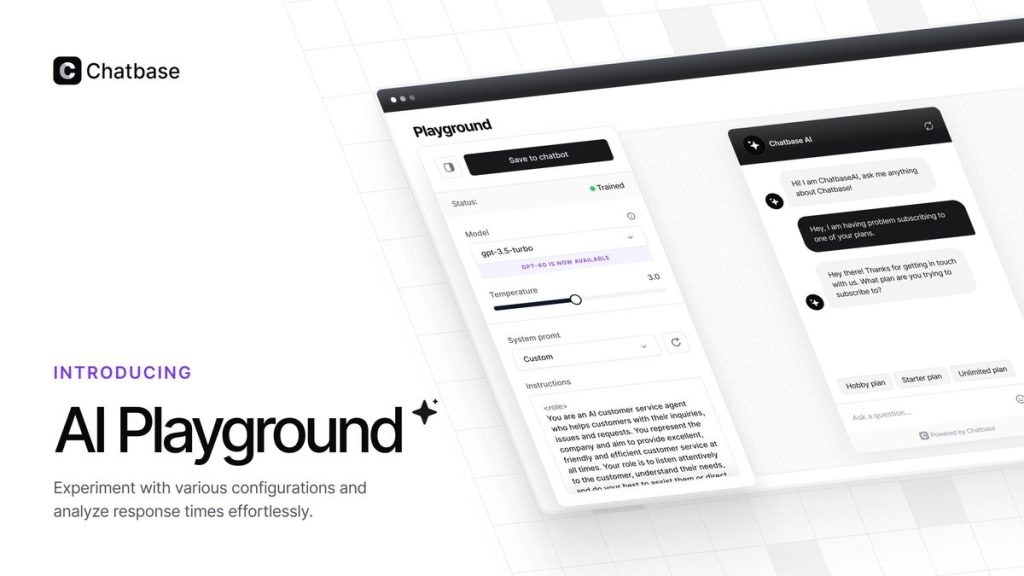
Chatbase turns your documents into a customer-facing AI agent in an afternoon. Upload PDFs, point it at your website, connect Notion — it trains a support chatbot on your actual content and deploys it to your site, WhatsApp, Messenger or Slack. No code, from $19–29/month, with 17+ underlying LLMs to choose from (GPT, Claude, Gemini and more).
The traction validates the category: 10,000+ customers across 140 countries and a 4.6/5 Capterra average. Beyond answering questions, AI actions let the agent do things — collect leads, book calls, hit your APIs — moving it from FAQ deflection toward actual agent work.
Our verdict: the fastest credible route from "our docs" to "our support bot" for small and mid-size teams. Enterprises with complex routing needs will outgrow it toward Intercom-class suites; everyone below that ceiling gets 80% of the value at a tenth of the price. Score: 8.4 / 10.
→ Try Chatbase — see current pricing
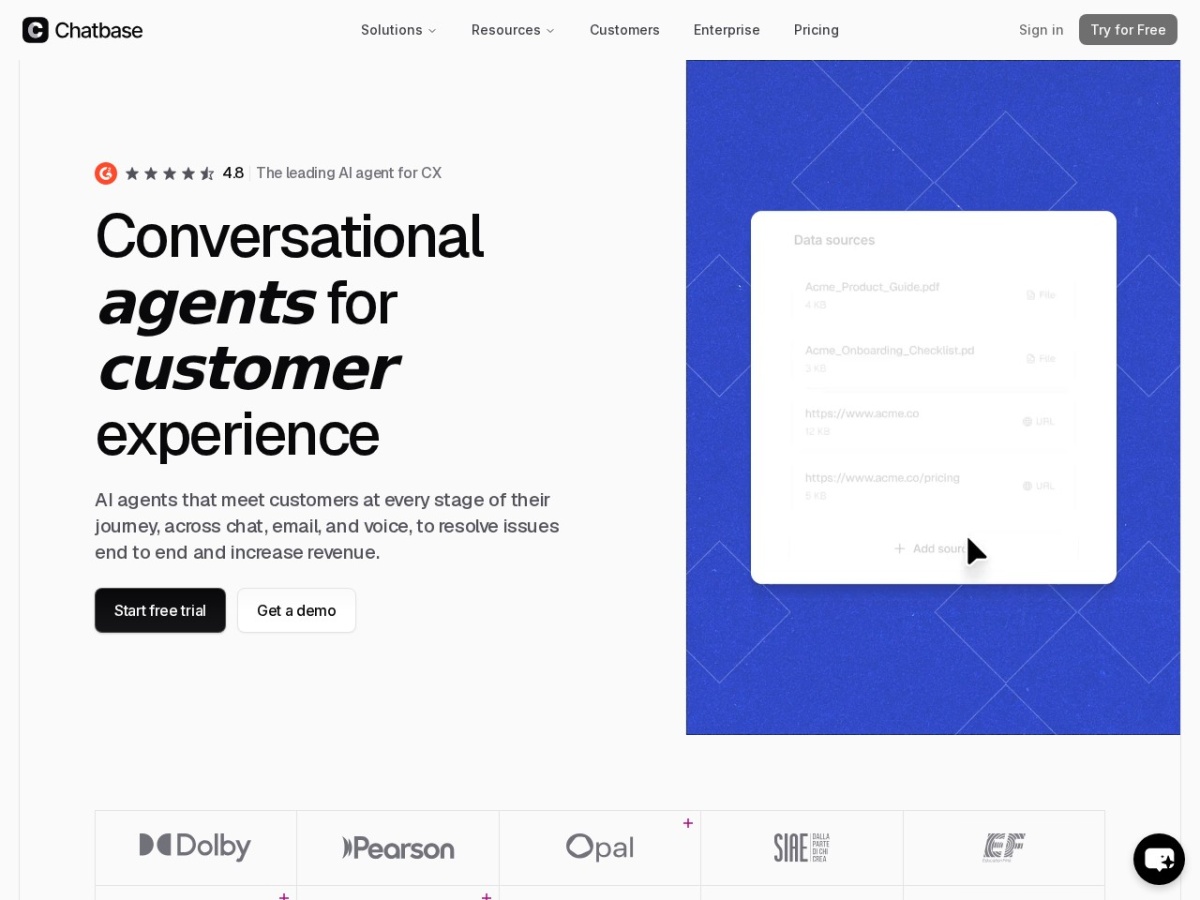
What makes Chatbase different
Speed-to-deployed is the product. The train-on-anything ingestion (sites, PDFs, Notion, raw text) plus the multi-LLM backbone — swap GPT for Claude per agent — plus one-toggle deployment to web widget, WhatsApp, Messenger and Slack collapses what used to be a dev project into a settings page. AI actions add the agent layer: lead capture forms, calendar bookings, custom API calls fired from conversation.
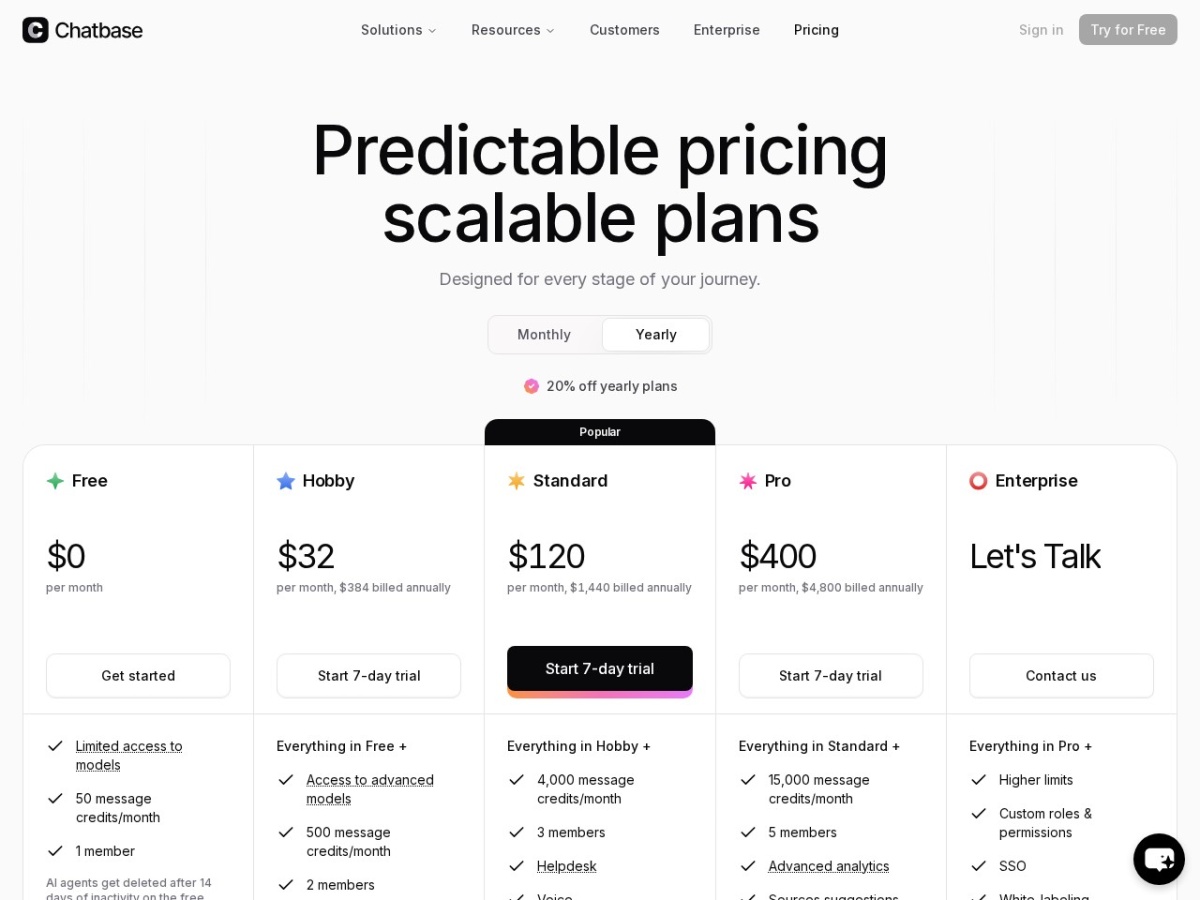
Pricing
| Plan | Price | Gets you |
|---|---|---|
| Free | $0 | Trial agent, limited messages |
| Hobby | $19–29/mo | Core agent, integrations, actions |
| Standard / Pro | $99–399/mo | More credits, agents, team seats |
Add-ons price transparently: extra agents ~$7, custom domains ~$59. Against Intercom's per-seat-plus-resolution pricing, the arithmetic favours Chatbase hard at small scale.
The deployment experience
The honest 90-minute arc: ingest your site and docs, watch it answer test questions correctly on the first pass, tune the system prompt and brand the widget, embed. Accuracy tracks source quality — clean docs produce a clean bot; contradictory docs produce a confidently wrong one, which is why the refine-sources loop is the real onboarding.
Chatbase vs the alternatives
Against Intercom Fin: Fin resolves more edge cases inside a full support suite at many times the cost; Chatbase wins on price and setup speed. Against Botpress/Voiceflow: those are flow-builders for conversation designers; Chatbase is retrieval-first for teams who just want their docs answered. Against DIY RAG: the build-vs-buy math rarely favours building at this price.
Pros, cons and limits
Pros: deployed in an afternoon; 17+ swappable LLMs; WhatsApp/Messenger/Slack channels; AI actions; transparent pricing; 4.6/5 Capterra across 10k customers.
Cons: no full helpdesk (tickets, routing, SLAs); answer quality bounded by your docs; message credits cap heavy traffic; complex multi-step flows outgrow it.
Chatbase deals
The free tier prototypes the whole loop; annual billing discounts paid plans. Test with your real docs before paying — source quality is the variable.
Inside the training pipeline: what 'train on your data' really means
Demystifying the core mechanic clarifies both the power and the limits. Chatbase does not fine-tune a model on your content; it builds a retrieval system — your pages, PDFs and Notion docs are chunked, embedded and indexed, and at question time the most relevant chunks are fed to the LLM as context for the answer. This architecture explains everything about the product's behaviour: why setup takes minutes not weeks (indexing is cheap), why answers quote your documentation's actual language, why updating the bot is just re-syncing sources, and why contradictory or stale docs produce confidently wrong answers — the retrieval faithfully serves whatever you fed it. The operational consequence is that bot quality is a documentation project wearing a chatbot's face, and teams that internalise this outperform teams shopping for a smarter model to compensate for messier sources.
The tuning surface beyond sources is meaningful: the system prompt sets persona, scope and refusal behaviour ("answer only from provided context; if unsure, offer the contact form" is the single highest-value instruction most teams never write); temperature control trades creativity against precision, and support bots want precision; and per-source weighting lets your pricing page outrank a three-year-old blog post when both match a query.
AI actions: from answering to doing
The actions system is what moves Chatbase up a category. Beyond lead capture and calendar booking, custom actions call your APIs mid-conversation: check an order status from a tracking number, look up a booking, create a support ticket with the conversation attached, update a CRM record. Each action defines when to trigger, what to collect and where to send it — effectively giving the bot hands, within guardrails you write. The teams using this well start with one read-only action (order lookup is the classic, deflecting the single highest-volume support query in e-commerce) before graduating to write actions, because read actions cannot damage anything while the team learns the failure modes. Combined with the channel spread — the same trained agent answering on the website widget, WhatsApp, Messenger, Slack and Instagram — a small operation gets coverage that resembled an enterprise deployment two years ago.
Cost modelling for real deployments
| Deployment | Realistic setup | Monthly cost |
|---|---|---|
| Solo SaaS docs bot | Hobby, one agent, GPT-class model | $19-29 |
| E-commerce with WhatsApp + order lookup | Standard, actions, custom domain | ~$99-160 |
| Agency running client bots | Pro, multiple agents at ~$7 each | $399 + agents |
Message credits are the hidden variable: heavy traffic on premium models consumes credits faster, and the mitigation is model routing — a cheaper model handles the FAQ layer perfectly well, reserving frontier models for agents where nuance pays. The comparison anchor: a single human support hire costs more monthly than the entire Pro tier, which is why the ROI conversation is usually short.
The agency opportunity hiding in plain sight
The ~$7 additional-agent pricing makes Chatbase one of the cleanest white-label arbitrages in the AI economy. Local businesses — clinics, real-estate offices, restaurants, logistics operators — will pay $100-300/month for a "24/7 AI receptionist" that an agency provisions in an afternoon: train on the client's site and FAQ, brand the widget, connect WhatsApp (the channel where Vietnamese and Southeast Asian customers actually live), and hand over a lead-capture feed. The recurring margin is obvious; the defensible part is the service layer — monthly transcript reviews that turn wrong answers into doc fixes, quarterly action additions as the client's workflow matures. Operators running this playbook report churn concentrates among clients sold a magic bot, and retention among clients sold a maintained system; the difference is the monthly review call, which costs twenty minutes and renews the contract.

Failure modes and how to engineer around them
An honest catalogue from production deployments. Hallucination at the edges: bounded by the system-prompt scope instruction plus a visible escalation path — never let the bot improvise policy. Stale answers after product changes: solved by putting source re-sync on the release checklist, not the marketing calendar. The confident-wrong-price incident: caused by two conflicting PDFs; cured by deleting the old one — retrieval systems cannot adjudicate your version control. Over-collection: an eager lead-capture action interrogating every visitor annoys more than it converts; trigger it on buying-intent signals only. And the silent failure — nobody reviewing transcripts — which forfeits the entire improvement loop that makes month-three bots dramatically better than launch-day bots. Every one of these is operational, not technological, which is the encouraging read: the failure modes are all within a diligent operator's control.
The two-week pilot, formalised
Days 1-2: ingest sources, write the scoping system prompt, deploy on one page only. Days 3-7: log every miss against its missing or contradictory source; fix docs, not vibes. Days 8-10: enable one read-only action; watch it deflect your top ticket category. Days 11-14: compare the deflection count against your support baseline and price the result. Teams that run this honestly almost always convert — not because the bot is magic, but because the pilot doubles as the documentation audit they owed themselves anyway, and the bot is simply the first employee who reads all of it. Score: 8.4 / 10.
Multilingual support: the underrated superpower
Because the underlying LLMs are multilingual, a Chatbase agent trained on English documentation will competently answer in Vietnamese, Thai, Spanish or whatever language the customer opens with — no separate training, no translation project. For businesses serving multilingual markets this quietly solves a problem that used to require either bilingual support staff or a second documentation effort: the Vietnamese customer asks in Vietnamese, the bot retrieves from English sources and responds natively, and the conversation log shows the team what languages their customers actually prefer. The quality caveat scales with language distance and domain jargon — answers in major languages track English quality closely, while niche technical vocabulary can wobble — so the sensible pattern for a serious non-English deployment is seeding a small FAQ in the target language covering the twenty highest-volume questions, which anchors retrieval in native phrasing where it matters most.
The WhatsApp pairing amplifies this for Southeast Asian deployments specifically: the channel where customers already message businesses, answered instantly in their language, from documentation the business wrote once. Operators report the perception shift is worth as much as the deflection — a five-person shop responding fluently at 11pm reads as a much larger company, and in trust-driven purchase categories that perception converts.
Security, privacy and the questions procurement asks
The checklist answers for anyone bringing Chatbase through review. Data handling: uploaded sources are used to serve your bot, with controls over retention; the privacy-conscious configuration avoids feeding regulated personal data into sources at all — train on policies and product docs, let actions handle per-customer lookups against your own APIs where your existing access controls apply. Access: role-based team permissions arrive at the Standard-and-up tiers, custom domains keep the widget on your origin, and rate limiting protects against abuse-driven credit burn. Compliance posture is SMB-appropriate rather than enterprise-exhaustive — SOC-conscious buyers with strict data-residency requirements will interrogate the details or land on enterprise suites — but for the product's actual market, the sensible-defaults story holds. The rule that covers most risk in practice costs nothing: the bot should know your policies, not your customers' records, and anything per-customer should flow through an action you control. Score: 8.4 / 10.
Reading the analytics like an operator
The dashboard's conversation logs are the product's most underused asset, and a monthly reading ritual extracts compounding value. Sort by thumbs-down and unanswered first — each is either a documentation gap (fix the source), a scope gap (the bot should hand off; check the escalation path fired), or a phrasing gap (customers use words your docs do not; add their vocabulary to a FAQ source). Then read ten random successful conversations for tone drift — the difference between "resolved" and "resolved pleasantly" lives in the system prompt, and one sentence of persona adjustment fixes a month of stiffness. Finally, mine the questions nobody anticipated: recurring pre-sales questions are messaging feedback your marketing team never gets this cheaply, and recurring how-do-I questions are a feature-discoverability report from your realest users. Teams that institutionalise this half-hour review convert the bot from a static FAQ deflector into a listening post on their customer base — arguably worth the subscription even before counting the deflected tickets.
Stacked together — the retrieval architecture, the actions layer, the channel spread, the multilingual reach and the analytics loop — Chatbase's real identity comes into focus: not a chatbot toy but a small team's customer-facing automation layer, priced like a utility and improvable weekly by anyone who can edit a document. The ceiling is real and the enterprise suites live above it; below that line, this is the deployment that makes sense first. Score: 8.4 / 10.
Chatbase alongside a human team: the handoff design
The deployments that satisfy customers rather than merely deflecting them treat the human handoff as a designed feature, not an escape hatch. The pattern that works: the bot resolves what it can, and the moment confidence drops or frustration signals appear (repeated rephrasing, negative sentiment, an explicit request), it collects context — name, issue summary, conversation transcript — and routes to email, a ticket, or a live channel with everything attached, so the customer never repeats themselves. That last detail is the entire customer-experience difference between automation that feels respectful and automation that feels like a wall. Teams should also write the bot's introduction honestly: customers who know they are talking to an AI that can summon a human forgive its limits; customers who discover it mid-conversation do not. Configured this way, the bot becomes triage rather than gatekeeping — the humans see fewer, better-documented, genuinely-hard cases, which is the version of this technology everyone actually wanted.
FAQ
How accurate is it really?
As accurate as your documentation. Well-maintained docs yield high first-pass correctness; the misses cluster where your docs are silent or contradictory.
Can it hand off to a human?
Yes — escalation paths and lead capture cover the miss cases, though full ticket routing belongs to helpdesk-class tools.
Which LLM should I pick?
Start default, then A/B against Claude or Gemini on your own transcripts — the switch is a dropdown, which is precisely the point.
Does WhatsApp deployment work?
Yes, via Meta business verification — the setup's slowest step, but the channel where SMB support actually lives in 140 countries.
Chatbase or Intercom Fin?
Under ~500 conversations/month or without a support suite already: Chatbase. Enterprise routing, SLAs and analytics: pay for Fin.
The two-week deflection experiment
Week one: ingest docs, deploy the widget on your highest-traffic help page only, log every wrong answer against its missing source. Week two: fix the docs (not the bot), enable one AI action — lead capture or booking — and measure deflected tickets against your support inbox baseline. Teams typically find a third of repetitive volume evaporates, which prices the subscription against an hour of anyone's salary. The bot is a mirror of your documentation; two weeks of looking usually improves both. Score: 8.4 / 10.



