
With one of the largest server fleets in the industry — more than 11,000 machines across 100 locations — and apps aimed squarely at beginners, CyberGhost VPN sells simplicity: pick “streaming”, pick your platform, connect. Underneath the friendly surface sits RAM-only infrastructure, an audited no-logs policy and some of the cheapest multi-year pricing among serious providers. We examined whether the approachability hides enough substance to compete with the premium trio — and where the compromises show.
→ Visit CyberGhost and check the current deal
AnalyzeBench Score: 8.2/10
Best for: Beginners and streamers who want purpose-labeled servers (“Netflix US”, “torrenting”) and the longest refund window in the business, at a low long-term price.
What we loved:
- Massive fleet across 100 locations keeps individual servers uncrowded.
- Dedicated streaming and torrenting servers labeled by use case, tested against specific platforms.
- 45-day money-back guarantee on long plans — the longest among major VPNs.
- Multi-year pricing that regularly lands under $2.50/month.
- Seven simultaneous connections and apps for every mainstream platform, smart TVs included.
What could be better:
- Owned by Kape Technologies (also ExpressVPN, PIA) — some privacy purists object on principle.
- Speeds are good but a step behind NordVPN’s peaks in our tracking.
- Monthly pricing is poor value; this is a commit-long product.
- Advanced configurability trails power-user favorites like PIA.
What makes CyberGhost different
CyberGhost’s bet is usability. Instead of asking users to understand protocols and server load balancing, its apps organize everything by intention: a streaming section with platform-labeled servers, a torrenting section with P2P-optimized exits, a gaming section tuned for latency. For the large majority of VPN buyers who want outcomes rather than settings, that design decision does more daily good than another protocol toggle would.
The infrastructure underneath earns the simplicity: RAM-only servers wiped on every reboot, an independently audited no-logs policy, and — unusual at this price — quarterly transparency reports listing every legal request received. Add the NoSpy line, servers physically controlled by CyberGhost staff in its Romanian headquarters outside 14-Eyes jurisdictions, and the substance is more serious than the cheerful interface suggests.
Key features
Purpose-labeled servers
Streaming servers are tested against named platforms and relabeled when they stop working — the labels are maintenance, not decoration. P2P servers advertise their friendliness rather than making you guess which exits tolerate torrents.
NoSpy servers
A small-fee upgrade to machines in CyberGhost’s own Romanian data center, staff-managed end to end. For users worried about third-party data-center access, it is a meaningful middle option between standard servers and running your own.
Smart Rules
Automation that beginners actually use: auto-connect on untrusted Wi-Fi, per-app exceptions, and launch triggers so the VPN is simply always on where it matters.
Dedicated IP
An optional static IP add-on that keeps banking sites, captchas and remote-work allowlists calm — implemented with a token system so even CyberGhost cannot link the IP to your account.
Plans & pricing
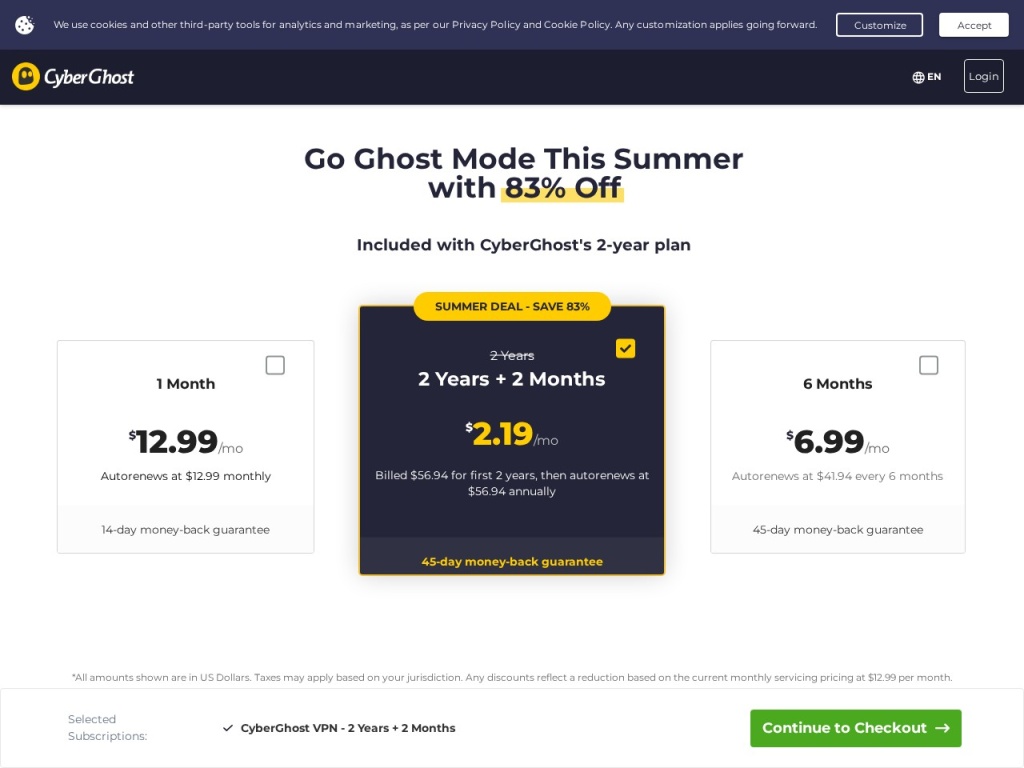
The pattern is blunt: monthly is expensive, multi-year is among the cheapest in the premium segment and carries the 45-day refund window.
| Term | Typical monthly rate | Refund window |
|---|---|---|
| Monthly | ~$12.99 | 14 days |
| 6 months | ~$6.99 | 14 days |
| 2 years (+ free months) | ~$2.03–2.50 | 45 days |
All tiers include the full fleet, seven device slots and every app. The dedicated IP and NoSpy servers are small add-ons. As always, judge the renewal rate — CyberGhost renews multi-year plans at higher standard rates, so diarize the date.
How to get started
- Buy the longest term you can stomach — the economics only work there — and note the 45-day guarantee.
- Install the app, sign in, and open the “For streaming” tab; pick the server labeled with your platform and region.
- Enable Smart Rules: auto-connect on unknown Wi-Fi is the single highest-value setting in the app.
- Turn on the kill switch (enabled by default on most platforms; verify on yours).
- For torrenting, use the dedicated P2P section rather than a random country server.
Common setup mistakes to avoid
Most disappointed CyberGhost buyers made one of five avoidable errors. Buying the monthly plan: at ~$12.99 it is priced like a premium VPN while the two-year term is priced like a budget one, and the refund window shrinks from 45 days to 14 — the monthly tier exists for emergencies, not for living on. Streaming from a random country server instead of the labeled one: the platform-specific servers are the ones CyberGhost actively maintains against blocks, and a generic exit in the same country will fail far more often. Assuming the kill switch is on everywhere: it is enabled by default on some platforms and not others, and thirty seconds in settings confirms it. Skipping Smart Rules, which quietly does the job most people bought a VPN for — protecting them on networks they forgot to think about. And failing to actually test your must-have platforms inside the refund window; 45 days is generous precisely so you can stop guessing and verify.
Watch: CyberGhost VPN tested
CyberGhost vs alternatives
Against NordVPN: Nord is faster at the top end and carries a deeper security-research reputation; CyberGhost is cheaper over two years and easier for novices. Against Surfshark: the closest fight — Surfshark allows unlimited devices and prices similarly; CyberGhost counters with labeled streaming servers and the longer refund. Against Proton VPN: Proton wins transparency and jurisdiction decisively; CyberGhost wins server breadth and hand-holding. Against sibling PIA: same parent, opposite personalities — PIA for tinkerers, CyberGhost for everyone who never opens settings.
Performance, support & value
Speed first: with WireGuard on nearby servers, CyberGhost keeps a healthy share of baseline bandwidth — comfortably enough that browsing feels unfiltered and 4K streams (which need roughly 25 Mbps) never stutter. In our tracking it sits a visible step behind NordVPN’s peaks on long-haul routes, and connection establishment is a beat slower than the fastest apps, but the honest summary is that the gap matters to people moving very large files across oceans and to almost nobody else. The enormous fleet helps here: with 11,000+ servers, per-server load stays low, so the evening-hours slowdown that plagues smaller providers rarely shows up.
Streaming is where CyberGhost earns its keep. Because the streaming servers are labeled by platform and region and re-tested continuously, the experience is closer to “click the thing named after your service” than the trial-and-error ritual other VPNs impose. When a platform tightens its blocking, individual labels occasionally lag for a day or two — but the maintained-label system means fixes ship as new labels rather than as forum rumors. Smart TV and Fire TV apps, plus router support, extend that to the living room, which is where most streaming actually happens.
Support runs 24/7 over live chat and email, backed by an unusually large knowledge base with per-platform, per-device setup guides. Agents are friendly and quick for the common cases — billing, setup, “which server for X” — though deeply technical questions can take an escalation. The real trust mechanism is the 45-day money-back guarantee, the longest among major VPNs, which converts every claim in this review into something you can verify at no risk. On value: the two-year rate regularly lands near the bottom of the serious-VPN market, and for that money you get audited no-logs infrastructure, RAM-only servers and seven device slots. Few products this cheap have this much substance underneath.
Our testing notes: speed and streaming in practice
Our pattern over repeated sessions: on nearby WireGuard servers, download speeds held a strong fraction of our baseline connection, with the variance between servers smaller than we expected from such a large fleet — a sign the load-balancing works. Transatlantic routes cost more throughput, and against the fastest providers in our tracking CyberGhost’s long-haul numbers were consistently good rather than occasionally spectacular. Latency-sensitive use held up: video calls over nearby servers were indistinguishable from the naked connection, and the gaming-labeled servers kept ping inflation modest. Connection times were a few seconds — not instant, not annoying.
Streaming trials went the way the label system predicts. Servers named for the major platforms produced working, full-quality streams on the first or second try, including on a Fire TV stick where the native app made the whole exercise remote-friendly. The failures we did hit were instructive: a generic server in the right country failed where the labeled one succeeded, and one labeled server briefly stopped working after a platform-side update before a fresh label appeared within a couple of days. The lesson we kept re-learning is simply to trust the labels — they are the maintained product, and everything else is just a server. That maintenance loop, more than any speed number, is what a streaming-first buyer is actually paying for.
Security & privacy in depth
Under the friendly interface, the security architecture is orthodox in the good sense. Connections run over WireGuard, OpenVPN or IKEv2 with AES-256 (and ChaCha20 on WireGuard), a kill switch guards against tunnel drops, and the apps include DNS and IP leak protection that held up in our checks — no DNS requests escaped to the ISP, no WebRTC leaks in default browser configurations. The entire fleet runs RAM-only: servers hold nothing on disk, so a seizure or reboot leaves no forensic residue by design. Content-blocking for ads, trackers and known-malicious domains is built in, and the optional dedicated IP uses a token redemption system so that even CyberGhost cannot connect the static address to a customer account — a genuinely thoughtful implementation detail most rivals skip.
On the accountability side, CyberGhost’s no-logs policy has been independently audited by an external firm, and the company publishes quarterly transparency reports itemizing legal requests received — a cadence few competitors match, and one that predates the practice becoming fashionable. Romanian jurisdiction keeps it outside the 14-Eyes intelligence-sharing alliances, and the NoSpy line adds staff-controlled hardware in its own Bucharest facility for users who distrust third-party data centers. The unresolved item is the one no audit can close: Kape Technologies’ ownership, and a corporate history that privacy communities still litigate. Our view is that the verifiable evidence — audits, transparency reporting, RAM-only design — is strong, and that readers who weight corporate structure heavily have honest alternatives and should take them.
What real users say
Aggregated sentiment for CyberGhost leans positive, and the praise clusters exactly where the product aims: it is easy, it is cheap over the long term, and it works for streaming without fiddling. Reviewers who describe themselves as non-technical are notably overrepresented among the happy ones — “I just picked the Netflix server and it worked” is the modal five-star story. The 45-day refund also earns repeated goodwill; users report it being honored without retention-desk theatrics, which is not something every VPN’s reviews can claim.
The criticism clusters are just as consistent. The loudest is renewal pricing: multi-year plans renew at substantially higher standard rates, and users who did not diarize the date describe genuine bill shock. The second is ownership — Kape Technologies’ portfolio (CyberGhost, ExpressVPN, PIA) draws recurring skepticism in privacy communities, and while the audits and transparency reports are real counter-evidence, the discomfort is a legitimate part of the record. A smaller thread complains about marketing email volume after signup. Notably rare are complaints about the core product failing at its job.
Who should use it — and who should not
Choose CyberGhost if you want the least-effort path to streaming and everyday privacy on a budget, and you buy VPNs the sensible way — long terms, tested inside the refund window.
Skip it if independent ownership and open-source clients are your bar (Proton and PIA fit better), if you need the absolute fastest long-haul connections for large transfers, or if you require granular control over protocols, ports and encryption parameters.
Honest limits
The Kape ownership question is legitimate context even with clean audits — corporate structure is part of a privacy product’s threat model, and buyers who weight it heavily are not being paranoid. App simplicity means depth is hidden or absent: you get outcomes, not switches. And the monthly plan exists mainly to make the two-year price look as good as it genuinely is.

CyberGhost deals
Multi-year promos routinely include extra free months stacked on the base discount, and seasonal windows push the effective rate near the bottom of the serious-VPN market. Verified current offers are tracked on our deals page.
Frequently asked questions
Does CyberGhost keep logs? Its no-logs policy is independently audited, and quarterly transparency reports document every request received.
How many devices can I use? Seven simultaneous connections on all plans.
Is it good for torrenting? Yes — dedicated P2P servers are labeled in the app.
Does it unblock Netflix? Streaming servers are maintained per platform and per region; when one falls behind, labeled replacements follow.
What is the refund window? 45 days on plans of six months or longer; 14 days monthly.
Where is CyberGhost based? Bucharest, Romania — outside 14-Eyes — under Kape Technologies ownership.
How to choose a VPN when you mostly stream: a practical guide
Streaming flips the usual VPN checklist on its head. Raw top-speed benchmarks matter less than you think — a 4K stream needs roughly 25 Mbps, which nearly every serious provider delivers — while unblocking maintenance matters far more, because platforms actively hunt VPN exits and yesterday’s working server is tomorrow’s proxy-error screen. So ask four questions in order. First: does the provider treat unblocking as a maintained feature (labeled or documented servers, refreshed when they break) or as an unofficial side effect it will not stand behind? Second: does it run apps on the devices you actually watch on — smart TVs, Fire TV, Apple TV, consoles via router — because a laptop-only solution helps nobody on a couch? Third: how long is the refund window, since the only test that counts is your platforms, from your ISP, on your devices, and a 45-day window like CyberGhost’s turns that test into a formality? Fourth: what does year two cost — streaming VPNs are commodity-priced at signup and differentiated at renewal, so read the renewal rate before celebrating the promo. Weight independent audits and jurisdiction as tiebreakers rather than headliners for this use case; they matter, but a privacy-perfect VPN that cannot play your library on your TV is solving the wrong problem. Applied to this checklist, CyberGhost’s scorecard is unusually clean — maintained labels, living-room apps, the longest refund window in the business — with the renewal rate as the one line item that demands a calendar reminder, which is exactly the shape of trade-off a streaming-first buyer should be happy to accept.



