

HostGator has been one of the most recognizable names in budget web hosting since 2002. If you have ever shopped for a cheap place to park a WordPress site, a small business page, or a first blog, you have almost certainly seen that friendly cartoon alligator. Two decades later, HostGator is part of the Newfold Digital family (the same parent company behind Bluehost), and it still positions itself as the approachable, low-cost, no-fuss host for beginners and small businesses.
But a familiar name is not the same thing as the right choice in 2026. Competition from providers like Hostinger has intensified, and Newfold-owned brands have a reputation for aggressive renewal pricing and upsells. This review looks past the marketing to answer the practical questions: what do you actually get, what does it really cost over time, and where does HostGator shine or fall short?
AnalyzeBench Score: 7.8 / 10
Best for: Beginners, bloggers, and small-business owners who want a simple, affordable shared or WordPress host with a generous refund window and 24/7 support, and who are willing to lock in a longer term to keep the price low.
What we loved:
- Low introductory pricing that makes getting online genuinely cheap
- A 45-day money-back guarantee, longer than the 30-day industry norm
- Free domain for the first year and free SSL on shared, WordPress and cloud plans
- Unmetered bandwidth so normal traffic spikes will not surprise you with fees
- A full ladder of plans, from shared through cloud, VPS and dedicated, so you can grow without switching hosts
- 24/7 chat and phone support plus a large, mature knowledge base
Watch out for:
- Renewal prices jump sharply after the intro term, often two to three times the promo rate
- A steady stream of upsells during checkout (email, backups, SEO tools, security add-ons)
- Some users report support quality has slipped since the Newfold acquisition
- “Unmetered” bandwidth still comes with resource and file-count limits in the fine print
- Performance is solid but not class-leading compared with newer, faster hosts
What makes HostGator different
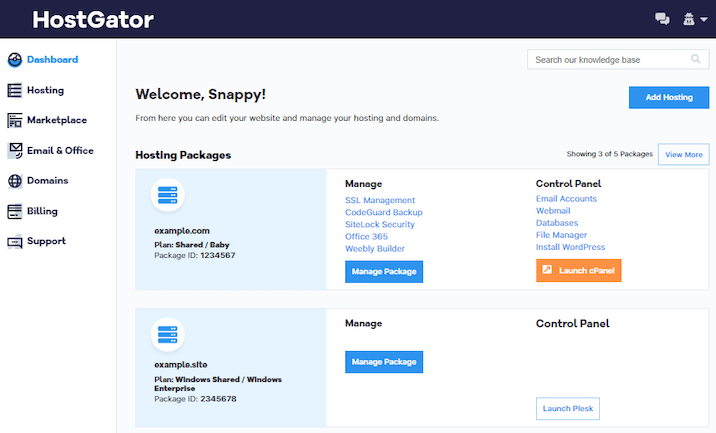
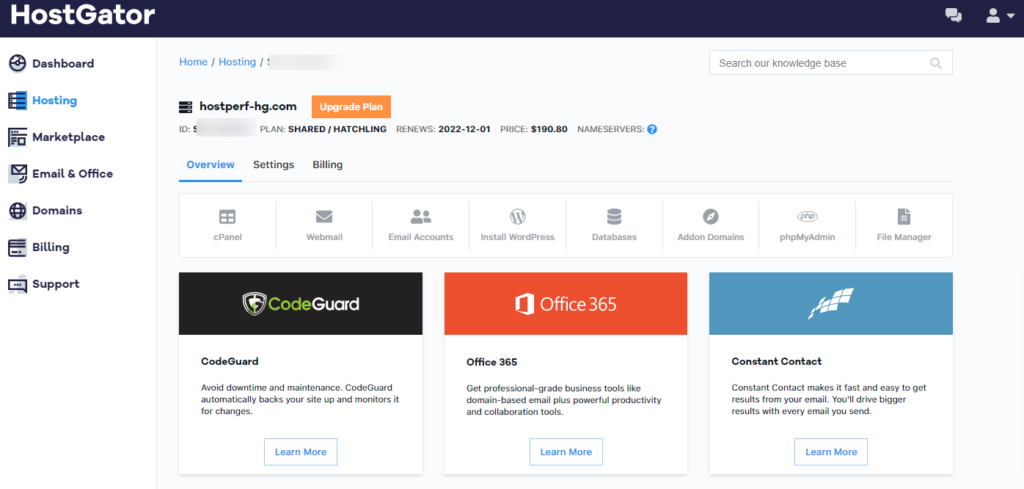
HostGator’s identity has always been built around accessibility. Where some hosts chase developers with advanced tooling, HostGator aims squarely at people who are not technical and just want a website that works. The onboarding is friendly, the control panel is the familiar cPanel that most tutorials assume you have, and one-click installers make it easy to spin up WordPress in a few minutes.
The second differentiator is longevity and scale. HostGator says it hosts over two million websites, and that maturity shows up in a deep knowledge base, years of tutorials, and 24/7 support. For a first-time site owner, that ecosystem of help is worth something real: when you get stuck, the answer usually already exists in a help article or a third-party guide.
The third factor, worth keeping your eyes open about, is that HostGator is a Newfold Digital brand, sharing infrastructure and business practices with siblings like Bluehost. The upside is a stable, proven platform. The downside is a pricing model built around low intro rates and higher renewals, plus a checkout flow that nudges you toward add-ons. None of that is unique to HostGator, but it is central to what you are signing up for.
The core service
At its heart, HostGator sells shared web hosting: your site lives on a server alongside many others, which keeps costs low. On top of that base it layers managed WordPress hosting, cloud hosting, VPS, dedicated servers, and reseller plans, so the same company can host a hobby blog or a resource-hungry business site.
Across the shared and WordPress tiers you get the essentials done well: a free SSL certificate via Let’s Encrypt, a free domain for the first year on 12-month-plus terms, unmetered bandwidth, a free Cloudflare CDN, automated malware scanning, a web application firewall, and DDoS protection. WordPress users get managed updates, static and object caching on higher tiers, and a free migration tool to bring an existing site over.
Storage is SSD-based, and plans are sized by number of websites and expected monthly visits. Hatchling is single-site and beginner-friendly, while Baby, Business and Pro add more sites, storage, and features like domain privacy and staging. Note that “unmetered” bandwidth is not the same as unlimited resources: the terms of service still cap how much CPU and memory one account can use, and there are practical file-count (inode) limits. A normal small site will never hit these, but a heavy workload can.
Hosting plans & pricing
HostGator’s pricing follows the classic budget-host pattern: attractive introductory rates on longer terms, with meaningful renewal increases once that first term ends. Exact promotional prices shift with ongoing sales, so treat the figures below as representative and always confirm the current price and the renewal rate in the cart before you buy. As a rule of thumb, longer terms mean lower monthly intro pricing.
Hatchling Plan
The entry-level shared plan is aimed at a single website. It is the cheapest way in and includes the core bundle: unmetered bandwidth, free SSL, a free domain for the first year, and 24/7 chat support. If you are launching one blog, portfolio, or simple business site, Hatchling is usually all you need. The trade-off is that it is limited to one site and the lightest allocation of resources in the lineup.
Baby Plan
The most popular shared tier removes the single-site limit and lets you host multiple websites on one account, with more storage and the same core features plus phone support alongside chat. If you expect to run more than one site, or want a little more headroom, the Baby plan is the natural pick and often the best value of the shared range.
Business Plan
The top shared tier adds more websites, more storage, and extras such as free domain privacy for the first year and additional security tooling. It suits a growing small business that wants a bit more capacity and polish without moving up to a VPS. You still share a server, so it is not a performance tier so much as a fuller-featured one.
Cloud, VPS and Dedicated
Above shared hosting, HostGator offers cloud hosting for better scalability, VPS plans (branded “Snappy,” on AMD EPYC servers with NVMe storage) for dedicated resources and root control, and fully dedicated servers for maximum performance. These tiers cost considerably more and are worth it only once a site has outgrown shared hosting, but having them under one roof means you can scale up without switching providers.
Managed WordPress
HostGator’s managed WordPress hosting layers automatic updates, caching, and a migration tool onto a WordPress-optimized stack. For users who want the CMS handled for them rather than tinkering with server settings, it is a reasonable middle ground, though dedicated WordPress specialists elsewhere can offer more advanced tooling.
Every plan is backed by HostGator’s 45-day money-back guarantee, which is genuinely longer than the 30 days most competitors offer and gives you a real window to test the service risk-free. Note that the guarantee covers hosting fees, not domain registration or add-on services, and does not apply to renewals.
How to get the best deal (watch renewals)
The single most important thing to understand about HostGator, and about budget hosting generally, is the gap between the introductory price and the renewal price. The low headline rate you see applies to your first term only. When that term ends, the plan renews at the standard rate, which is commonly two to three times higher than what you paid initially. This is not hidden, but it is easy to overlook in the excitement of a cheap first invoice.
Here is how to keep your costs down honestly:
- Lock in the longest term you are comfortable with. The 36-month term gives the lowest monthly intro price and delays the renewal jump for three full years. If you are confident in the site, this is the biggest lever you have.
- Read the renewal rate in the cart before you buy. HostGator’s own checkout discloses that pricing reflects a discount on the first term. Note the number so there are no surprises later.
- Decline the upsells you do not need. Checkout offers professional email trials, backups, SEO tools, and security add-ons. Some are useful, but many can be added later or replaced with free alternatives. Uncheck anything you are not sure about.
- Use the 45-day guarantee as a real test. Put a live workload on the account and evaluate speed and support before you are committed. If it is not right, you have a generous window to get a refund on hosting fees.
- Set a renewal reminder. Before the term ends, decide whether to stay, negotiate, or migrate. This is where many users get caught paying full price by default.
Bought with eyes open, HostGator is a legitimately cheap way to run a small site for the first few years. The trap is only autopilot renewal at the standard rate.
Watch: HostGator in action
If you want a walkthrough before deciding, this independent video review covers HostGator’s plans, setup experience, and whether it still holds up for beginners and small sites.
HostGator vs alternatives
HostGator does not exist in a vacuum. Its two most common comparison points are its Newfold sibling Bluehost and the aggressively priced Hostinger. Here is how they stack up on the factors that matter most for a small site.
| Factor | HostGator | Bluehost | Hostinger |
|---|---|---|---|
| Best for | Budget shared and small-business sites | WordPress beginners, official WP recommendation | Rock-bottom pricing and speed on a modern panel |
| Money-back guarantee | 45 days | 30 days | 30 days |
| Control panel | cPanel (familiar, traditional) | Custom panel over cPanel | Custom hPanel (clean, modern) |
| Free domain (1st year) | Yes, on eligible terms | Yes, on eligible terms | Yes, on eligible terms |
| Renewal increase | Significant | Significant | Significant |
| Ownership | Newfold Digital | Newfold Digital | Hostinger International |
The short version: HostGator’s standout advantage is the longer 45-day refund window and friendly, well-documented onboarding. Bluehost is the safer pick if WordPress is your whole world. Hostinger tends to win on raw speed, its modern panel, and often price, but with a shorter guarantee. All three follow the same intro-versus-renewal pricing model, so none escapes the renewal conversation.
Uptime, speed & value
HostGator advertises a 99.9% uptime commitment, and in practice most monitoring lands close to that, though real-world figures can dip slightly below the promise during busy periods. For a small business or blog, that level of reliability is perfectly adequate, but it is not the near-perfect uptime that a few premium hosts deliver.
Speed is solid rather than spectacular. On shared plans, load times are fine for typical WordPress sites, especially with the bundled Cloudflare CDN and caching on higher tiers. If you need the fastest possible load times, newer NVMe-based competitors and HostGator’s own VPS tier will outperform the entry shared plans.
On value, the calculus depends entirely on the term you choose and how you handle renewal. During the intro period, HostGator is genuinely cheap for what you get: free domain, free SSL, unmetered bandwidth, and 24/7 support bundled in. Across a full multi-year lifecycle including renewal, it is competitive but no longer a standout bargain, which is why locking in a longer term matters.
Who should use it — and who should not
HostGator is a strong fit if you are a beginner, blogger, or small-business owner who values simplicity, a familiar cPanel experience, and a long refund window. If you want to get a WordPress site online quickly, do not need cutting-edge performance, and are happy to commit to a longer term to keep costs low, it delivers exactly that with a safety net.
It is a weaker fit if you are a performance-obsessed developer, run a resource-heavy application, or want the fastest load times on the market. It is also not ideal if you dislike upsell-heavy checkouts or know you will forget the renewal date and want a host whose everyday price is simply low. In those cases a modern speed-focused or flat-rate provider may suit you better.
Honest limits
To keep this balanced, here are the caveats worth repeating. The renewal jump is real and material; the cheap first invoice is not the long-term price. “Unmetered” bandwidth and “unlimited” storage still carry resource caps and file-count limits in the terms of service, so an unusual workload can run into them. Checkout pushes add-ons, and it is on you to decline what you do not need. And some long-time users report support has declined since the Newfold acquisition, though experiences vary and many still get quick, helpful replies. None of these are dealbreakers for a typical small site, but you should sign up knowing about them.
HostGator discount codes & deals
HostGator runs promotions more or less continuously, so there is rarely a bad time to buy at the intro rate, and no need for fake urgency. The best real-world discount comes from choosing a longer term rather than hunting for a magic coupon, because the 36-month term carries the lowest monthly price and the free first-year domain. Any additional promo codes stack on top of that, and the current offer is always shown live in the cart.
The smart move is simple: pick the plan that matches your number of sites, choose the longest term you are comfortable committing to, decline the add-ons you do not need, and use the 45-day guarantee to make sure you are happy. If it is not the right fit, you get your hosting fees back.
Check the latest HostGator deals here
Frequently asked questions
Is HostGator good for beginners?
Yes. HostGator is one of the more beginner-friendly hosts thanks to its familiar cPanel, one-click WordPress installs, extensive knowledge base, and 24/7 support. If you have never built a website before, its onboarding and documentation make the process approachable.
Why is the renewal price so much higher than the intro price?
Like most budget hosts, HostGator discounts your first term heavily to win your signup, then renews at the standard rate, which is often two to three times higher. This is disclosed in the cart. To minimize the impact, choose the longest term you are comfortable with and set a reminder before renewal so you can decide whether to stay or move.
Does HostGator really offer unlimited bandwidth?
HostGator offers “unmetered” bandwidth, meaning it does not bill you by data transferred for normal small-site use. However, its terms of service still limit how much of a shared server’s resources any one account can use, and there are practical file-count limits. A typical blog or business site will never hit these, but a heavy workload might.
How does the 45-day money-back guarantee work?
If you cancel within 45 days of signing up, HostGator refunds your hosting fees. The guarantee does not cover domain registration fees, add-on services, or renewals. It is a genuinely generous window compared with the usual 30 days and lets you test the service properly before committing.
Can I upgrade from shared hosting later?
Yes. HostGator offers cloud, VPS, and dedicated plans, so you can move up as your site grows without leaving the provider. The VPS tier in particular gives you dedicated resources and root control when a shared plan is no longer enough.
Is HostGator’s support any good?
Support is available 24/7 via chat and phone, backed by a large knowledge base. Many users get fast, helpful responses, though some long-time customers feel quality has slipped since the Newfold acquisition. Experiences vary, so the refund window is a good way to test support before you commit.
Do I need the checkout add-ons?
Usually not right away. HostGator’s checkout offers email, backups, SEO tools, and security extras. Some are worthwhile, but many can be added later or replaced with free alternatives, so uncheck anything you are unsure about and revisit it once your site is live.
How to choose a web host: a quick buyer’s guide
Whether or not you land on HostGator, the same principles apply to picking any host. Use this checklist to make a confident decision:
- Match the plan to your site, not the marketing. A single blog needs an entry shared plan; a store or high-traffic site may need cloud or VPS. Do not overbuy, but leave room to grow.
- Always read the renewal price. The intro rate is a hook. Calculate what you will pay over the full lifecycle, including renewal, before you commit.
- Value the refund window. A longer money-back guarantee lets you test real performance and support with your actual site before you are locked in.
- Check what is bundled. Free SSL, a free first-year domain, a CDN, and backups all have real value. Add them up when comparing prices.
- Weigh performance honestly. Uptime and speed matter, but only to the level your audience needs. Do not pay premium prices for performance a small site will never use.
- Understand the fine print on “unlimited.” Unmetered and unlimited almost always come with resource caps. Know where they are so a growth spurt does not blindside you.
- Plan your exit before you enter. Confirm the host has an easy migration tool and reasonable cancellation terms, so you are never trapped by inertia at renewal time.
Judged against that checklist, HostGator earns its place as a dependable, affordable option for beginners and small businesses, provided you buy on a longer term and stay aware of the renewal. It is not the fastest or cheapest host over a full lifecycle, but friendly onboarding, a generous 45-day guarantee, and a full ladder of plans to grow into make it a sensible, low-risk way to get online.



