
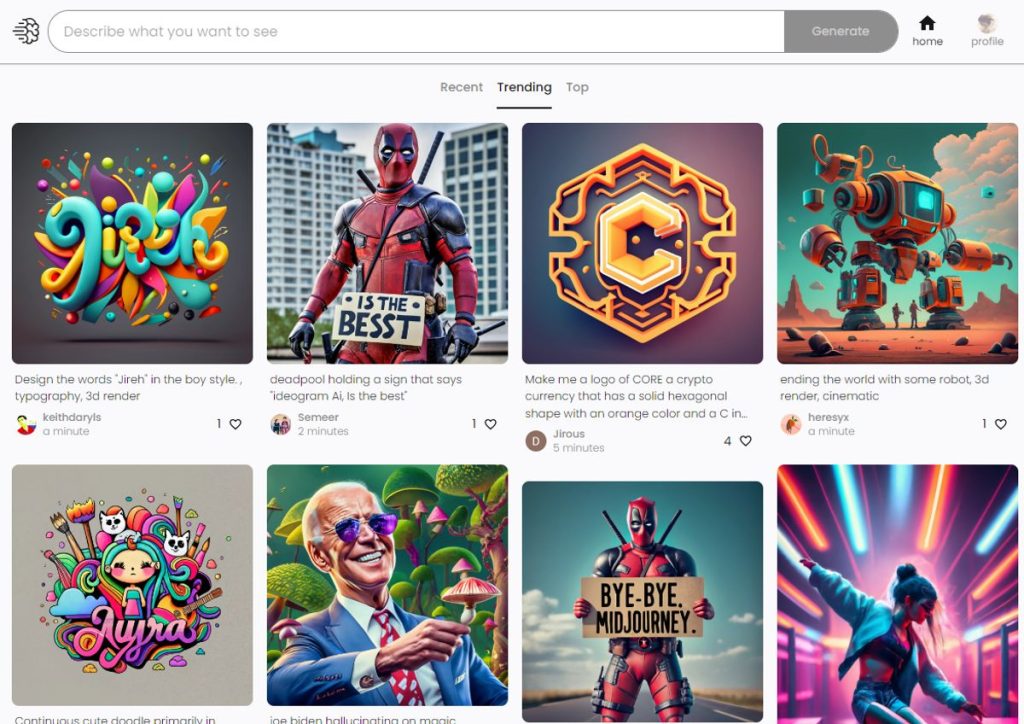
Ideogram built its reputation on the one thing AI image models famously botched: text. Posters, logos, packaging mockups, memes, thumbnails — anywhere words live inside an image, Ideogram renders them correctly at a rate rivals still chase. The current 4.0-generation models extend that lead into layout-aware design generation, while pricing stays accessible: free weekly slow credits, paid from ~$15/month (Plus) to ~$42 (Pro), with per-image API rates from ~$0.03.
Around the text superpower sits a full generator: strong photorealism, a style-reference system, magic prompt enhancement, canvas editing with inpainting, and batch generation — a complete tool, not a one-trick demo.
Our verdict: the first choice for design-adjacent generation — thumbnails, ads, posters, product mockups — where in-image text decides usability. Pure art and cinematic imagery still tilt Midjourney; vectors belong to Recraft. Score: 8.4 / 10.
→ Try Ideogram — see current pricing
What makes Ideogram different
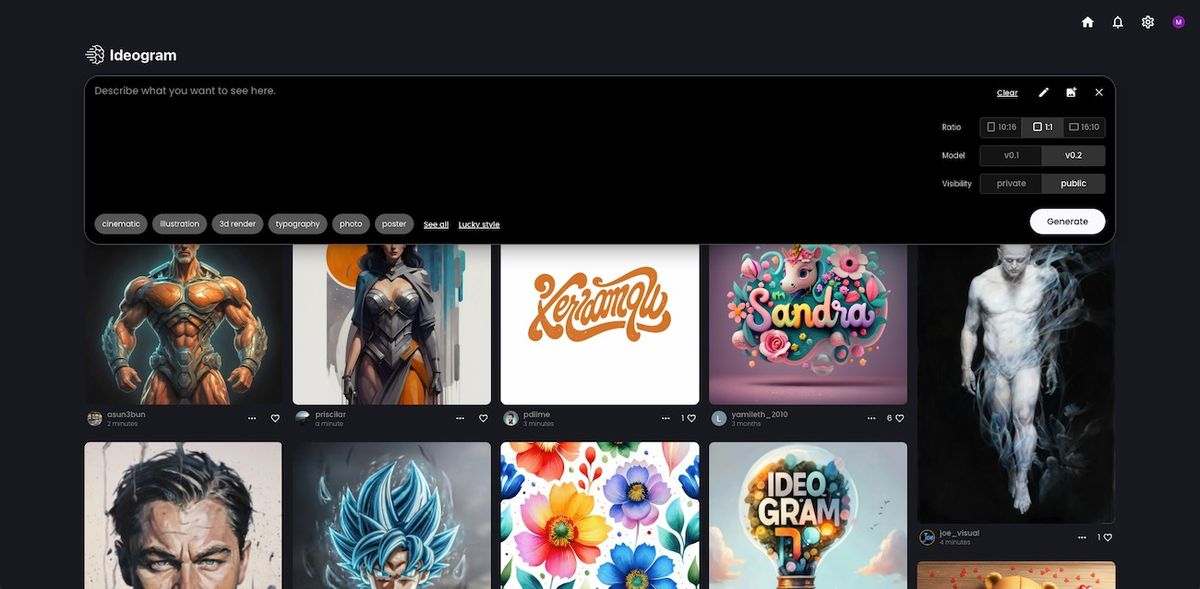
Typography-native generation: headlines, labels and multi-word layouts render as coherent design elements — kerned, aligned, spelled — enabling one-shot posters and thumbnails no competitor reliably produces. The style and character reference system carries a look or a face across a campaign. Magic Prompt rewrites terse prompts into detailed ones (toggle it off for control), and the canvas editor handles extend, inpaint and text correction without leaving the tool.
Pricing
| Plan | Price (annual) | Credits |
|---|---|---|
| Free | $0 | ~10 slow credits weekly |
| Basic | ~$7-8/mo | 400 priority credits |
| Plus | ~$15-16/mo | 1,000 priority credits |
| Pro | ~$42-48/mo | 3,500 credits, bulk tools |
Credit accounting matters: newer-model generations cost multiple credits each (4.0-class quality runs ~4 credits/image), so a "1,000-credit" plan is realistically 250-1,000 images depending on model choice — and unused monthly credits expire. The free weekly drip is enough to evaluate the typography edge on your real use case.
The working experience
Prompting for text works best explicit and quoted: the exact string, the style ("bold condensed sans, cream on forest green"), the placement. First-try success on short headlines is routine; dense multi-line layouts still reward two or three attempts plus a canvas fix pass. Photorealism has quietly caught the leaders for product-adjacent scenes, and generation speed on paid tiers keeps iteration conversational.
Ideogram vs Midjourney vs Recraft vs the aggregators
Against Midjourney: aesthetic ceiling and community lean Midjourney; anything with words in it leans Ideogram decisively — many professionals run both, routing by whether the deliverable contains type. Against Recraft: Recraft owns vectors and brand-kit consistency; Ideogram owns raster typography and photoreal-with-text. Against aggregators (Krea, Freepik): they include Ideogram-class models among many; direct subscription buys the newest models first and the native canvas. The routing question is simply: does text live inside the image?
Pros, cons and limits
Pros: best-in-class in-image text; strong photorealism; style/character references; capable canvas editor; accessible pricing with a real free tier; fast batch tools on Pro.
Cons: credit costs on newest models cut effective volume; credits expire monthly; free-tier outputs are public; no vector output; long-form text layouts still imperfect; library organisation is basic at scale.
Ideogram deals
Annual billing saves ~25-30%; the free weekly credits make the typography test permanent and costless.
Prompting for typography: the craft that multiplies results
Because text rendering is the purchase reason, the prompting patterns that maximise it deserve documentation. Quote the exact string — always: the poster headline "GRAND OPENING" in bold condensed sans beats any paraphrase, and the model treats quoted text as sacred where unquoted intent drifts. Specify the type's job, not just its look: "as the dominant headline" versus "as a small corner label" changes layout logic, and Ideogram's layout awareness — the 4.0-generation's real upgrade — responds to compositional instruction ("text on the left third, product on the right") with genuine reliability. Constrain palette and mood the way a brief would ("two-colour: cream type on deep green, vintage grocery signage feel"), and for multi-line layouts, structure the prompt as the design: headline, subhead, footer text each quoted and placed. The failure modes worth knowing: dense paragraphs still degrade past ~15 words, ultra-thin weights render less reliably than medium-to-bold, and non-Latin scripts (including Vietnamese diacritics) have improved substantially but warrant a proof pass on every deliverable. The two-minute canvas fix — select the botched word, regenerate locally — cleans most stragglers without rerolling the composition.
The meta-habit of high-output users: build a personal prompt library keyed by deliverable type (thumbnail, poster, packaging, ad) with proven scaffolds, because typography prompting rewards precision that improvisation rarely reproduces.
Style references and character consistency
The reference system converts one-off wins into repeatable identity. Style references: upload or pick previous generations, and new outputs inherit the aesthetic — palette, texture, compositional temperament — with adjustable strength; a campaign's look, once found, propagates across every format without re-describing it. Character references hold a face or mascot consistent across scenes, the capability that unlocks serialised content (a brand mascot in twelve situations, a recurring thumbnail persona) that raster rivals handle with fine-tuning ceremony. The practical workflow: a project's first session is exploration (loose prompts, many candidates); the second session locks winners into references; every session after is production at consistency levels that used to require a trained LoRA and a weekend. Combined with batch generation on Pro, the system supports genuine campaign-scale output — forty on-brand variants in an afternoon — which is where the tool stops being a generator and starts being a production department.
The canvas: editing where generation happens
The canvas module — infinite workspace with generation, extension and inpainting — earns its place in the daily loop. Magic Fill repairs and replaces regions (the botched word, the awkward hand, the cluttered corner) without touching the rest; Extend grows a composition beyond its frame for format adaptation — the square social visual becoming a wide banner by generating coherent continuation rather than cropping. For the thumbnail-and-ad workflow this review keeps returning to, the canvas closes the round-trip: generate, fix locally, extend to every placement's aspect ratio, download — no Photoshop detour for the 80% of assets whose edits are structural rather than surgical. Honest limits: layer-based compositing, precise masking and colour-grade finishing remain external-editor work, and the canvas's organisational tooling strains past a few dozen boards — professional libraries live in your DAM, not here.
Ideogram for e-commerce and print-adjacent work
Two commercial lanes deserve specific coverage. Product-adjacent marketing: lifestyle scenes with readable packaging, promo banners with prices and claims rendered correctly, seasonal campaign sets held consistent by references — the category where text failure made raster AI unusable for commerce, now serviceable at production speed. The proofing discipline remains mandatory (a wrong price generated confidently is a liability, not a typo), and product-exact packshots still belong to photography or dedicated product-AI tools; Ideogram's lane is the marketing layer around the product, not the catalogue image itself. Print-on-demand and merch: slogan tees, posters and stickers are Ideogram's native habitat — short bold type, graphic compositions, style variety on demand. The resolution question resolves with the built-in upscaling for most POD formats; the rights question resolves with a paid plan's commercial terms; the differentiation question remains yours — the tool industrialises execution, and POD margins die on designs everyone can now execute. The winning pattern mirrors every AI-commerce niche: speed to trend plus taste in curation, with Ideogram compressing the first and never supplying the second.
Credit strategy: getting maximum images per dollar
The two-model habit from the FAQ deserves expansion into a full protocol. Iterate on default-quality models (1 credit-class) with Magic Prompt on — exploration is where volume lives, and enhanced prompts teach you the model's vocabulary. Lock composition and style at draft quality, then re-render finals on the top model (4-credit-class) — the quality delta shows in type edges and texture exactly where deliverables need it. Batch the finals: Pro's bulk tools amortise the session overhead. Watch the expiry: monthly credits vanish at rollover, so month-end is free-experiment season — the use-it-or-lose-it window where reference-building and style exploration cost nothing you were keeping. And route honestly: images without text have no business burning Ideogram credits when your other subscriptions (or free tiers) generate them — the tool's premium is typography, and disciplined routing keeps the effective cost-per-typographic-image at the level that embarrasses design-labour alternatives.
The API lane: programmatic typography at scale
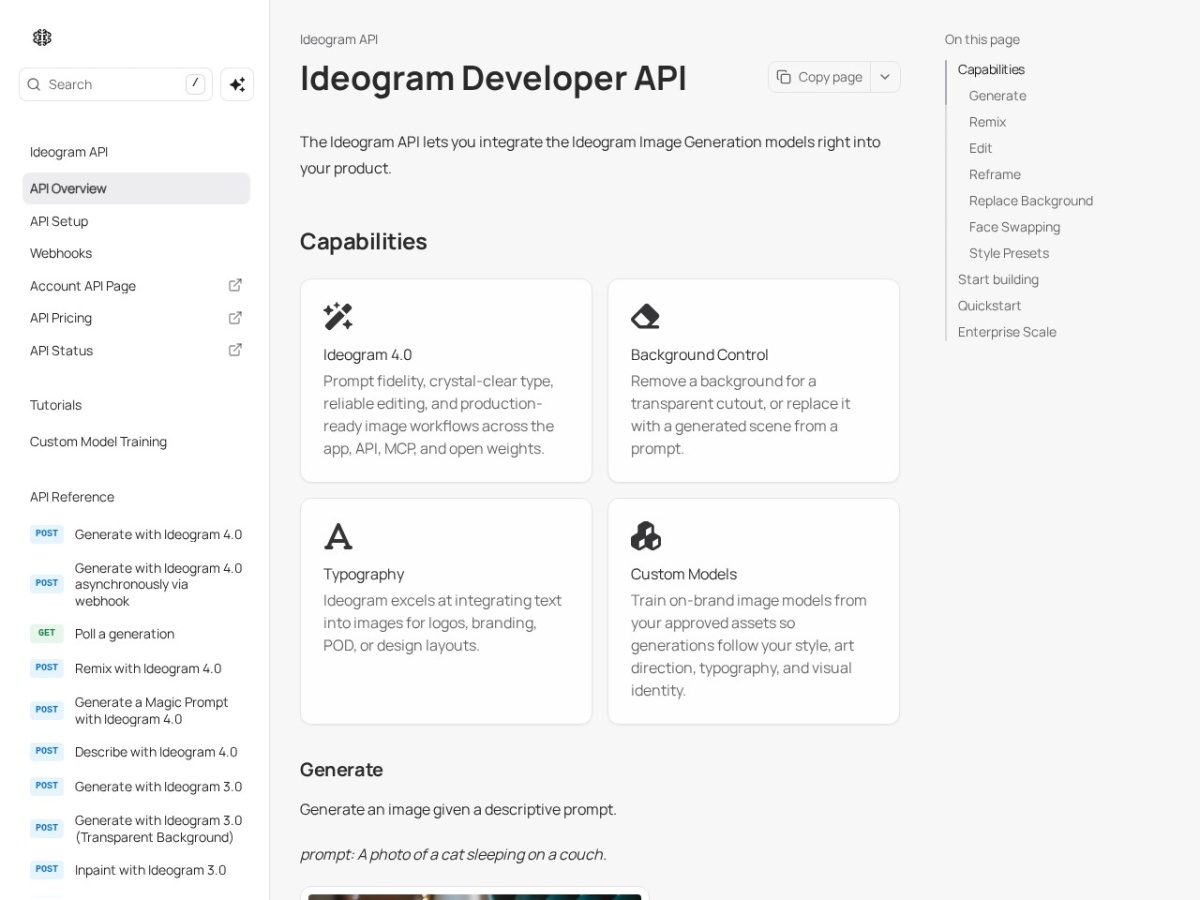
The per-image API pricing (roughly $0.03-0.10 by model and quality) opens the workflows that define Ideogram's enterprise quiet zone: personalised ad variants generated per audience segment, thumbnail pipelines producing candidates for every video upload, localised campaign assets swapping quoted strings per market, and marketplace sellers refreshing listing graphics on schedule. The build pattern is straightforward — templates with variable text fields, the API filling and rendering, human review gating publication — and the economics against design labour are the story: a hundred localised banner variants cost single-digit dollars and an afternoon of pipeline code, versus a week of production design. The governance note scales with the automation: generated text is confidently wrong when inputs are wrong, so the review gate earns its place in any pipeline touching prices, claims or legal copy. For technical marketers, this lane alone justifies watching the platform regardless of the consumer app's comparison-table standing.
The full-review synthesis: Ideogram found the one durable moat in commodity image generation — doing correctly the thing everyone else does wrongly — and built a complete, sensibly priced tool around it. Route your text-bearing work here, your art elsewhere, and let the click-through data from week one's thumbnail test write the renewal decision. Tools with one superpower and no pretensions age well; this is one of them. Score: 8.4 / 10.
Ideogram vs the text-rendering catch-up: how durable is the moat?
The fair strategic question: rivals' typography improves every cycle, so is the lead structural or temporal? The evidence for durability: Ideogram's advantage is not one model trick but accumulated specialisation — layout awareness, quoted-string discipline, canvas text-repair tooling, and reference systems all built around type-bearing design as the primary use case rather than an evaluation checkbox. Rivals close the spelling gap while remaining picture-first products; Ideogram compounds design-first workflow features on top of the rendering lead. The evidence for erosion: frontier multimodal models improve typography as a side effect of scale, and a future where correct text is table stakes across all generators is plausible within a few cycles. The buyer's hedge writes itself: subscriptions are monthly, switching costs are near zero (prompts and references rebuild in an afternoon), and the correct posture is renting the current best tool for the job while re-benchmarking twice a year — exactly the posture this site's comparison protocol exists to serve. What does not erode meanwhile: the deliverables shipped, the design hours saved, and the click-through lifts banked during the lead. Moats matter to investors; working output matters to operators, and on output the verdict stands unhedged. Score: 8.4 / 10.
Ideogram's community and inspiration economy
The public gallery deserves strategic use rather than casual scrolling: every image ships with its prompt visible, making the feed a living prompt-engineering textbook filtered by your search terms — search your deliverable type ("podcast thumbnail", "vintage poster") and reverse-engineer the top results' prompt grammar in minutes. The remix culture (generate from any public image's prompt as a starting point) accelerates the learning curve further, and the weekly community showcases surface technique trends — the current typography meta — faster than any tutorial pipeline. The free tier's public-by-default posture, a privacy caveat elsewhere in this review, is precisely what makes this commons work; the paid tiers' private mode opts you out of contributing while retaining the reading rights. For a working designer, thirty minutes weekly in the gallery is continuing education at zero cost.
FAQ
Is the text rendering really solved?
Short headlines and labels: near-solved. Paragraph-length text: improved, still needs a proof pass. The gap to rivals remains visible on both.
Can I use images commercially?
Paid plans include commercial rights with private generation; free-tier images are public and best kept to drafts.
Ideogram or Canva AI for social graphics?
Canva assembles layouts from assets; Ideogram generates finished visuals whole. Fastest workflow: Ideogram for the hero image, Canva for templated resizing.
How do credits actually stretch?
Default-quality models for iteration, top models only for finals — the two-model habit triples effective volume on any plan.
What about API use?
Per-image pricing from ~$0.03 makes programmatic thumbnail and ad-variant pipelines viable — the quiet enterprise lane behind the consumer app.
The thumbnail-and-ad sprint
Week one: recreate your five best-performing thumbnails or ads in Ideogram — same message, generated layout — and A/B them against the originals. Week two: build style references from the winners so the look repeats on demand. Week three: batch a month of creative variants (Pro's bulk tools earn their tier here) and let platform metrics pick survivors. Week four: total the design hours the pipeline replaced and price the subscription against them. For text-in-image work, the verdict usually arrives by week two — visibly, in your own click-through data. Score: 8.4 / 10.



