

If you have spent any time shopping for cloud infrastructure, you already know the conversation is dominated by three American hyperscalers. But there is a growing camp of teams that want their data hosted in Europe, billed in euros, and supported by people who work in their own time zone. Scaleway is one of the most complete answers to that demand. It is a French cloud provider, part of the Iliad group, that has quietly built a portfolio of more than 100 cloud and AI products, from bare metal servers to serverless functions to a managed Kubernetes service.
In this review we take an honest look at what Scaleway does well, where it still lags behind the giants, and who should actually consider building on it. We are an affiliate, which means we earn a commission if you sign up through our links, but that does not change our willingness to point out the rough edges. If you want to skip ahead and explore for yourself, you can Try Scaleway and follow along.
AnalyzeBench Score: 8.4 / 10
Best for: European startups, SaaS teams, and AI builders who value data sovereignty, transparent euro pricing, and a modern developer experience without hyperscaler complexity.
What we loved:
- Genuine EU data sovereignty with data centers only in France, the Netherlands, and Poland.
- Transparent, product-level pricing that is frequently cheaper than the hyperscalers for equivalent compute and storage.
- A surprisingly deep catalog: CPU and GPU instances, bare metal, Apple silicon, serverless, managed Kubernetes, and managed databases.
- Free Kubernetes Kapsule control plane, so you only pay for worker nodes.
- A strong AI and GPU story, trusted by names like Mistral AI and Hugging Face.
- Real sustainability commitments, with renewable energy and a publicly displayed PUE.
Watch out for:
- Documentation can be uneven, and some newer products feel like betas.
- The ecosystem and feature set are smaller than AWS, Azure, or Google Cloud.
- Global reach is limited, so teams serving Asia or the Americas may see higher latency.
- Pricing changes do happen, including a round of increases in mid 2026.
What makes Scaleway different
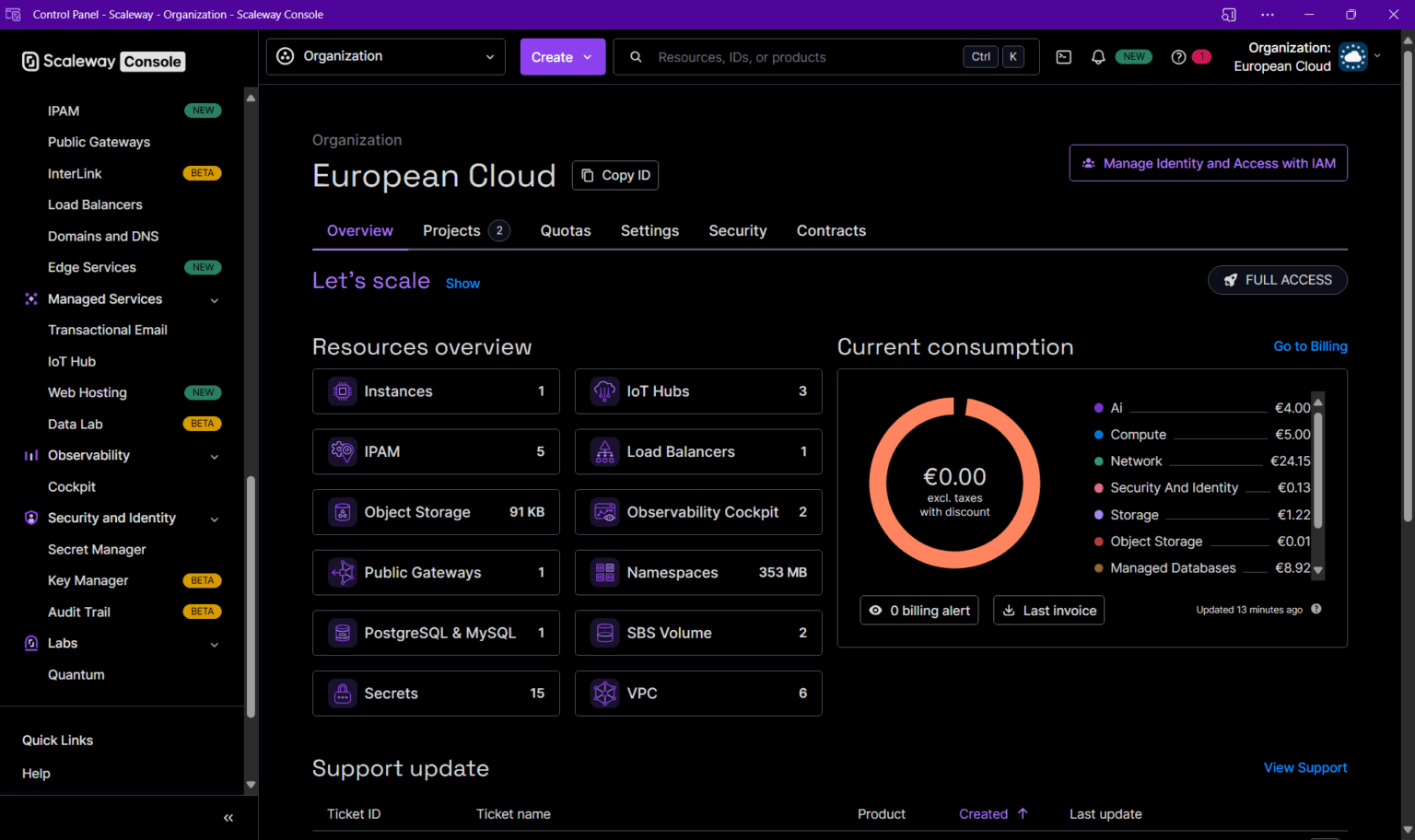
The single biggest reason people choose Scaleway is sovereignty. All of its cloud regions sit inside the European Union, currently spanning Paris, Amsterdam, and Warsaw, with multiple availability zones in each region. For a company that has to answer to GDPR, sector rules like HDS for healthcare data, or simply a board that does not want customer records sitting under foreign jurisdiction, that geography matters. Scaleway leans into this identity hard, and it has the credibility to back it up: the company was selected by the European Commission to help deliver a sovereign public cloud and AI platform for EU institutions.
The second differentiator is philosophy. Scaleway markets itself around three ideas that actually show up in the product: open and interoperable technology so you are not locked in, transparent pricing published at the product level, and a fast-moving roadmap. Its object storage is S3 compatible, its Kubernetes is standard upstream Kubernetes, and it maintains a mature Terraform provider, a CLI, and a clean API. In practice this means a team already fluent in AWS tooling can port a lot of their muscle memory across without relearning everything.
The third is sustainability, which is more than a marketing line here. Scaleway recycles hardware, runs on renewable energy, and publishes its Power Usage Effectiveness in real time. If your organization reports on the carbon footprint of its infrastructure, having a provider that gives you an environmental footprint calculator is genuinely useful. None of this makes Scaleway a hyperscaler killer, but it does make it a coherent, opinionated alternative rather than a cut-price clone.
The core products
Scaleway is broad. Rather than list all 100-plus services, here are the pillars that most teams will actually touch.
Compute Instances
The CPU instance range is segmented sensibly: Development Instances for lightweight testing, General Purpose Instances for a balance of price and power, plus Compute Optimized and Memory Optimized lines for specialized workloads. You start an instance in seconds and scale up as you grow, which covers the vast majority of web and application hosting needs.
GPU Instances and AI
This is where Scaleway has invested aggressively. The GPU lineup runs from cost-effective L4 and L40S cards up to H100 PCIe and H100 SXM instances, and newer Blackwell-based B300 SXM instances for the most demanding training. On top of the raw hardware, Scaleway offers Generative APIs, letting you consume AI models through a simple serverless API call, all hosted in Europe. This combination of European GPU capacity and inference services is a big part of why AI companies have gravitated to the platform.
Elastic Metal, Dedibox, and Apple silicon
For hardware isolation, Elastic Metal delivers fully dedicated bare metal servers with native cloud integration, in ranges named Aluminium, Beryllium, Iridium, Lithium, and Titanium, and there is even a RISC-V option billed as the world’s first RISC-V servers in the cloud. The older Dedibox line offers classic dedicated servers at strong price-performance. Scaleway also rents dedicated Apple Mac mini machines, from M1 up to M4 Pro, which is a niche but valuable option for iOS and macOS build pipelines.
Serverless and containers
Scaleway covers the serverless spectrum with Functions, Containers, and Jobs for batch workloads. For orchestration it offers Kubernetes Kapsule, its managed Kubernetes, and Kosmos, a multi-cloud variant that can pool Scaleway and external nodes into one cluster. A Container Registry rounds this out.
Managed databases and storage
On the data side you get Managed Databases for PostgreSQL, MySQL, Redis, and MongoDB, plus a Serverless SQL Database and a ClickHouse-based data warehouse. Storage spans S3-compatible Object Storage, Block Storage, a beta File Storage, and Glacier cold storage for archives. Networking adds VPC, Load Balancer, Public Gateway, and a WAF.
Plans & pricing
Scaleway bills in euros with pay-as-you-go by the hour or by the month, and it publishes prices openly. The figures below are starting points at the time of writing and can change, so always confirm on the live pricing page before committing.
Compute Instances
Development and General Purpose CPU instances are among the cheapest ways onto the platform, with pay-as-you-go hourly billing and monthly caps. The Dedibox VPS line starts around €4.99 per month for a very affordable entry point.
Elastic Metal bare metal
Elastic Metal servers start from roughly €27.99 per month, or about €0.077 per hour, giving you a fully dedicated machine with no hypervisor overhead.
Apple silicon Mac mini
Dedicated Apple Mac mini machines start from around €0.11 per hour, with M1, M2, M2 Pro, M4, and M4 Pro options depending on how much horsepower your build or test workflow needs.
GPU Instances
NVIDIA H100 GPU instances start at approximately €2.73 per hour for a single-GPU configuration, with multi-GPU options available. The L4 and L40S instances are meaningfully cheaper and are often the smarter choice for inference and lighter training jobs.
Kubernetes Kapsule
The Kapsule control plane is free. You pay only for the worker nodes, load balancers, and persistent volumes your cluster actually uses, which keeps small clusters genuinely inexpensive.
Storage
Object Storage and Block Storage are billed by capacity and usage, with Glacier providing a much cheaper tier for cold, rarely accessed archives. Note that a pricing update in mid 2026 adjusted several line items, including some storage, IPv4, GPU, and serverless charges, so review current rates rather than relying on older figures.
Ready to see the numbers for your own workload? You can Try Scaleway and use its cost manager to model spend before you deploy anything.
How to get started
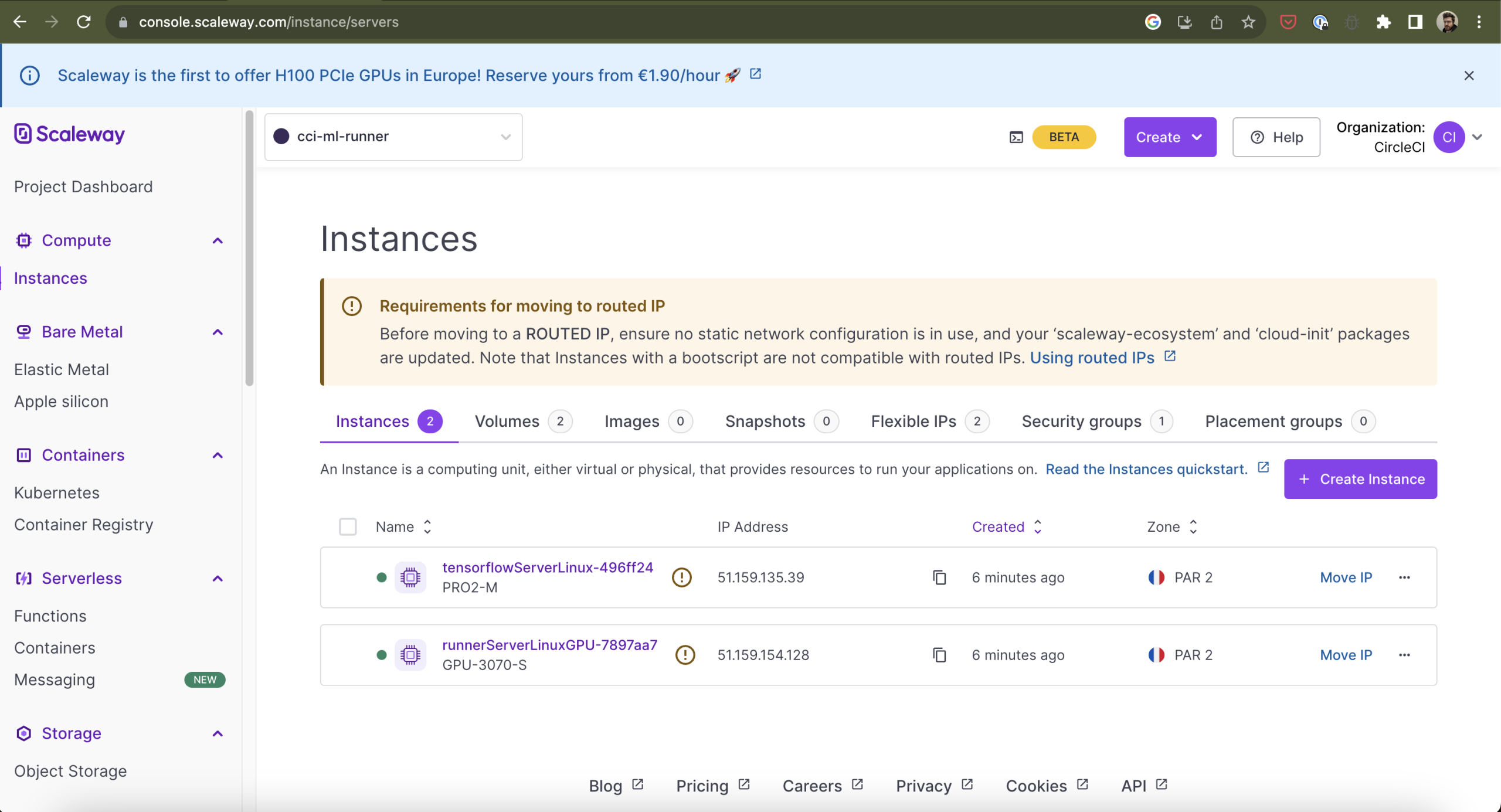
Getting onto Scaleway is refreshingly quick. You create an account, confirm your email, and add a payment method. From the console you can launch your first instance in a few clicks: pick a region and availability zone, choose an instance type, select an operating system image, and add an SSH key. Within a minute or two you have a running server with a public IP.
Developers who prefer automation will feel at home. Scaleway exposes a full REST API, a command line interface, and a well-maintained Terraform provider, so you can define infrastructure as code from day one. For Kubernetes, you provision a Kapsule cluster from the console or CLI, download your kubeconfig, and point kubectl at it exactly as you would with any standard cluster. There is a free startup program too, offering up to €36,000 in cloud credits for eligible companies, which is a strong reason for early-stage teams to kick the tires. When you are ready, Try Scaleway and start with a small instance before scaling up.
Watch: Scaleway in action
To see how fast the developer experience really is, this short walkthrough shows how to get started with the Scaleway API and make your first call in about three minutes.
Scaleway vs alternatives
Scaleway is not the only European cloud worth considering. Here is how it stacks up against two of the most common alternatives, Hetzner and OVHcloud.
| Factor | Scaleway | Hetzner | OVHcloud |
|---|---|---|---|
| Origin | France (Iliad group) | Germany | France |
| Core strength | Broad cloud + AI catalog, managed services | Rock-bottom prices on servers | Very large product range and global data centers |
| Managed Kubernetes | Yes, free Kapsule control plane | No native managed offering | Yes, managed Kubernetes |
| GPU and AI | Strong, H100/L40S plus Generative APIs | Limited GPU options | GPU instances available |
| Developer experience | Polished console, CLI, Terraform | Functional but more basic | Powerful but can feel complex |
| Best fit | Startups and AI teams wanting managed services in the EU | Cost-focused teams comfortable self-managing | Enterprises needing scale and breadth |
The short version: Hetzner usually wins on raw price if you are happy to manage everything yourself, OVHcloud wins on sheer breadth and global footprint, and Scaleway sits in a sweet spot with a modern, managed developer experience and a serious AI offering.
Performance, support & value
On performance, Scaleway is solid rather than record-breaking. Reliability tends to hover near the 99.9 percent mark, and the multi-AZ regions let you architect for high availability if you design for it. Bare metal and dedicated GPU options give you predictable, uncontended performance when you need it, while the instance range covers everyday workloads without drama. For European users, network latency is excellent because the infrastructure is close by.
Support is a genuine strength for European customers. Staff work in EU time zones, and language support extends beyond English to French and German. Reports from users suggest serious issues are typically acknowledged within a few hours, which is competitive with paid support tiers at larger providers. There is also an active Slack community and a public feature request board, which signals a company that listens.
On value, the combination of transparent euro pricing, frequently lower compute and storage costs, and generous startup credits makes Scaleway attractive, especially for teams whose customers are in Europe. You are not paying a premium for a global footprint you do not use.
Who should use it — and who should not
Scaleway is an excellent fit if you are a European startup or SaaS company that wants data sovereignty without sacrificing a modern developer experience. It is a strong choice for AI and machine learning teams who need European GPU capacity, and for agencies or product teams that value predictable euro billing. If you are already comfortable with S3, Kubernetes, and Terraform, you will be productive quickly.
It is a weaker fit if your users are concentrated in North America or Asia and latency is critical, since Scaleway’s footprint is European. It is also less ideal if you depend on the deep, specialized managed services that only the hyperscalers offer, or if your compliance team specifically requires a provider with a presence in a dozen global regions. For those cases, a hyperscaler or a truly global provider will serve you better.
Honest limits
No review is complete without the caveats, and Scaleway has real ones. First, documentation quality is uneven. The core products are well documented, but some newer or niche services have thinner guides, and you will occasionally find yourself piecing things together from the Slack community or GitHub. Second, several products carry a beta label, so if you need rock-solid maturity across every service, check the status of the specific feature you plan to rely on.
Third, the ecosystem is simply smaller than the hyperscalers. There are fewer third-party integrations, fewer tutorials scattered across the internet, and a smaller talent pool of engineers who already know the platform intimately. Fourth, global reach is limited to Europe, which is a feature for sovereignty but a limitation for global latency. Finally, pricing is not frozen in stone; the mid-2026 adjustments are a reminder to model your costs on current rates and keep an eye on changes. None of these are dealbreakers for the target audience, but they are worth knowing before you migrate a production workload.
Scaleway deals
The best offer for most readers is not a flash discount but the startup program, which provides up to €36,000 in cloud credits for eligible early-stage companies, along with technical guidance from solution architects. There is also a Founders program with smaller credits for the earliest teams. Combined with pay-as-you-go billing and no long lock-in, that lets you validate the platform with real workloads at very low risk. If that sounds like a fit, Try Scaleway and check which credit program you qualify for.
Frequently asked questions
Is Scaleway a good alternative to AWS?
For European teams, yes, with caveats. Scaleway covers the essentials, compute, storage, Kubernetes, databases, and GPUs, at competitive prices with EU data sovereignty. It does not match AWS on the sheer number of specialized managed services, so evaluate whether you depend on any AWS-only feature.
Where is my data stored with Scaleway?
Data stays within the European Union. Scaleway operates cloud regions in Paris (France), Amsterdam (Netherlands), and Warsaw (Poland), each with multiple availability zones, which is central to its sovereignty proposition.
Is Scaleway cheaper than the big cloud providers?
Often, yes, for equivalent compute and storage. Reviews frequently cite meaningful savings versus the hyperscalers, and pricing is published transparently in euros. Always compare current rates for your specific workload, since a mid-2026 update adjusted several line items.
Does Scaleway offer managed Kubernetes?
Yes. Kubernetes Kapsule is its managed offering, and the control plane is free, so you pay only for worker nodes and associated resources like load balancers and volumes. Kosmos extends this to multi-cloud clusters.
Can I run AI and GPU workloads on Scaleway?
Yes. Scaleway offers GPU instances from L4 and L40S up to H100 and Blackwell-based cards, plus serverless Generative APIs for consuming AI models hosted in Europe. It is used by AI companies including Mistral AI and Hugging Face.
Is there a free trial or credits?
There is no unlimited free tier, but the startup and founders programs provide substantial cloud credits for eligible companies, and pay-as-you-go billing lets you start small and stop anytime.
How to choose a cloud provider: a practical guide
Whether or not you land on Scaleway, choosing a cloud provider is a decision worth making deliberately. Here is a simple framework we use.
Start with data location and compliance. Before comparing features, decide where your data legally needs to live and which certifications you require. If sovereignty or GDPR posture is non-negotiable, that alone narrows the field dramatically and pushes European providers up the list.
Map your actual workloads. List what you truly run: web apps, databases, batch jobs, containers, GPU training. Match those to a provider’s core products rather than being dazzled by a long catalog you will never touch. A smaller provider that covers your real needs beats a giant whose extra services you never use.
Model the total cost, not the sticker price. Include compute, storage, egress bandwidth, load balancers, and IP addresses. Egress and networking fees are where cloud bills quietly balloon, so always estimate them. Transparent, product-level pricing makes this far easier, which is one area where Scaleway helps.
Weigh the developer experience and lock-in. A good console, a solid API, a maintained Terraform provider, and open standards like S3 and upstream Kubernetes save time and keep your exit options open. Prefer providers that make it easy to leave, because that is the same thing that makes them easy to trust.
Check support and community. When something breaks at 2am, response time and time-zone alignment matter. Look at the support tiers, the language coverage, and whether there is an active community you can lean on.
Pilot before you commit. Finally, run a real pilot. Deploy a representative workload, measure performance and cost for a couple of weeks, and only then migrate anything critical. Credits and pay-as-you-go billing exist precisely so you can do this cheaply. If Scaleway is on your shortlist, Try Scaleway with a small pilot and judge it on your own numbers.



