
If you have shopped for an AI writing tool in the last couple of years, you have almost certainly run into Writesonic. It started life as a template-driven copy generator and, honestly, looked a lot like every other “type a prompt, get marketing copy” app on the market. In 2026 it is a very different animal. Writesonic has pushed hard into long-form SEO content and, more notably, into AI search visibility — the emerging discipline of getting your brand mentioned when people ask ChatGPT, Claude, Gemini, or Google’s AI Overviews for a recommendation.
That shift makes Writesonic more interesting than the average AI writer, but it also makes it harder to evaluate. Is it a writing tool? An SEO platform? An AI-visibility tracker? The honest answer is that it tries to be all three, and how much you like it depends heavily on which of those jobs you actually need done. This review digs into the real features, the (frequently changing) pricing, the output quality, and the trade-offs, so you can decide whether Writesonic belongs in your stack.
Throughout this review I link to Writesonic so you can start a free trial and judge the output on your own content — that is genuinely the best way to test any AI writer.
AnalyzeBench Score: 8.4 / 10
Best for: Content marketers, SEO teams, agencies, and solo creators who want long-form article generation, on-page SEO tooling, and AI-search (GEO) visibility bundled into a single subscription instead of paying for three separate tools.
What we loved:
- Fast, coherent long-form drafts from the AI Article Writer, with the option to pull in real-time data and competitor structure.
- A genuinely useful bundle — writing, an SEO checker/optimizer, an AI chatbot (Chatsonic), and AI-search visibility tracking under one roof.
- Access to multiple underlying models (GPT-class and Claude-class) so you can trade speed for quality.
- Strong ratings from a large review base (roughly 4.8/5 across G2 and Capterra) and enterprise trust signals like SOC 2 Type II, GDPR, and HIPAA.
- An unusually forward-looking GEO module that tracks whether AI engines mention your brand — something most writing tools ignore entirely.
Watch out for:
- Pricing has been re-tiered many times, which makes budgeting and comparisons frustrating.
- Brand voice matching is decent but still trails Jasper for nuanced, on-brand tone.
- Raw output can feel generic and occasionally needs fact-checking — human editing is not optional.
- Chatsonic and Botsonic are effectively separate products with their own costs, so the “all in one” promise has asterisks.
- There is no permanent free plan — only a time-limited trial.
What makes Writesonic different
Most AI writing tools stop at generation. You give them a topic, they hand you a draft, and the rest — optimization, publishing, measuring whether the content actually gets found — is your problem. Writesonic’s 2026 pitch is that it closes that loop. The company describes it as an “AI search growth engine” built around a cycle of track, prioritize, act, and measure.
In plain terms, that means Writesonic wants to show you where your brand is invisible in AI answers, tell you what to fix, help you write or rewrite the content to fix it, and then report on whether visibility improved. That is a broader ambition than Jasper or Copy.ai, which remain primarily focused on generating copy. Whether you need that breadth is the central question — but the ambition itself is what sets Writesonic apart.
The second differentiator is model flexibility. Rather than locking you into one engine, Writesonic lets you choose quality tiers backed by different large language models, including GPT-class and Claude-class options. For routine social posts you can use a faster, cheaper model; for a cornerstone article you can dial up to the highest-quality tier. That granularity is handy when you are trying to control costs without sacrificing quality on the pieces that matter.
Third, Writesonic leans into real-time data. The AI Article Writer can reference current information rather than relying solely on stale training data, which reduces (though does not eliminate) the risk of confidently wrong statements. For anyone writing about fast-moving topics, that matters.
Try Writesonic and run one of your own article briefs through it — you will get a feel for the workflow within minutes.
The core features
Writesonic packs a lot into one dashboard. Here are the pieces that actually get used day to day.
AI Article Writer
This is the flagship. The AI Article Writer is built for long-form content — blog posts, guides, and SEO articles that can run to several thousand words. It walks you from keyword and title through outline to a full draft, and it can peek at ranking competitors to shape the structure. You can inject real-time facts, control tone, and regenerate sections you do not like. It is the feature most people sign up for, and it is the one that has improved the most across versions.
SEO checker and optimizer
Beyond raw generation, Writesonic includes on-page SEO tooling: keyword integration, content scoring against what is currently ranking, and site audit features that flag technical and structural issues. It integrates with Google Search Console and Google Analytics so recommendations are grounded in your real data rather than generic advice.
AI search visibility (GEO)
This is the newest and most distinctive module. It tracks whether AI engines — ChatGPT, Claude, Gemini, Perplexity, Copilot, and Google’s AI Overviews among them — mention your brand when users ask relevant questions, and it surfaces the citations those engines are pulling from. An “action center” then ranks the fixes most likely to move the needle, from missing content to citation gaps. If you believe AI search is where discovery is heading, this is a compelling reason to pick Writesonic over a pure writing tool.
Chatsonic
Chatsonic is Writesonic’s conversational AI assistant — a ChatGPT-style chatbot with real-time web access, image generation, and support for follow-up research. It is useful for brainstorming, quick answers, and pulling live information into your workflow. Note that it is positioned as its own product line rather than a bundled bonus.
Botsonic
Botsonic is a no-code builder for custom AI chatbots that you train on your own website, docs, and help-center content. It is aimed at customer support and lead capture, and it can resolve a large share of routine support queries automatically. Like Chatsonic, it carries its own subscription, so treat it as a separate purchase decision rather than a freebie.
Templates, brand voice, and API
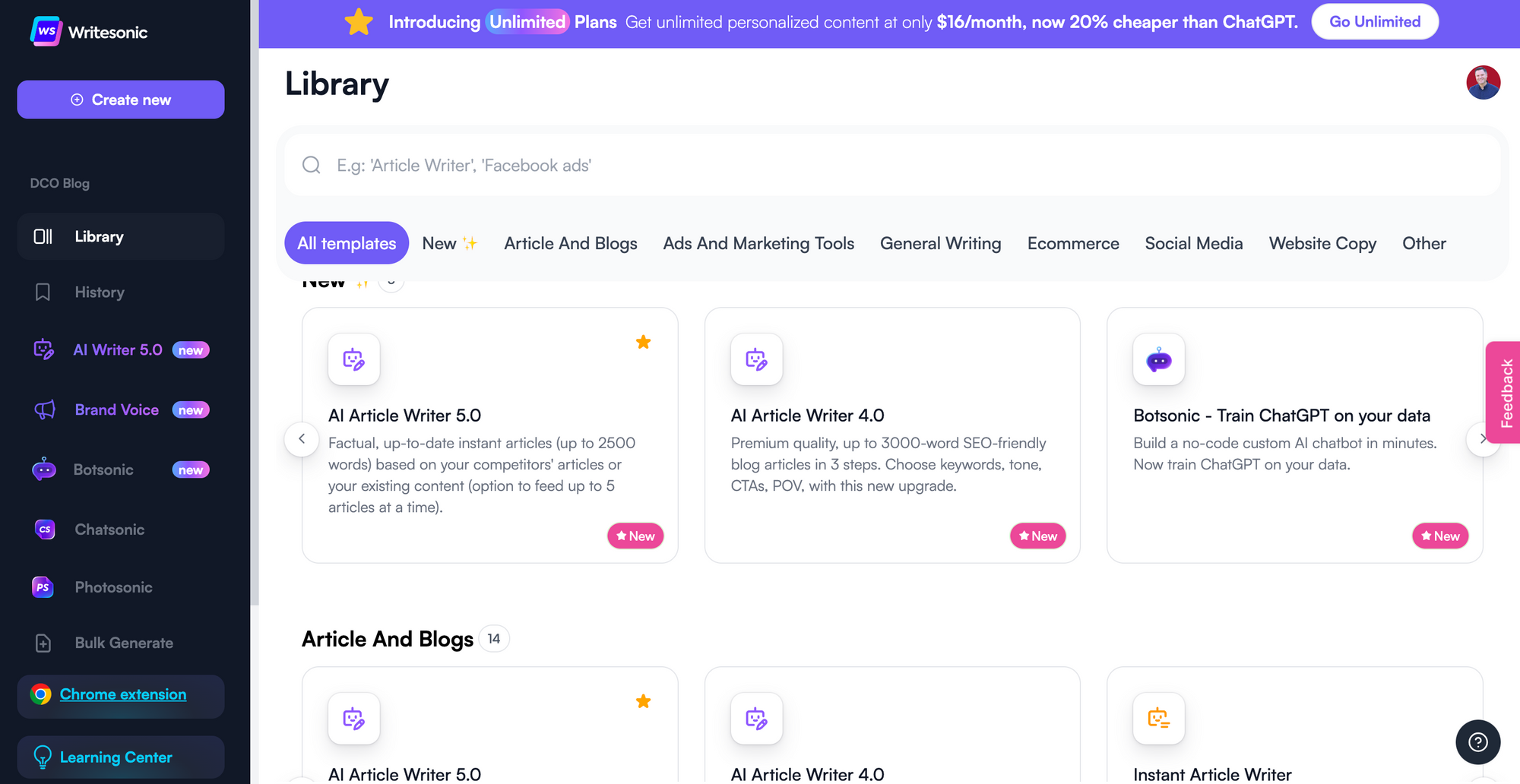
Writesonic still ships the library of 100-plus templates that made its name — ads, product descriptions, emails, landing-page copy, social posts, and more. Brand Voice lets you feed in samples of your writing so the AI tries to match your style. There is multilingual support across a couple dozen languages, an image generator, and a developer API (plus MCP and a WordPress integration) for teams that want to wire Writesonic into their own systems.
Plans & pricing
Here is where I have to be honest: Writesonic’s pricing is a moving target. The company has re-tiered its plans repeatedly, shifting between word-based, credit-based, and platform-seat models. Treat the figures below as directional and always confirm the current numbers on the official pricing page before you buy. Annual billing typically shaves a meaningful chunk (often around 20%) off the monthly rate.
Free trial
There is no permanent free tier, but Writesonic offers a time-limited free trial (currently advertised as a 7-day trial) so you can test the core writing and SEO features before committing. This is the right place to start — use it to run your actual briefs, not sample topics.
Entry / Lite plan
The entry-level SEO-content plan is aimed at solo operators and freelancers. At the time of writing it started around $39 per month on annual billing and included a capped number of long-form articles, a pool of AI generations, and a limited number of site audits. It is a reasonable on-ramp if you publish a handful of articles a month and do not need advanced visibility tracking.
Standard / team plans
Mid-tier plans raise the article and generation limits, add more brand voices, unlock additional seats, and expand the SEO tooling. These are the plans most small marketing teams land on once they are producing content at volume.
Professional / Advanced plans
The higher tiers are where the AI search visibility (GEO) tracking, deeper audits, and larger usage allowances live. If the AI-visibility angle is your reason for choosing Writesonic, budget for one of these plans rather than the entry tier, since the tracking features are generally reserved for higher levels.
Enterprise
Enterprise is custom-priced and adds multi-brand tracking, approval workflows, white-glove support, a dedicated strategist, SSO, and the compliance guarantees (SOC 2 Type II, GDPR, HIPAA) that larger organizations require. Pricing is quote-based, and agencies get white-label reporting and multi-client management options.
Ready to see which tier fits? Try Writesonic on the free trial and match the limits to your real publishing cadence.
How to get the best value / free trial
The smartest way to buy Writesonic is to resist the temptation to jump straight onto an annual plan. Start on the free trial and stress-test the tool against your actual work: your topics, your brand voice, your SEO targets. Generate a real article you would otherwise pay a writer for, then edit it to publishable quality and honestly assess how much time you saved.
A few practical value tips. First, match the plan to your volume — article and generation caps are the numbers that actually constrain you, so do not overpay for headroom you will not use. Second, if you only need writing, do not pay up for the visibility-tracking tiers; conversely, if GEO is the whole point, skip the cheap plans that lack it. Third, commit to annual billing only after the trial confirms Writesonic fits your workflow, since that is where the biggest discount lives. Fourth, remember that Chatsonic and Botsonic are separate line items — factor them in only if you genuinely need a chatbot.
Because the plan structure changes so often, the single best move is to start a free Writesonic trial and confirm the current limits and prices yourself before you commit a cent.
Watch: Writesonic in action
If you would rather see the interface and workflow before signing up, this walkthrough covers account setup, the article writer, and the SEO features in a few minutes.
Writesonic vs alternatives
Writesonic does not operate in a vacuum. Its two most common comparisons are Jasper (the premium brand-voice specialist) and Copy.ai (the value pick with a genuine free plan). Here is how they stack up at a glance.
| Tool | Best for | Standout strength | Free option |
|---|---|---|---|
| Writesonic | SEO content plus AI-search visibility in one platform | Long-form article writer, GEO tracking, model choice, bundled SEO tools | Time-limited trial (no permanent free plan) |
| Jasper | Brand-led teams that prize on-brand tone and polish | Best-in-class brand voice, marketing workflows, campaign tooling | Trial only; generally pricier |
| Copy.ai | Budget-conscious users and short-form copy | Generous free-forever tier, simple UI, fast short-form output | Permanent free plan available |
The short version: choose Jasper if flawless brand voice justifies a higher bill, choose Copy.ai if a free-forever plan and short-form copy are your priorities, and choose Writesonic if you want long-form SEO content plus AI-search visibility without paying for three separate subscriptions.
Output quality & value
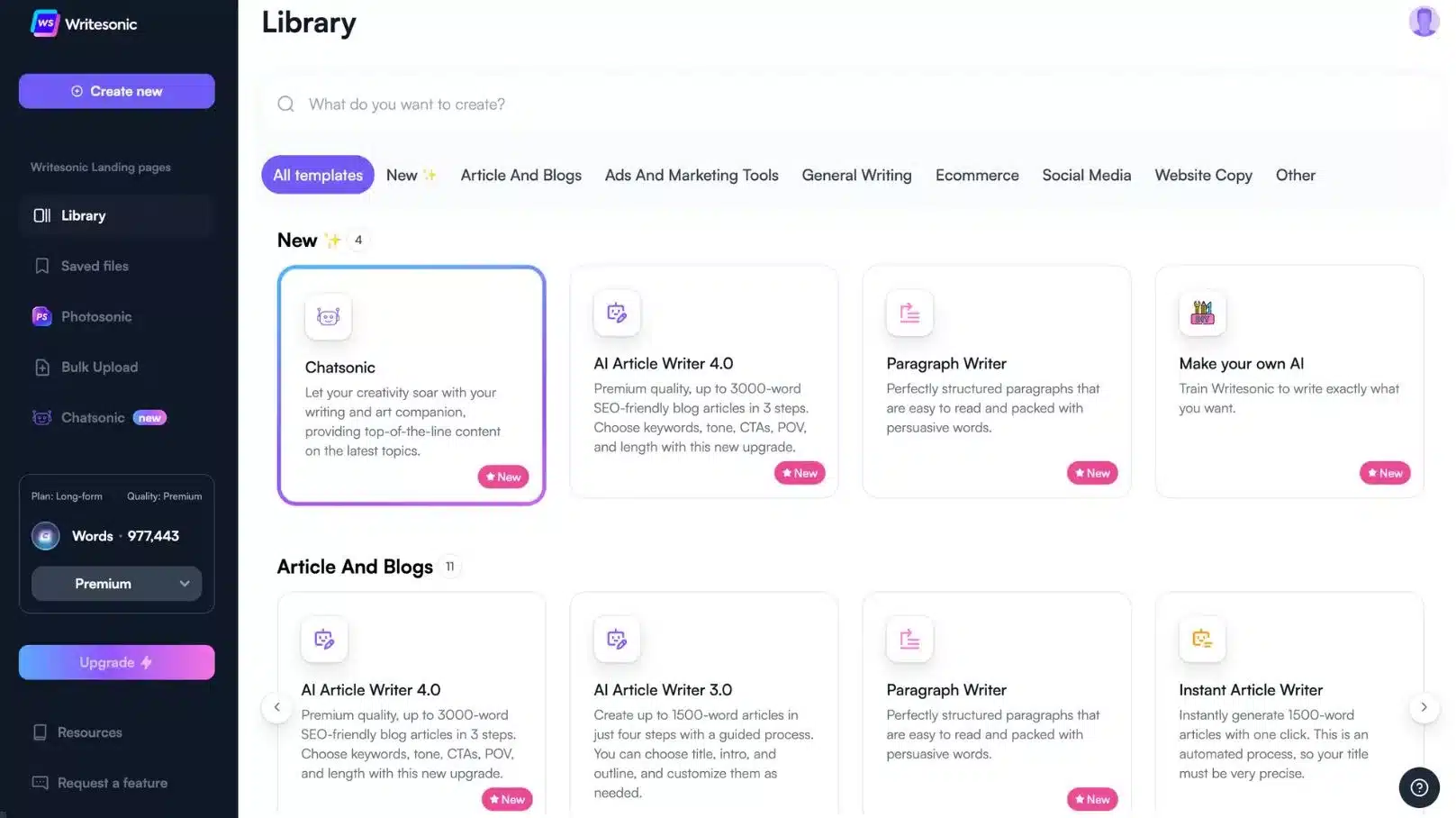
So how good is the writing? For long-form SEO drafts, Writesonic is genuinely strong. The Article Writer produces structured, readable content that follows a logical outline, incorporates your target keywords naturally, and gives you a solid first draft far faster than writing from scratch. On the highest-quality model tier, coherence and factual grounding improve noticeably over the faster, cheaper tiers.
That said, the output is a starting point, not a finished product. Like every AI writer, Writesonic can produce passages that read as generic, repeat themselves, or state something with more confidence than the facts support. You will want to fact-check claims, tighten the prose, and inject the specifics and point of view that only a human (or your proprietary data) can provide. Teams that treat the draft as raw material and edit it well get excellent value; teams that publish unedited output get mediocre, forgettable content — and that is true of every tool in this category, not just Writesonic.
On pure value, the bundle is the argument. If you would otherwise pay for a writer, an SEO tool, and an AI-visibility tracker separately, consolidating them into one Writesonic subscription can be a clear win. If you only need one of those jobs done, a more specialized (or cheaper) tool may serve you better.
Who should use it — and who should not
Writesonic is a strong fit if you are a content marketer or SEO professional publishing regularly and you want writing, optimization, and AI-search tracking in one place. It suits agencies that manage multiple clients and want white-label reporting, and it suits growth teams that need to produce a lot of on-brand-enough content quickly. If you are curious about AI search visibility and want to get ahead of competitors on GEO, Writesonic is one of the few tools that treats that as a first-class feature.
It is a weaker fit if your absolute priority is pixel-perfect brand voice — Jasper still edges it there. It is also not the pick if you need a genuinely free tool forever, in which case Copy.ai’s free plan is more appropriate. And if you only ever write short social captions or product blurbs, you may be paying for long-form and SEO machinery you will never touch.
Not sure which camp you fall into? The trial settles it fast. Try Writesonic against your real workload and you will know within a week.
Honest limits
No tool is perfect, and Writesonic has some real rough edges worth naming plainly. The most common complaint is pricing instability — the plans have been reshuffled so many times that it is hard to compare year over year, and features occasionally move between tiers. Budget with that unpredictability in mind.
Brand voice, while improved, still does not match the nuance of the category leaders, so highly voice-sensitive brands will do more manual polishing. Output consistency can wobble between generations, and some users report that customer support responsiveness is not always as fast as they would like. Finally, the “all-in-one” framing oversells the bundle a little: Chatsonic and Botsonic are effectively their own products with their own costs, so do not assume everything is included in one flat fee. None of these are dealbreakers for most teams, but you should go in with clear eyes.
Writesonic discount codes & deals
Writesonic’s best standing offer is not a coupon code — it is the annual billing discount, which typically knocks a substantial percentage off the monthly rate when you pay yearly. Combine that with a free trial to validate the tool before you lock in, and you are getting close to the best available deal without hunting for sketchy codes that rarely work.
Rather than chase expired promo codes around the web, use our link to reach the current plans and any live offers directly. Try Writesonic here, start the free trial, and pick the annual plan only once you are confident it fits — that combination is where the real savings are.
Frequently asked questions
Is Writesonic free?
There is no permanent free plan, but Writesonic offers a time-limited free trial so you can test the writing and SEO features before paying. Paid plans then scale up by article and generation limits.
What is the difference between Writesonic, Chatsonic, and Botsonic?
Writesonic is the writing and SEO platform, Chatsonic is a ChatGPT-style conversational assistant with real-time web access, and Botsonic is a no-code builder for custom support chatbots trained on your own content. Chatsonic and Botsonic are separate products with their own pricing.
Does Writesonic help with SEO?
Yes. It includes on-page SEO scoring, keyword integration, site audits, and integrations with Google Search Console and Analytics. Its newer AI search visibility (GEO) module also tracks whether AI engines mention your brand and recommends fixes.
Which AI models does Writesonic use?
Writesonic offers multiple quality tiers backed by different large language models, including GPT-class and Claude-class options, so you can trade speed and cost against output quality depending on the task.
Is the content good enough to publish as-is?
Treat it as a strong first draft rather than a finished piece. The output is coherent and well-structured, but you should fact-check claims and edit for voice and specificity before publishing — the same caveat applies to every AI writing tool.
How does Writesonic compare to Jasper and Copy.ai?
Jasper wins on brand voice and polish, Copy.ai wins on a free-forever plan and short-form copy, and Writesonic wins on bundling long-form SEO writing with AI-search visibility tracking in one subscription.
Can I integrate Writesonic with my own tools?
Yes. It offers a developer API, an MCP integration, and a WordPress connection, plus integrations with Google’s analytics and search tools, so teams can wire it into existing workflows.
How to get great results from any AI writing tool
Whether you land on Writesonic or a competitor, the tool is only half the equation — how you use it determines the quality you get out. A few habits separate people who get real value from AI writers from people who quietly cancel after a month.
Start with a specific brief, not a vague prompt. “Write about email marketing” produces bland filler. Give the tool your target keyword, the audience, the angle, the key points you want covered, and the tone. The more direction you supply, the less generic the output.
Feed it your own facts. AI models are excellent at structure and phrasing but weak at proprietary specifics. Paste in your data, your examples, your customer quotes, and your unique point of view. That is what turns a competent-but-forgettable draft into something only your brand could have written.
Always fact-check. Any AI writer can state something inaccurate with total confidence. Verify statistics, names, dates, and claims before publishing. Real-time-data features reduce the risk but do not remove your responsibility to check.
Edit for voice and rhythm. Read the draft aloud. Cut the repetition, vary the sentence length, and rewrite anything that sounds like a template. This is where brand voice actually happens — in the edit, not the generation.
Use the tool for leverage, not replacement. The best results come from treating AI as a fast first-drafter and research assistant while you supply judgment, expertise, and editorial taste. Teams that keep a human firmly in the loop consistently outperform those that publish raw output.
Do those five things and almost any capable AI writer will earn its keep. Writesonic gives you the added benefit of tying that content directly to SEO and AI-search visibility — so if that combination fits your goals, try Writesonic and put it to work on your next piece.



