
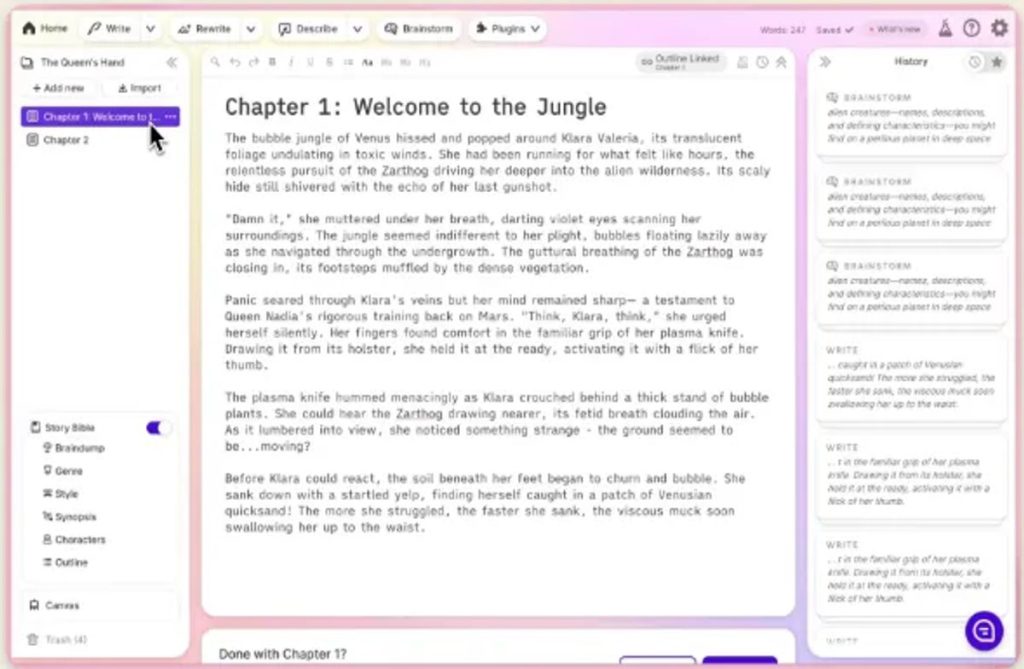
Sudowrite is the AI tool built by fiction writers, for fiction writers — and it shows. While general chatbots write serviceable prose, Sudowrite runs on Muse, a proprietary model fine-tuned on published novels, and it understands things ChatGPT does not: scene blocking, dialogue rhythm, comic timing, and how a chapter should breathe. One reviewer tested it against ChatGPT across 70,000 words and the difference was visible.
Its Story Engine takes you from premise to structured beats to scene-by-scene prose, while the Story Bible keeps characters, world and voice consistent across an entire novel. We tested whether the specialist really beats the generalists — and who should pay for it.
Our verdict: Sudowrite is the best AI writing partner for fiction, full stop — Muse prose quality and the Story Bible continuity system justify the price for serious novelists, though the credit model and fiction-only focus limit its audience. Score: 8.5 / 10.
→ Try Sudowrite — see current pricing
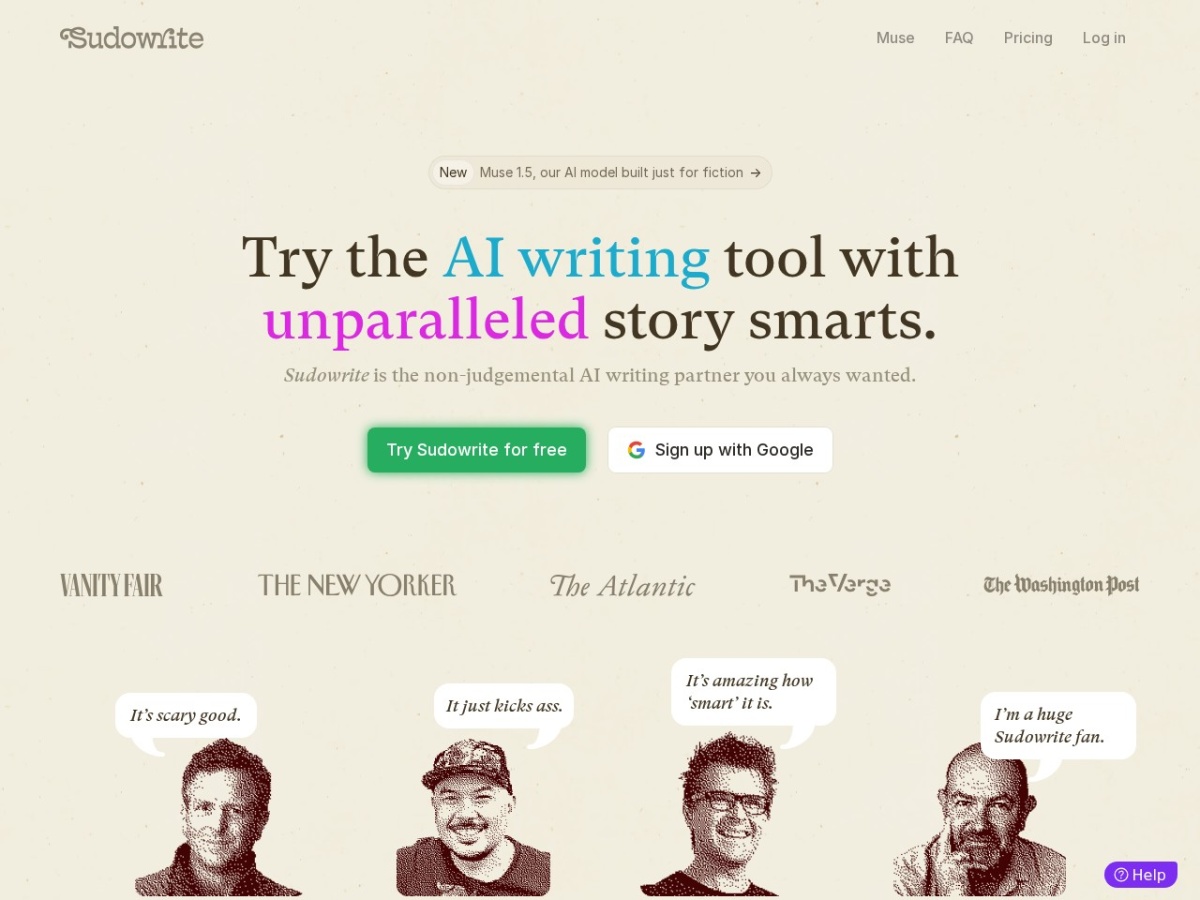
What is Sudowrite and who is it for
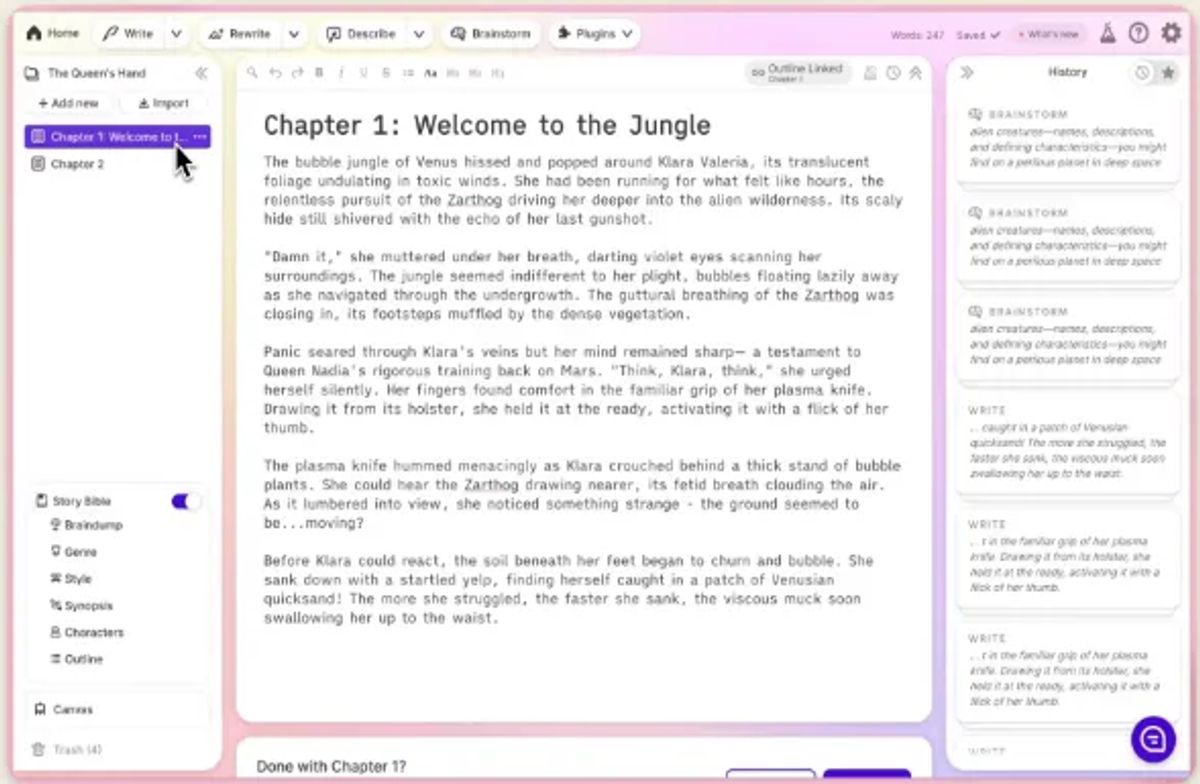
Sudowrite is a browser-based writing studio for fiction. Instead of a chat box, you get a manuscript editor surrounded by craft tools: Write (continue the scene in your voice), Describe (expand a moment with sensory detail), Rewrite (style variations), Brainstorm, and the flagship Story Engine for full-novel drafting. Everything reads your Story Bible first, so output stays consistent with your world.
It is for novelists, serialized-fiction authors, fan-fiction writers and genre authors drafting at volume — anyone whose bottleneck is producing quality prose fast while keeping continuity across 50,000+ words.
It is not for marketers, bloggers or non-fiction — there are no such templates, and general tools serve those jobs better. This is a specialist instrument.
Sudowrite pricing and credits
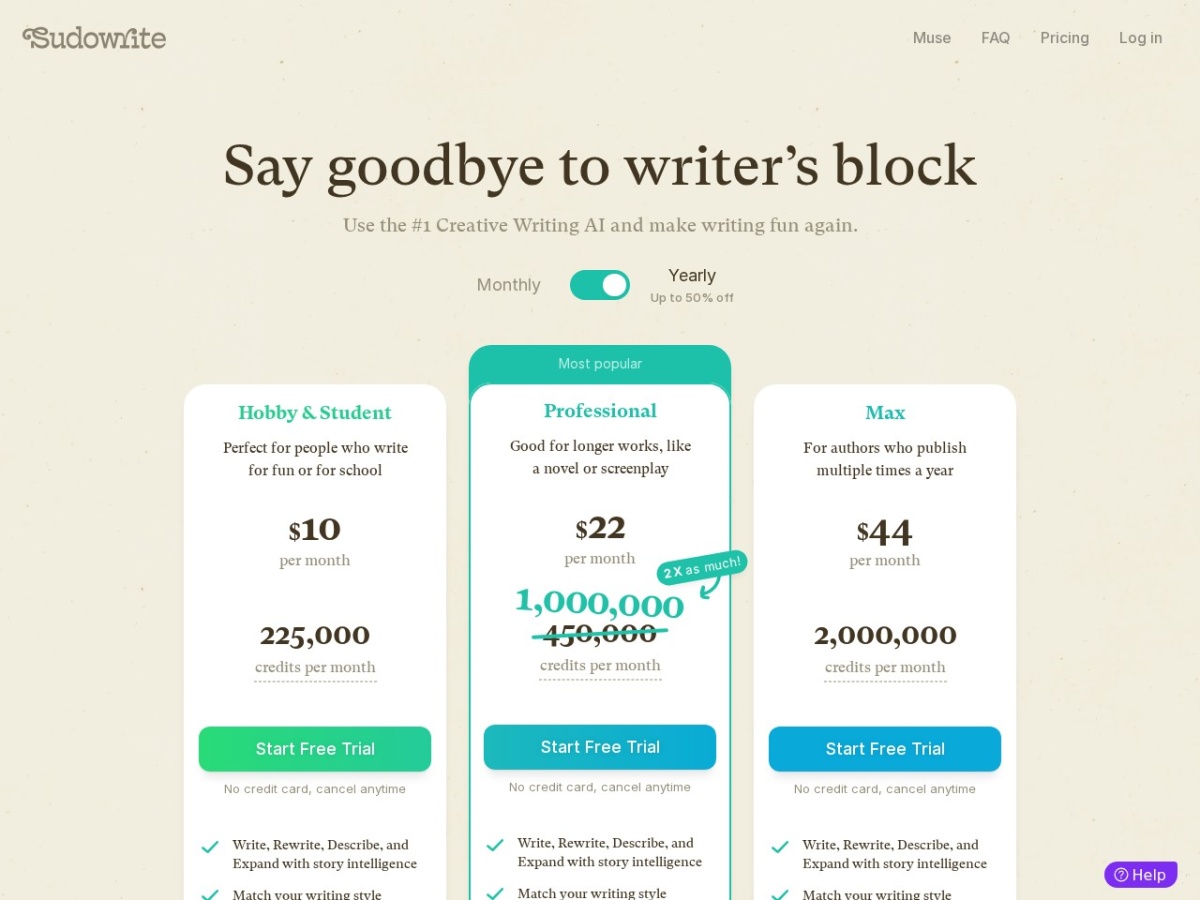
Plans run $10–$44/month on annual billing ($19–$59 monthly): Hobby/Student tiers around 225k credits, Professional at ~$22/month annual with 1M credits, and Max with 2M credits and 12-month rollover. Crucially, every tier has identical features — you only buy more generation capacity.
Credits meter AI output; drafting a full novel comfortably fits Professional for most writers, and Max suits high-volume serial authors. There is a trial, but no ongoing free plan once trial credits are spent.
| Tier | Annual price | Credits/mo |
|---|---|---|
| Hobby/Student | ~$10/mo | 225k |
| Professional | ~$22/mo | 1M |
| Max | ~$44/mo | 2M + rollover |
Muse: the fiction-tuned model
Muse (now 1.5) is the differentiator. Fine-tuned on novels and short stories rather than the whole internet, it writes prose that feels authored: scenes stay blocked coherently, dialogue lands with rhythm, humour times correctly, and description knows when to linger. Against general models the gap shows most in longer passages, where ChatGPT drifts generic while Muse holds voice.
You can still pick other frontier models per tool when you want a different flavour — but Muse is why people stay.
Story Engine and Story Bible
Story Engine is the guided path from idea to manuscript: feed it premise, characters, setting and tone; it proposes a structured beat outline; approve or edit; then it drafts prose scene by scene following your beats. You steer at every step — it is co-writing, not vending.
The Story Bible is the quiet hero: a structured document defining world, characters, plot threads and voice that the AI consults before generating anything. That is how chapter 27 remembers what chapter 3 established — the continuity problem that breaks general chatbots on long work.
Ease of use
The interface is a pleasant manuscript editor with tools a click away — no prompt engineering required, since the tools encode the prompts. New writers can lean on Story Engine end-to-end; experienced authors cherry-pick Describe and Rewrite mid-draft. The learning curve is genre-writer friendly.
Limitations, honestly
Sudowrite exports plain text — no PDF, EPUB or DOCX export, no cover designer, no audiobook pipeline, no non-fiction templates. It drafts; you publish elsewhere. And AI prose still needs your revision pass: it is a fast first-draft partner, not a replacement for craft.
Sudowrite vs the alternatives
Against ChatGPT/Claude: better sustained fiction prose and continuity, worse at everything non-fiction. Against NovelCrafter (the organiser-first rival): Sudowrite wins on generation quality, NovelCrafter on codex flexibility and bring-your-own-model pricing. Many serious authors run Sudowrite for prose inside a broader toolkit.
| Tool | Best for | Edge |
|---|---|---|
| Sudowrite | Fiction prose quality | Muse + Story Bible |
| NovelCrafter | Organisation + BYO models | Flexibility |
| ChatGPT | General writing | Breadth |
| Jasper | Marketing copy | Brand tools |
Pros and cons
Pros: Muse writes the best AI fiction prose we have tested; Story Bible keeps novels consistent; Story Engine guides premise-to-draft; craft tools (Describe, Rewrite) genuinely help; same features on every tier; credits roll over on Max; active author community.
Cons: Fiction-only; no EPUB/DOCX export or publishing tools; no permanent free plan; credit anxiety for heavy drafters on small tiers; output still needs human revision.
Who should use Sudowrite — and who should not
Use it if you write novels or serials and want a drafting partner that holds your voice and your world across tens of thousands of words — Professional pays for itself in drafting speed.
Look elsewhere if you write non-fiction or marketing (Jasper, ChatGPT), want manuscript organisation first (NovelCrafter), or need publishing-format exports built in.
Frequently asked questions
How much does Sudowrite cost?
$10–$44/month on annual billing depending on credit tier; Professional (~$22/month, 1M credits) fits most novelists. Features are identical across tiers.
What is Muse?
Sudowrite proprietary LLM fine-tuned on published fiction — the reason its prose handles scene blocking, dialogue rhythm and pacing better than general models.
What is the Story Bible?
A structured reference for your world, characters, plot and voice that the AI reads before generating, keeping long manuscripts consistent.
Can Sudowrite write a whole novel?
Story Engine can draft one scene-by-scene from your beats — but the good results come from steering it and revising. Think co-writer, not vending machine.
Is there a free plan?
A trial with credits, but no ongoing free tier once they are used.
The bottom line
Sudowrite is what happens when AI is built for one craft and takes it seriously. Muse prose, Story Engine structure and Story Bible continuity make it the clear choice for fiction writers drafting at length — a specialist that beats the generalists at its own game. Bring your revision pen and your own publishing pipeline, and it is the best co-writer money buys. Score: 8.5 / 10.



