
If you have spent any time in budget hosting forums, you have seen the name Contabo come up again and again, usually in the same breath as a slightly disbelieving comment about how much RAM you get for the money. The German provider has built its reputation on a single, stubborn idea: give people far more compute, memory, and storage per euro than anyone else, and keep the pricing honest by not jacking up the rate at renewal. For self-hosters, indie developers, and small teams running their own infrastructure, that pitch is genuinely compelling.
But “cheap and generous” is not the whole story. Contabo has also earned a reputation for uneven support response times, performance that can vary with node load, and provisioning that is not always instant. This review walks through what Contabo actually sells, what the pricing looks like, where it shines, and where you should temper your expectations before you buy.
AnalyzeBench Score: 8.4 / 10
Best for: Developers, self-hosters, and small teams who want the maximum amount of RAM, vCPU, and storage per euro and are comfortable managing an unmanaged Linux server themselves.
What we loved:
- Industry-leading resource allocations for the price, especially RAM and storage.
- No price hike at renewal, which is rare in hosting.
- Unlimited traffic on every VPS, VDS, and dedicated plan.
- Free DDoS protection included on all servers.
- Eleven global data-center regions, including choices in the US, Europe, and Asia-Pacific.
- A real product ladder from cheap shared-core VPS up to bare-metal AMD EPYC servers.
Watch out for:
- Support response times can be slow and are inconsistent depending on the ticket.
- Network throughput on entry plans is capped (the cheapest VPS ships with a 200 Mbit/s port).
- Disk and network performance can vary with node load; it is shared infrastructure.
- Some products and shorter billing cycles carry a one-time setup fee.
- Provisioning is usually fast but is not always instant for VPS orders.
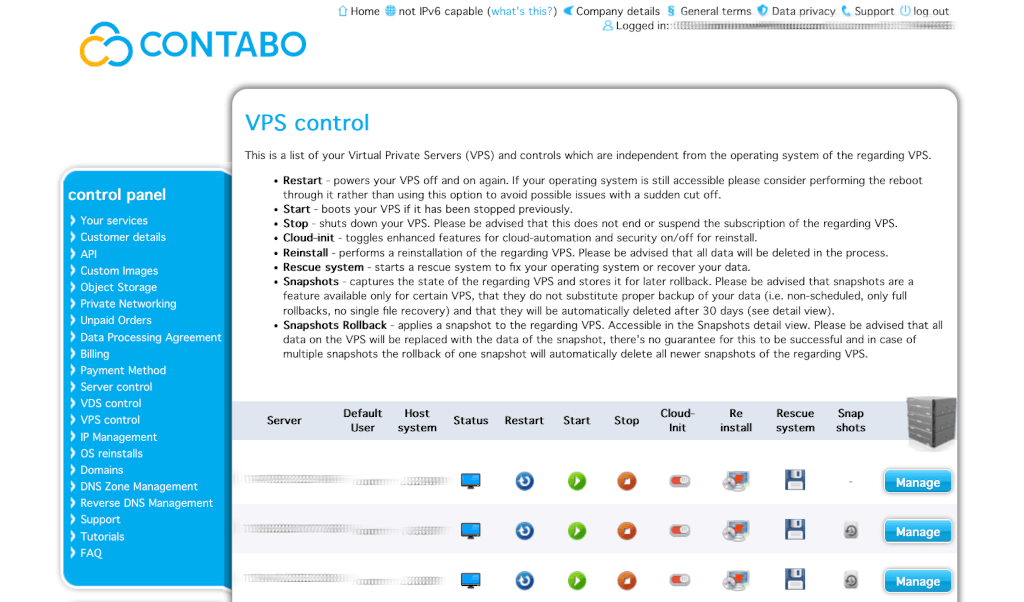
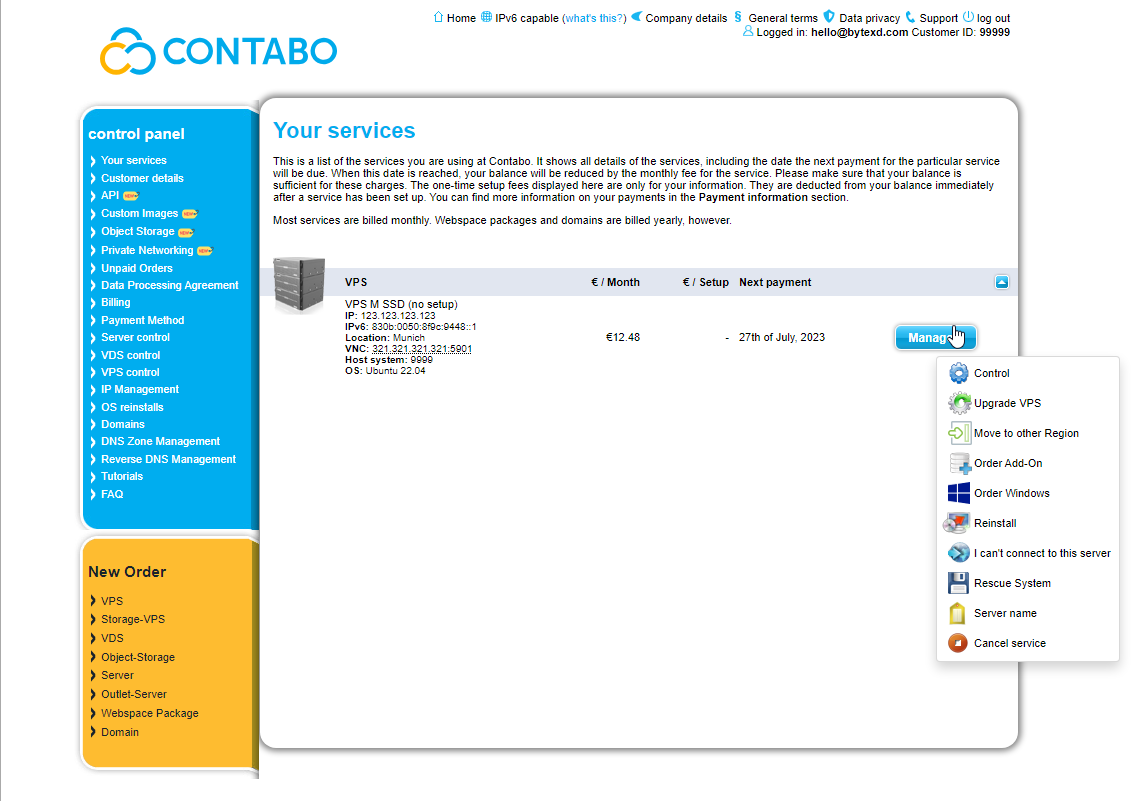
- The control panel is functional but feels dated next to the big cloud dashboards.
What makes Contabo different
Contabo is a German hosting company that has been around since the mid-2000s, and its whole identity is built around undercutting the market on price-to-resource ratio. Where a mainstream cloud provider might charge you a meaningful monthly sum for 2 GB of RAM, Contabo’s entry Cloud VPS gives you 8 GB of RAM and four vCPU cores for €4.50 a month. That is not a typo, and it is the single reason the brand has such a loyal following among people who run game servers, self-hosted apps, home-lab replacements, and side projects.
The trade-off that makes those numbers possible is oversubscribed, shared-core virtual machines on the low end. You get a genuinely large slice of resources, but you share the underlying hardware with other tenants, so expect a burst ceiling rather than guaranteed dedicated performance at the cheapest tiers. Contabo addresses this with a separate Virtual Dedicated Server (VDS) line for anyone who needs pinned physical cores.
Two other things set the company apart. First, it does not raise your price at renewal, so the rate you sign up at is the rate you keep. In an industry built on low teaser pricing that doubles in year two, that is a meaningful differentiator. Second, every plan includes unlimited traffic and free DDoS protection, which removes two of the classic “gotcha” line items that inflate bills elsewhere. If you want to see current configurations, you can Check Contabo deals before reading on.
The core products
Contabo’s catalog is broader than most people realise. It is not just a one-trick VPS shop; it is a small, self-service infrastructure provider with a coherent ladder of products.
- Cloud VPS — the flagship. Shared-core virtual servers on NVMe (or larger SSD) storage, tuned for the best raw resources per euro. This is where most customers start.
- Storage VPS — the same VPS idea but weighted toward capacity, with terabyte-class SSD storage for backups, media libraries, and data-heavy workloads.
- Cloud VDS (Virtual Dedicated Servers) — virtual machines with dedicated physical AMD EPYC cores, so CPU performance is consistent rather than shared. This is the answer to the main criticism of the cheap VPS tiers.
- Dedicated Servers — single-tenant bare metal with modern AMD Ryzen and EPYC (Genoa, Turin) processors, for people who want the whole machine.
- Object Storage — S3-compatible object storage sold in simple capacity bundles, useful for backups, static assets, and application data.
- Block Storage — additional volumes you can attach to a VPS or VDS to expand capacity independently of the base plan.
On top of the compute, Contabo runs eleven data-center regions spread across Europe, the Americas, and Asia-Pacific, which matters if latency to your users is a factor. Location availability and any location surcharge vary by product, so check the order form for the region you want.
Plans & pricing
All prices below are the headline monthly rates from Contabo’s own pricing page in euros. Your actual rate depends on the billing cycle you choose (monthly through twelve months), your region, and any storage upgrades, and some products or shorter terms add a one-time setup fee. Treat these as the starting reference, not a quote.
Cloud VPS
The VPS line is the reason most people are here. Even the base plan is generous, and the resource jumps as you climb the ladder are large.
| Plan | vCPU | RAM | Storage | Port | From |
|---|---|---|---|---|---|
| Cloud VPS 10 | 4 cores | 8 GB | 75 GB NVMe / 150 GB SSD | 200 Mbit/s | €4.50/mo |
| Cloud VPS 20 | 6 cores | 12 GB | 100 GB NVMe | 300 Mbit/s | €7.00/mo |
| Cloud VPS 30 | 8 cores | 24 GB | 200 GB NVMe | 600 Mbit/s | €14.00/mo |
| Cloud VPS 40 | 12 cores | 48 GB | 250 GB NVMe | 800 Mbit/s | €25.00/mo |
| Cloud VPS 50 | 16 cores | 64 GB | 300 GB NVMe | 1 Gbit/s | €37.00/mo |
| Cloud VPS 60 | 18 cores | 96 GB | 350 GB NVMe | 1 Gbit/s | €49.00/mo |
There is also a Storage VPS variant of this line, which trades some CPU and network for much larger SSD capacity, starting around €4.50/mo for a 300 GB plan and scaling to well over a terabyte of storage for roughly the price of a mid-tier Cloud VPS. It is the natural home for backup targets and media servers.
VDS (Virtual Dedicated Servers)
If the shared-core caveat on the VPS line worries you, this is the fix. VDS plans pin dedicated physical AMD EPYC cores to your machine, so you get consistent CPU performance rather than a burst ceiling. Pricing is higher than the VPS line but still undercuts most dedicated-CPU cloud offerings.
| Plan | Physical Cores | RAM | Storage | From |
|---|---|---|---|---|
| Cloud VDS S | 3 cores (AMD EPYC) | 24 GB | 180 GB NVMe | around €34/mo |
| Cloud VDS M | 4 cores | 32 GB | 240 GB NVMe | around €45/mo |
| Cloud VDS L | 6 cores | 48 GB | 360 GB NVMe | around €64/mo |
| Cloud VDS XL | 8 cores | 64 GB | 480 GB NVMe | around €82/mo |
| Cloud VDS XXL | 12 cores | 96 GB | 720 GB NVMe | around €119/mo |
The “around” prices reflect a promotional discount that Contabo was running at the time of writing; check the live page for the current rate.
Dedicated Servers
At the top of the ladder are single-tenant bare-metal machines with modern AMD silicon. These are for people who want the entire box, full hardware control, and no noisy neighbours at all.
| Server | CPU | RAM | Storage | From |
|---|---|---|---|---|
| AMD Ryzen 12 Cores | AMD Ryzen 9 7900 (12c) | 64 GB (up to 128) | 1 TB NVMe | €96/mo |
| AMD Genoa 24 Cores | AMD EPYC 9224 (24c) | 128 GB ECC (up to 768) | 2 × 1 TB SSD | €169/mo |
| AMD Turin 32 Cores | AMD EPYC 9355P (32c) | 128 GB (up to 768) | 2 × 1 TB NVMe | around €249/mo |
| AMD Turin 64 Cores | AMD EPYC 9555P (64c) | 192 GB (up to 1152) | 2 × 1 TB NVMe | €666/mo |
Object Storage is priced separately and simply: capacity bundles run from roughly €2.49/mo for 250 GB up to about €99.60/mo for 10 TB in the European region, with the option to customise the size. You can compare the full, current line-up any time and Check Contabo deals.
How to choose the right plan
The catalog looks big, but the decision tree is short. Start with the workload, not the price.
- Hobby projects, a personal site, a small app, a game server for friends: a Cloud VPS 10 or 20 is almost certainly enough, and the amount of RAM will feel luxurious compared with what you would get elsewhere at that price.
- Self-hosting a stack of services (Nextcloud, media server, home-lab replacement, a couple of Docker containers): jump to a Cloud VPS 30 or 40 for the extra RAM headroom, or a Storage VPS if your main constraint is disk space rather than CPU.
- Production workloads where consistent CPU matters — a busy database, CI runners, video encoding, or anything latency-sensitive — choose a VDS. The dedicated physical cores are the difference between “usually fine” and “predictable”.
- Heavy, sustained, single-tenant workloads or compliance reasons to avoid shared hardware: go bare metal with a Dedicated Server.
Two practical tips: pick your region based on where your users are, since latency is the one thing you cannot fix later without migrating; and although longer billing cycles lower the monthly rate, do not overcommit to a twelve-month term until you have run your workload for a few weeks.
Watch: Contabo in action
If you would rather see the setup and performance discussed than read specs, this walkthrough covers a real-world look at a Contabo VPS.
Contabo vs alternatives
Contabo does not exist in a vacuum. The two names that come up most often in the same conversation are Hetzner, another German budget favourite, and Vultr, a globally distributed cloud provider. Here is how they compare on the things that actually drive a decision.
| Factor | Contabo | Hetzner | Vultr |
|---|---|---|---|
| Core pitch | Maximum RAM/storage per euro | Strong price-to-performance, EU-centric | Global cloud, fast provisioning, API-first |
| Resource generosity | Highest at the price point | Very good | Moderate; you pay for the cloud polish |
| Global regions | Eleven, incl. US and Asia-Pacific | Fewer, mostly EU plus limited US | Extensive worldwide footprint |
| Performance consistency | Varies on shared VPS; VDS fixes it | Consistent, well-regarded | Consistent, predictable |
| Support & tooling | Functional panel, slower support | Solid panel and support | Polished dashboard, good API, fast support |
| Best for | Max resources on a budget | Balanced EU hosting | Cloud-native, multi-region apps |
The short version: if raw resources per euro is your only metric, Contabo usually wins. If you want a more polished cloud experience, faster support, and instant, API-driven provisioning, Vultr is the more refined product. Hetzner sits in between, with a strong reputation for reliability but a smaller global footprint and, in some regions, tighter availability.
Performance, support & value
In most day-to-day use, Contabo performs well above what its price suggests. Its NVMe storage is genuinely fast, independent reviews cite low disk latency and solid memory throughput, and the company advertises a strong uptime record. For the vast majority of workloads — web apps, self-hosted services, game servers, small databases — the experience is smooth and the value is hard to argue with.
The honest caveats live in two places. The first is performance variability. Because the standard VPS tiers run on shared, oversubscribed hardware, your disk and network throughput can dip when a node is busy, and a few users report performance changes after maintenance events or migrations. This is the nature of budget shared infrastructure, and it is exactly why the VDS line exists. If consistency is critical, pay for pinned cores rather than hoping the shared node stays quiet.
The second caveat is support. Contabo’s ticket support is competent but not fast; response times are the most common complaint in user reviews, and there is no premium hand-holding at these prices. This is an unmanaged product. You are expected to administer your own server, and the support team is there for infrastructure issues, not to configure your application stack. If that matches your skill level, the value is outstanding. If you need managed hosting with someone on call, this is not that.
Netting it out: for a technically comfortable user, the value is exceptional. You are trading a bit of polish and support speed for a lot of hardware. That is a trade most self-hosters happily make, and you can Check Contabo deals to see how the current numbers stack up against what you are paying now.
Who should use it — and who should not
Contabo is a fantastic fit for a specific kind of customer and a poor fit for another, and being clear about which one you are will save you frustration.
You should use Contabo if you are a developer, sysadmin, or technical hobbyist who is comfortable on the Linux command line, wants the most RAM, cores, and storage you can get for the money, and is happy to manage your own server. Self-hosters, home-lab enthusiasts, game-server operators, indie SaaS builders on a tight budget, and anyone running batch or storage-heavy workloads will feel like they are getting away with something.
You should look elsewhere if you need managed hosting, guaranteed dedicated performance at the cheapest tier, a polished point-and-click experience with fast support, or an API-first cloud for spinning resources up and down constantly. In those cases a managed host or a mainstream cloud provider will serve you better, even at a higher price. Buying Contabo and expecting managed-host support is the most common way people end up disappointed.
Honest limits
To keep this review straight, here are the limitations worth internalising before you buy, with no spin.
- Shared-core variability. Standard VPS plans are oversubscribed. Performance is usually great but not guaranteed; upgrade to VDS if you need consistency.
- Support latency. Tickets can take a while, and there is no premium fast-track. Plan to solve most things yourself.
- Setup fees on some options. Certain products and shorter billing cycles add a one-time setup charge, so the first invoice can be higher than the monthly rate implies.
- Entry network caps. The cheapest VPS ships with a 200 Mbit/s port; higher tiers scale up toward 1 Gbit/s. Traffic is unlimited, but throughput is tiered.
- Provisioning is not always instant. VPS orders usually deploy quickly, but occasionally take longer than the “minutes” you might expect from a hyperscaler.
- Dated control panel. Functional and complete, but it is not the slick dashboard experience of a modern cloud console.
None of these are dealbreakers for the target audience. They are simply the cost of getting this much hardware this cheaply, and knowing them upfront is the difference between a happy customer and a surprised one.
Contabo deals
Contabo’s pricing is already its main selling point, so there is rarely a need for a dramatic coupon to make the numbers work — the base rates are the deal. What does move the needle is choosing a longer billing cycle, which lowers the effective monthly rate, and picking the right tier so you are not overpaying for headroom you never use. Promotional discounts do appear on the VDS and dedicated lines from time to time, as we saw on the pricing page during this review.
Because configurations, regional availability, and any active promotions change, the reliable move is to look at the live line-up before you commit. You can Check Contabo deals to see current pricing, the regions available for the plan you want, and whether any setup fee applies to your chosen billing cycle.
Frequently asked questions
Is Contabo actually cheap, or does the price jump at renewal?
It is genuinely cheap, and one of Contabo’s defining features is that it does not raise your price at renewal. The rate you sign up at is the rate you keep, which is unusual in an industry built on low first-year teaser pricing.
Are there setup fees?
Some products and shorter billing cycles carry a one-time setup fee, so your first invoice can be higher than the monthly rate suggests. Longer billing terms often reduce or waive it. Always check the order form for the exact plan and cycle you choose.
Is Contabo VPS good enough for production?
For many production workloads, yes — web apps, small-to-mid databases, and self-hosted services run well. But because standard VPS tiers use shared hardware, choose a VDS with dedicated physical cores if consistent CPU performance is business-critical.
Where are Contabo’s data centers?
Contabo operates eleven regions spread across Europe, the Americas, and Asia-Pacific. Pick the location closest to your users to minimise latency, since that is the one thing you cannot easily change after deployment.
Is Contabo managed or unmanaged?
Unmanaged. You administer your own server, and support handles infrastructure rather than your application stack. If you are comfortable with Linux, that is fine; if you need managed hosting, look elsewhere.
How is Contabo’s customer support?
Competent but not fast. Slow response times are the most common complaint in user reviews. It is best suited to people who can troubleshoot independently and only need support for genuine infrastructure issues.
Does Contabo include DDoS protection and unlimited traffic?
Yes. Every VPS, VDS, and dedicated plan includes free DDoS protection and unlimited traffic, so those common “extra” line items are not something you have to budget for separately.
How to read VPS specs like a pro
Because Contabo throws big numbers at you, it is worth knowing how to read a VPS spec sheet so you can compare providers fairly rather than being wowed by the largest figure.
- vCPU is not a physical core. On shared VPS plans a vCPU is a slice of a physical core shared with other tenants. Four vCPUs on a budget VPS will not match four dedicated physical cores. When CPU consistency matters, look for the words “dedicated” or “physical” cores, as on Contabo’s VDS line.
- RAM is the spec you will feel most. Running out of memory is what makes a server crawl or crash, so generous RAM — Contabo’s strong suit — genuinely improves day-to-day experience for databases, containers, and multiple services.
- Storage type matters as much as size. NVMe is faster than SSD, which is faster than spinning disk. A smaller NVMe volume often outperforms a larger, slower one for anything I/O-heavy like a database.
- Port speed versus traffic are two different things. “Unlimited traffic” means no cap on how much data you move; the port speed (200 Mbit/s up to 1 Gbit/s) is how fast you can move it at any instant. A busy download server cares about port speed; a low-traffic app does not.
- Shared versus dedicated is the real fork in the road. Almost every performance question about budget hosting comes back to this. Shared is cheaper and usually fine; dedicated costs more and is predictable. Match the choice to how much you care about consistency.
Read a spec sheet with those five points in mind and you will make a much better decision — not just with Contabo, but with any host. If Contabo’s mix of huge resources and honest, no-hike pricing fits your needs, take a moment to Check Contabo deals and match a plan to your workload.



