
ExpressVPN has spent well over a decade positioning itself as the premium option in a crowded VPN market, and in 2026 it is still one of the names most people reach for first. It is fast, polished, and backed by a long track record of independent security audits. It is also, unmistakably, one of the more expensive consumer VPNs you can buy. That tension — genuinely excellent engineering versus a price tag that asks you to pay for it — sits at the heart of this review. We spent time with the apps, dug through the audit history, compared pricing across terms, and weighed the ownership questions that follow the brand around. What follows is an honest look at where ExpressVPN earns its premium and where you might reasonably decide it does not.
A VPN is not a magic invisibility cloak. What ExpressVPN does well is encrypt your traffic, hide your real IP address from the sites you visit, and keep your internet provider from seeing what you are doing. What it cannot do is make you anonymous in an absolute sense or protect you from your own logged-in accounts and browser fingerprint. Keep that in mind and you will get an accurate picture of what your money buys.
AnalyzeBench Score: 8.7 / 10
Best for: Privacy-focused users who want a fast, reliable, heavily audited VPN with excellent apps across every platform and are willing to pay a premium for polish, streaming reliability, and strong customer support.
What we loved:
- The in-house Lightway protocol is genuinely fast and has been open-sourced and independently audited.
- RAM-only TrustedServer architecture means servers cannot write persistent logs to disk.
- An unusually long and public audit history — dozens of third-party assessments over the years.
- Servers in 105 countries and consistently reliable streaming and geo-unblocking.
- Apps are clean, beginner-friendly, and available on essentially every device, plus the Aircove router.
- 24/7 live chat support that actually resolves problems.
Watch out for:
- It is a premium-priced service, and the monthly plan in particular is expensive.
- Prices renew higher than the promotional first-term rate, so read the fine print.
- Ownership by Kape Technologies still gives some privacy purists pause (more on this below).
- The tiered plan structure (Basic, Advanced, Pro) means some extras are locked behind higher tiers.
What makes ExpressVPN different
Plenty of VPNs claim speed, security, and a no-logs policy. What separates ExpressVPN is the degree to which it has tried to prove those claims rather than simply assert them. The clearest example is TrustedServer, the company’s architecture that runs every VPN server entirely in RAM. Because nothing is written to a hard drive, each reboot wipes the machine clean, and there is no persistent storage where activity logs could accumulate even in principle. This is not unique to ExpressVPN anymore, but the company was among the first to deploy it at scale, and it remains a meaningful engineering commitment rather than marketing copy.
The second differentiator is Lightway, ExpressVPN’s own VPN protocol. Rather than relying solely on OpenVPN or WireGuard, the company built a lightweight protocol designed to connect quickly, stay stable when your network changes, and consume less battery on mobile. Lightway has been open-sourced on GitHub and put through multiple independent security audits, which matters: an open, audited protocol can be scrutinized by outside researchers rather than trusted on faith. It comes in UDP mode for the fastest general use, TCP mode for more reliable connections on unstable or restricted networks, and a newer Turbo mode that uses multiple connection lanes to squeeze out extra throughput.
The third piece is transparency around jurisdiction and audits. ExpressVPN is headquartered in the British Virgin Islands, a jurisdiction with no mandatory data-retention laws, and it has commissioned an unusually large number of third-party audits from firms including Cure53, PwC, KPMG, and others. In a real-world test of its no-logs claim, authorities in one country seized an ExpressVPN server years ago and reportedly found no usable user data on it. No audit is a permanent guarantee, but a long, repeated, public audit trail is about as good as consumer-grade assurance gets.
The core service
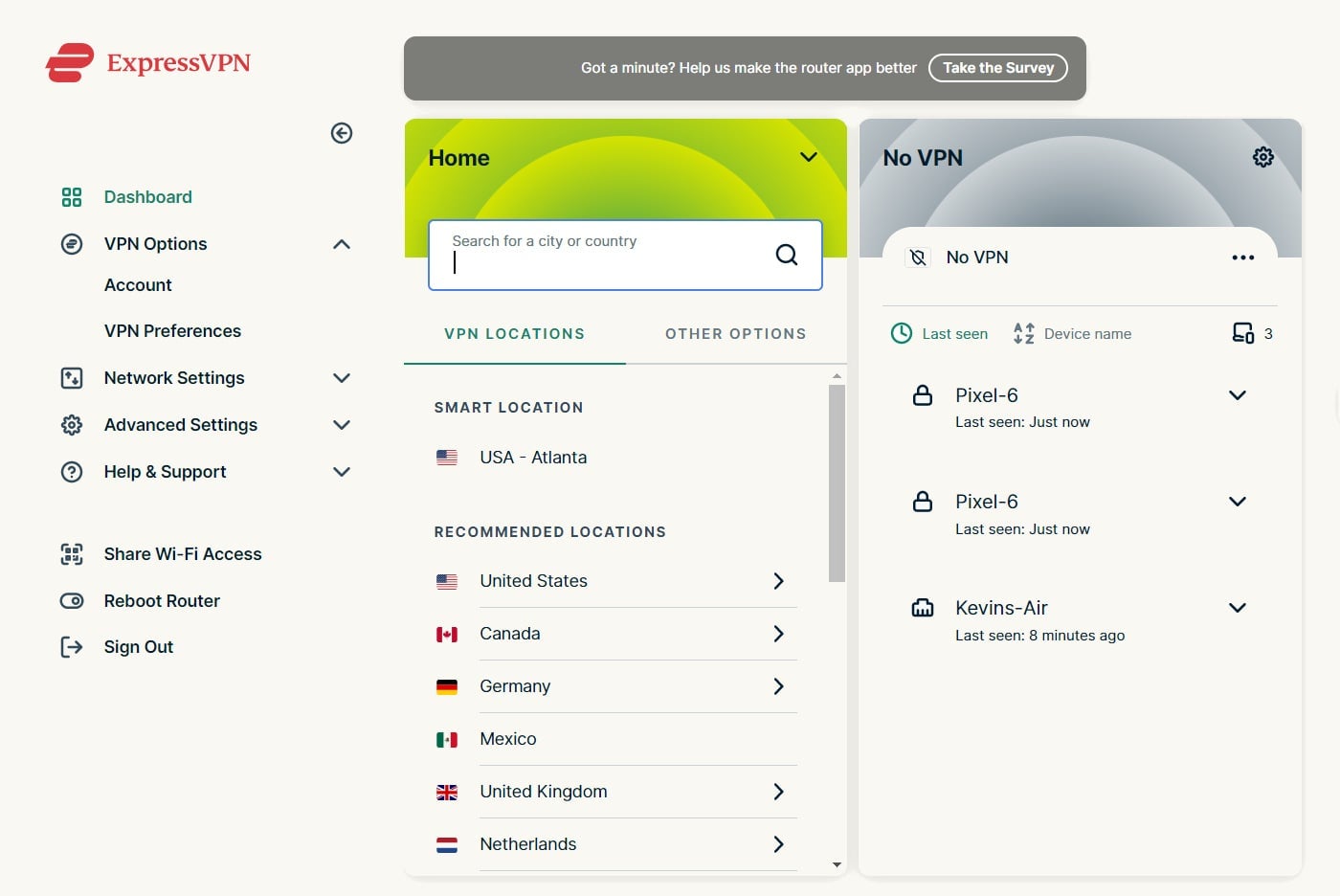
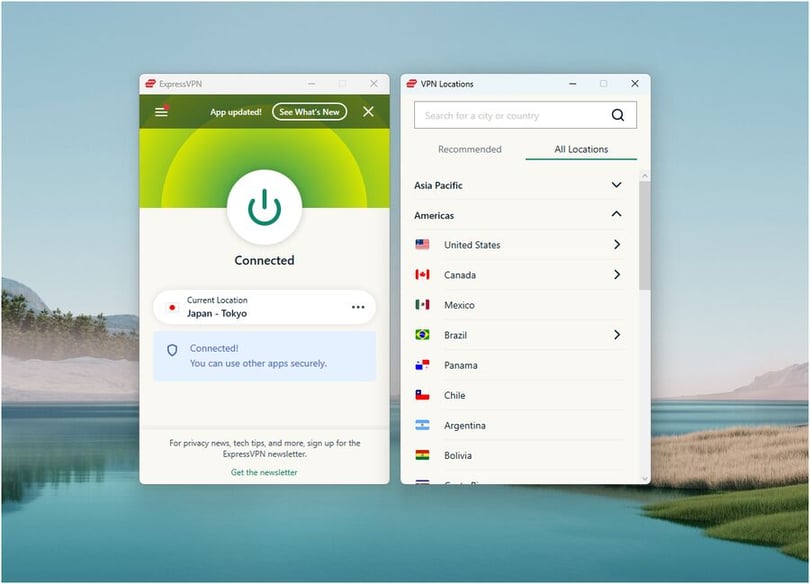
Day to day, ExpressVPN is one of the easiest VPNs to live with. The apps are consistent across Windows, macOS, Linux, iOS, Android, Apple TV, Fire TV, Android TV, and the major browsers. Connecting is a one-tap affair: open the app, hit the big button, and you are routed through your chosen location out of 105 countries. For people who do not want to think about protocols and ports, that simplicity is a real feature.
Under the hood you get the security essentials done properly. Network Lock is ExpressVPN’s kill switch, cutting your internet if the VPN connection drops so your real IP does not leak. Split tunneling lets you route some apps through the VPN while others use your normal connection. There is private, encrypted DNS handled on ExpressVPN’s own servers, plus Threat Manager and an ad blocker to cut down on trackers and unwanted content. Encryption is AES-256, the same standard trusted across the security industry.
Streaming is one of ExpressVPN’s strongest practical use cases. It reliably unblocks a wide range of international catalogs, and its MediaStreamer Smart DNS feature lets you get geo-unblocking on devices that do not natively support VPN apps, such as certain smart TVs and game consoles. For households, the Aircove line of routers ships with the VPN built in, protecting every device on the network at once — useful for gadgets that cannot run a VPN app themselves.
ExpressVPN has also broadened into a small suite of privacy products. Higher tiers bundle ExpressKeys, a password manager with client-side, zero-knowledge encryption, along with an encrypted email relay and, in some regions, identity-protection tools. Whether you value these depends on whether you already use standalone equivalents, but bundling them softens the premium price for people who would otherwise pay separately.
Plans & pricing
In 2026 ExpressVPN moved to a tiered structure — Basic, Advanced, and Pro — layered on top of the usual choice of billing term. The Basic plan covers the core VPN and supports up to 10 simultaneous devices; Advanced adds password management and other extras and raises the device count to 12; Pro sits at the top with the fullest bundle and up to 14 devices. Across all tiers, the longer the term you commit to, the lower the effective monthly cost, which is standard for the industry.
Monthly plan
The month-to-month option is the most flexible and, predictably, the most expensive per month — it starts around $12.99 per month for the entry tier. It makes sense only if you need a VPN for a short, defined period, such as a single trip, and want to cancel without a long commitment. For ongoing use it is poor value compared with the longer terms.
6-month plan
The six-month term sits in the middle: cheaper per month than paying monthly, but without the deepest discounts. It is a reasonable compromise if you want a meaningful commitment without locking in for a year or more. Exact pricing shifts with promotions, so check the current rate at checkout rather than relying on any figure quoted elsewhere.
12-month (and longer) plans
This is where ExpressVPN becomes competitive on price. The annual plan typically bundles several bonus months and brings the effective rate down substantially, and the two-year Basic plan has been advertised at roughly $2.49 per month during promotional periods with bonus months added on. That headline rate is a first-term promotional price; renewals are higher, so budget for the standard rate when your initial term ends. A 30-day money-back guarantee applies to most purchases, though promotional windows can carry exclusions — another reason to read the terms at checkout.
How to get the best deal
The single biggest lever is term length. If you will use a VPN regularly, the longest term you are comfortable committing to almost always delivers the lowest effective monthly price, and ExpressVPN frequently sweetens longer plans with bonus months. Avoid the monthly plan unless you have a specific short-term need.
Second, be clear-eyed about the tier you actually need. If you already use a password manager you trust, the Basic tier’s core VPN may be all you want, and there is no reason to pay for Advanced or Pro extras you will not touch. Conversely, if you were about to subscribe to a separate password manager anyway, the bundled higher tier can be better overall value than it first appears.
Third, remember the 30-day money-back guarantee is a genuine safety net for most standard purchases. It lets you try the service on your own devices and networks and get a refund if it does not meet your needs — just verify that your specific purchase is covered, since promotional periods can carry exclusions. Finally, plan around the renewal: the attractive introductory rate steps up when the term ends, so set a reminder before renewal so you can reassess rather than roll over automatically.
See current ExpressVPN pricing
Watch: ExpressVPN in action
If you prefer to see the apps and features demonstrated before committing, the video below walks through what ExpressVPN offers and how it performs in everyday use.
ExpressVPN vs alternatives
ExpressVPN does not exist in a vacuum. Its two most common rivals are NordVPN and Surfshark, and the right choice depends on what you prioritize. The table below gives a high-level comparison; the specifics of pricing and device limits change with promotions, so treat it as a directional guide rather than a live price sheet.
| Feature | ExpressVPN | NordVPN | Surfshark |
|---|---|---|---|
| In-house protocol | Lightway (open-sourced, audited) | NordLynx (WireGuard-based) | WireGuard-based |
| Server countries | 105 | 110+ | 100 |
| RAM-only servers | Yes (TrustedServer) | Yes | Yes |
| Simultaneous devices | 10–14 (by tier) | Around 10 | Unlimited |
| Independent audits | Extensive, repeated | Extensive | Multiple |
| Relative price | Premium | Mid to premium | Budget-friendly |
| Best known for | Polish, speed, support | Feature breadth | Value, unlimited devices |
In short: Surfshark is the value pick and lets you cover unlimited devices; NordVPN offers the broadest feature set and a large server network; ExpressVPN wins on refinement, consistency, and the depth of its audit history. If price is your primary concern, ExpressVPN is unlikely to be the cheapest. If reliability and a proven track record matter most, it is a strong contender.
Speed, security & value
On speed, ExpressVPN is consistently among the faster premium VPNs, largely thanks to Lightway. In practice, most users on a decent home connection will not notice the VPN slowing down streaming, browsing, or video calls, and the newer Turbo mode aims to improve throughput further on supported connections. Speed always depends on your base connection, your distance to the server, and network conditions, so your mileage will vary — but ExpressVPN rarely feels like a bottleneck.
On security, the fundamentals are all present and correct: strong AES-256 encryption, a working kill switch, leak protection, private DNS, and the RAM-only server architecture. The standout is the audit record. Rather than relying on a single assessment, ExpressVPN has repeatedly invited outside firms to examine its apps, protocol, and no-logs claims, and it has open-sourced Lightway so the protocol itself can be independently reviewed. That does not make any VPN infallible, and you should still treat a VPN as one layer of privacy rather than total protection, but it puts ExpressVPN near the top of the pack on demonstrable trustworthiness.
On value, the honest answer is nuanced. Judged purely on dollars per month, cheaper VPNs undercut it. Judged on the total package — app quality, streaming reliability, support responsiveness, security engineering, and the reassurance of a long audit trail — ExpressVPN justifies a premium for many users. Whether it justifies the premium for you depends on how much you value polish and peace of mind over saving a few dollars a month.
Who should use it — and who should not
ExpressVPN is a strong fit if you want a VPN that simply works, if you stream a lot of international content, if you travel and rely on public Wi-Fi, or if you value an extensively audited service and responsive support. It is also sensible for households wanting whole-network coverage through an Aircove router, and for anyone who would use the bundled password manager and privacy extras on the higher tiers.
It is a weaker fit if your primary concern is getting the absolute lowest price, in which case Surfshark or a discounted long-term plan from another provider will stretch your money further. It is also not the right tool if you are expecting perfect anonymity or protection from every threat — a VPN hides your IP and encrypts your traffic, but it will not defeat account-level tracking, browser fingerprinting, or malware, and no honest review should suggest otherwise. If unlimited simultaneous devices on one plan is a hard requirement, a provider that offers that outright may suit you better than counting device slots by tier.
Honest limits
Two caveats deserve emphasis. First, price. ExpressVPN is a premium product and charges accordingly, and the attractive headline rates are usually first-term promotional prices that renew higher. If you sign up expecting the introductory rate forever, you will be surprised at renewal. Budget for the standard price and decide whether it is still worth it to you.
Second, ownership. ExpressVPN is owned by Kape Technologies, a company whose earlier incarnation, Crossrider, was associated with ad-injection and adware software before that platform was discontinued. Kape now owns several VPN and privacy brands. Reasonable people disagree about how much weight to give this history: critics argue it is a reason for caution given how much trust a VPN requires, while defenders point out that ExpressVPN has maintained its audit cadence and privacy posture since the acquisition. We think it is a legitimate consideration to weigh rather than a disqualifier, and we would rather you know about it than not. As always, the right level of trust depends on your personal threat model.
Beyond those two points, the limits are the ordinary ones that apply to every VPN: it cannot make illegal activity legal, it cannot guarantee access to every geo-locked service forever as platforms adjust their blocking, and it is one privacy layer rather than a complete solution.
ExpressVPN discount codes & deals
ExpressVPN runs promotions throughout the year, and the best value almost always lands on the longer-term plans, which frequently include bonus months on top of a discounted monthly rate. Rather than hunting for a standalone coupon code — ExpressVPN’s discounts are usually applied automatically to the plan price rather than entered as a code — the reliable move is to check the current live offer and pick the term that fits your commitment level.
If you have been on the fence, the combination of a long-term discount and the 30-day money-back guarantee (on eligible purchases) is about as low-risk as trying a premium VPN gets: you can install it, test it on your own devices and networks, and request a refund if it does not deliver for you.
Frequently asked questions
Is ExpressVPN worth the higher price?
For users who prioritize polish, streaming reliability, fast speeds, responsive support, and a deep audit history, yes — ExpressVPN justifies its premium. If your main goal is the lowest possible monthly cost, cheaper alternatives will save you money, and you may find them good enough for your needs.
Does ExpressVPN keep logs of my activity?
ExpressVPN states it does not keep activity or connection logs, and its RAM-only TrustedServer architecture is designed so servers cannot write persistent data to disk. That no-logs claim has been examined by independent auditors on multiple occasions. No policy is an absolute guarantee, but the repeated third-party scrutiny is stronger evidence than most providers offer.
How many devices can I use at once?
It depends on your tier: the Basic plan supports up to 10 simultaneous connections, Advanced up to 12, and Pro up to 14. If you need to cover more devices at once than your tier allows, a router setup can protect an entire network under a single connection.
Will ExpressVPN work for streaming?
Streaming is one of its strongest use cases. It reliably unblocks many international catalogs, and its MediaStreamer Smart DNS feature extends geo-unblocking to devices that cannot run a VPN app directly. As with any VPN, individual services occasionally tighten their blocking, so no provider can promise permanent access to every catalog.
Is ExpressVPN safe given the Kape Technologies ownership?
ExpressVPN is owned by Kape Technologies, whose earlier form was linked to ad-injection software. Since the acquisition, ExpressVPN has continued to publish independent audits and maintain its privacy posture. Whether the ownership history matters to you is a personal judgment; we flag it so you can decide with full information rather than treating it as a hidden detail.
Does a VPN make me completely anonymous?
No. A VPN hides your IP address from the sites you visit and encrypts your traffic so your internet provider cannot read it, which is meaningful privacy protection. But it does not defeat account-level tracking, browser fingerprinting, cookies you accept, or malware on your device. Treat a VPN as one important layer, not a cloak of total invisibility.
Can I get a refund if I do not like it?
Most standard purchases come with a 30-day money-back guarantee, which lets you test the service and request a refund within that window. Certain promotional periods can carry exclusions, so confirm your specific purchase is covered before you buy.
What a VPN does and how to choose one
A VPN, or virtual private network, creates an encrypted tunnel between your device and a server run by the VPN provider. Your internet traffic travels through that tunnel, which means two useful things happen: the websites and services you use see the VPN server’s IP address instead of your own, and your internet provider (or anyone snooping on a public Wi-Fi network) can no longer read the contents or destination of your traffic. That is genuinely valuable for privacy on untrusted networks, for reducing tracking, and for accessing content as if you were in a different country.
It is just as important to understand what a VPN does not do. It does not make you anonymous if you log into your personal accounts, it does not stop websites from fingerprinting your browser, and it does not protect you from malware or phishing. Anyone promising total anonymity or bulletproof security is overselling. A VPN is one layer in a broader privacy toolkit that also includes good passwords, two-factor authentication, careful browsing habits, and up-to-date software.
When choosing a VPN, weigh a handful of practical factors. Look for a clear, ideally audited no-logs policy so you are not simply taking the provider’s word for it. Check for essential security features: strong encryption, a kill switch, and DNS-leak protection. Consider speed and server coverage if you stream or travel, and confirm the service supports every device you use. Think about jurisdiction if that matters to your threat model. And weigh price against value across the full term, remembering that introductory rates usually renew higher. Finally, favor providers that let you test risk-free through a money-back guarantee, so you can confirm the service works on your own connection before committing long term.
Measured against those criteria, ExpressVPN scores well on nearly every axis except price, where it deliberately positions itself at the premium end. If that trade — paying more for polish, speed, and a long record of independent scrutiny — matches what you value, it is one of the most dependable choices on the market.



