
I’ve spent more hours than I’d like to admit staring at blank content briefs, trying to guess what Google actually wants from a page. Frase was built to solve exactly that problem: point it at a keyword, and within about 30 seconds it hands back a SERP-driven outline, a list of questions real searchers are asking, and a running “content score” that tells you whether your draft actually covers the topic or just talks around it.
I tested Frase across several real client briefs — a competitive B2B SaaS keyword, a long-tail how-to post, and a stubborn page that had been slipping in rankings for months. What follows is what actually happened: where Frase earned its keep, where it fell short, and where the AI writer needed a heavy editorial hand before anything went near a CMS.
This isn’t a rewritten spec sheet. It’s a working review from someone who has used the tool on deadline, hit its usage caps, and had to decide whether the subscription was worth renewing. If you want the short version: Frase is one of the stronger content-research tools on the market for the price, but it is not a “set it and forget it” writer. Try Frase and judge the research and briefing tools for yourself — that’s where it earns its money.
AnalyzeBench Score: 8.2 / 10
Best for: content teams and solo SEOs who want fast, SERP-grounded briefs and a reliable content score without paying enterprise-tool prices.
What we loved:
- SERP research pulls headings, People Also Ask questions, and competitor gaps into a usable brief in under a minute.
- The content score gives writers a concrete, numeric target instead of vague “make it more SEO-friendly” feedback.
- Pricing undercuts most direct competitors, especially at the solo/starter tier.
- Google Search Console integration surfaces real query and impression data next to the content you’re optimizing.
- The affiliate/agency workflow (multiple domains, shareable briefs) scales reasonably well for small teams.
Watch out for:
- The AI writer produces usable first drafts, not publish-ready copy — expect real editing time.
- Article and audit-page caps are tight on the entry tier and can force an upgrade faster than you’d expect.
- Plan names and limits have changed more than once in the past year, so pricing pages and third-party reviews go stale quickly.
- Customer support experiences are inconsistent — G2 skews positive, but complaints about billing and support responsiveness show up elsewhere online.
- Deeper technical SEO (backlinks, crawl issues, site architecture) isn’t in scope; you’ll still need a dedicated SEO platform alongside it.
What makes Frase different
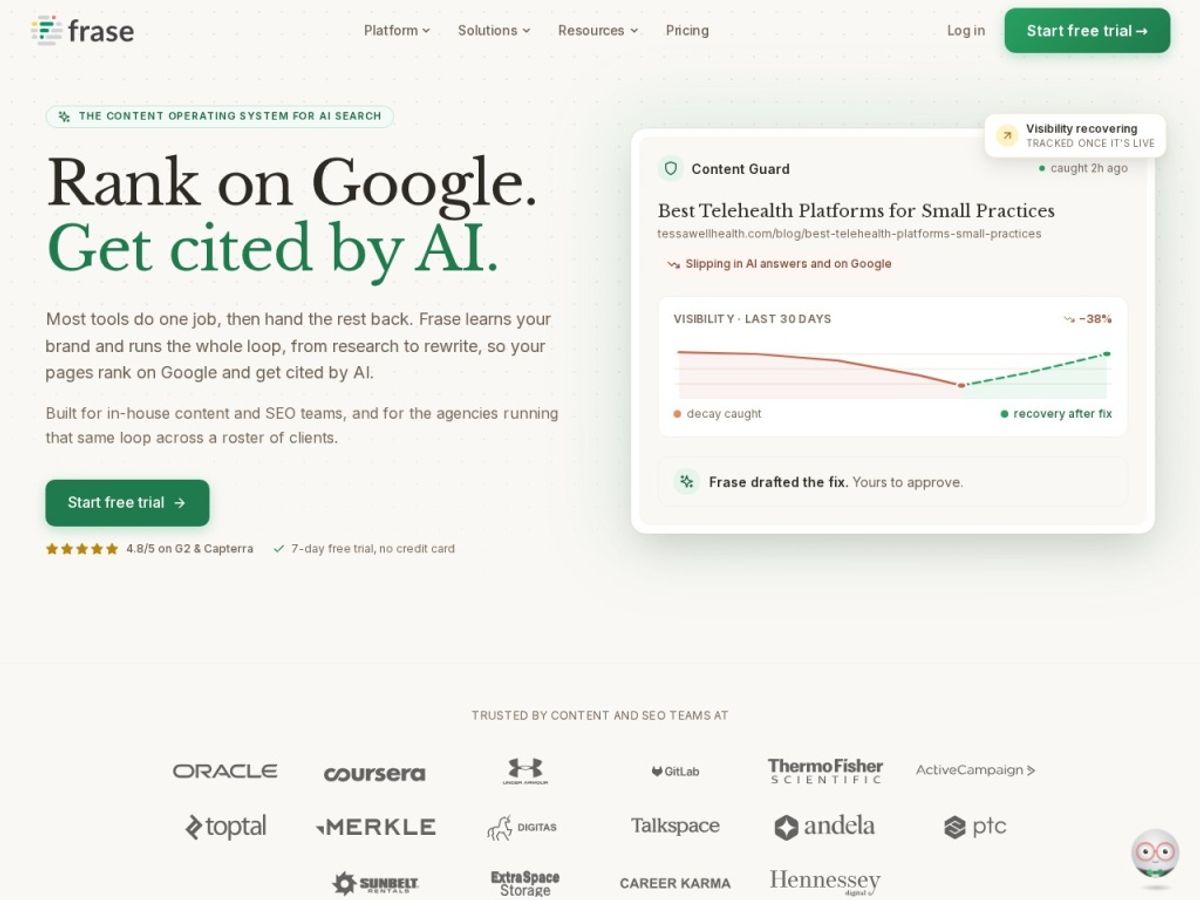
Most content tools split into two camps: keyword research tools that stop at the topic stage, and writing tools that generate text with no real grounding in what’s already ranking. Frase tries to sit in the middle of that gap. It pulls live SERP data for your target keyword, distills it into an outline and a set of questions people are actually asking, then keeps that research attached to the document as you write — so the brief and the draft never drift apart.
The other thing that sets Frase apart is the content score. Instead of a binary “optimized/not optimized” flag, you get a running number that moves as you add headings, hit target word counts, and cover topics your competitors already rank for. It’s not a magic ranking predictor — no tool’s score is — but as a writing guardrail it’s more useful than staring at a blank Google Doc guessing what “thorough enough” looks like.
Frase has also been pushing into newer territory: tracking whether your content gets cited by AI engines like ChatGPT and Google’s AI Overviews, alongside traditional Google rankings. That’s a meaningful shift from a pure “SEO content tool” positioning, and it’s worth knowing about before you compare it head-to-head with older-school competitors that haven’t made that move yet. If any of this sounds like what your content process is missing, it’s worth spinning up the free trial and running one real brief through it. Start a Frase trial and test it against a keyword you already understand well — that’s the fastest way to judge the research quality.
The core features
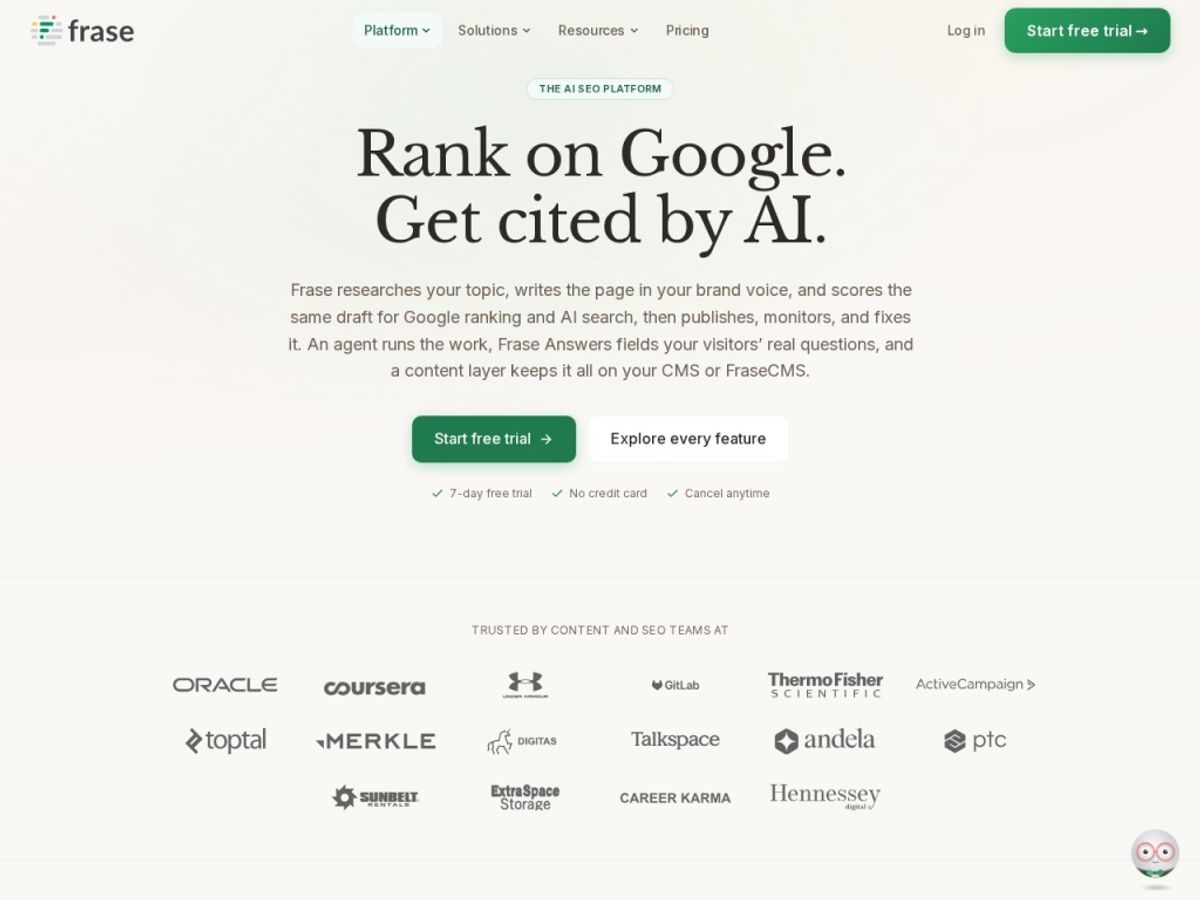
Frase’s feature set breaks down into research, drafting, optimization, and monitoring. Here’s what each piece actually does in practice.
Content research & SERP analysis
Enter a target keyword and Frase scrapes the top-ranking pages, extracting their headings, common questions (including Google’s People Also Ask box, plus signals pulled from forums like Reddit and Quora), and topics that show up repeatedly across competitors. In our testing this was consistently the strongest part of the product — it turned a 45-minute manual SERP-reading exercise into something closer to five minutes.
AI outline builder
Once the research is pulled, Frase auto-generates a structured outline with suggested headings and subtopics based on what’s actually ranking. You can reorder, delete, or expand sections before handing the brief to a writer. It’s genuinely useful for briefing freelance writers who don’t have time to do their own SERP research — the outline gives them a defensible starting structure rather than a blank page.
AI writer
Frase can draft full sections, intros, or entire articles from the outline. In our tests, the output was serviceable as a first draft — reasonably on-topic, generally well-structured — but it read like an AI draft: repetitive sentence patterns, occasional generic filler, and claims that needed a fact-check pass. Treat it as a fast first draft, not a finished asset.
Content optimization & score
As you write (or paste in existing content), Frase scores the piece against what’s ranking for your target term, flagging thin sections, missing subtopics, and word-count gaps versus the competition. This is the feature we came back to most often — it’s a fast sanity check before publishing, and it’s genuinely useful for auditing old content that’s started slipping.
Content analytics & Google Search Console integration
Connecting Google Search Console lets Frase show real impressions, clicks, and average position data next to the content you’re optimizing, instead of working from SERP snapshots alone. It also layers in AI-visibility tracking — checking whether your pages get cited in ChatGPT, Perplexity, or Google’s AI Overviews — which is a newer but increasingly relevant signal to watch.
Integrations
Frase publishes directly to WordPress, Webflow, Sanity, and Wix, or you can host content on Frase’s own lightweight CMS if you don’t already have one. For teams without a formal publishing pipeline, being able to push a finished draft straight to WordPress without a copy-paste round trip is a small but real time saver.
Plans & pricing
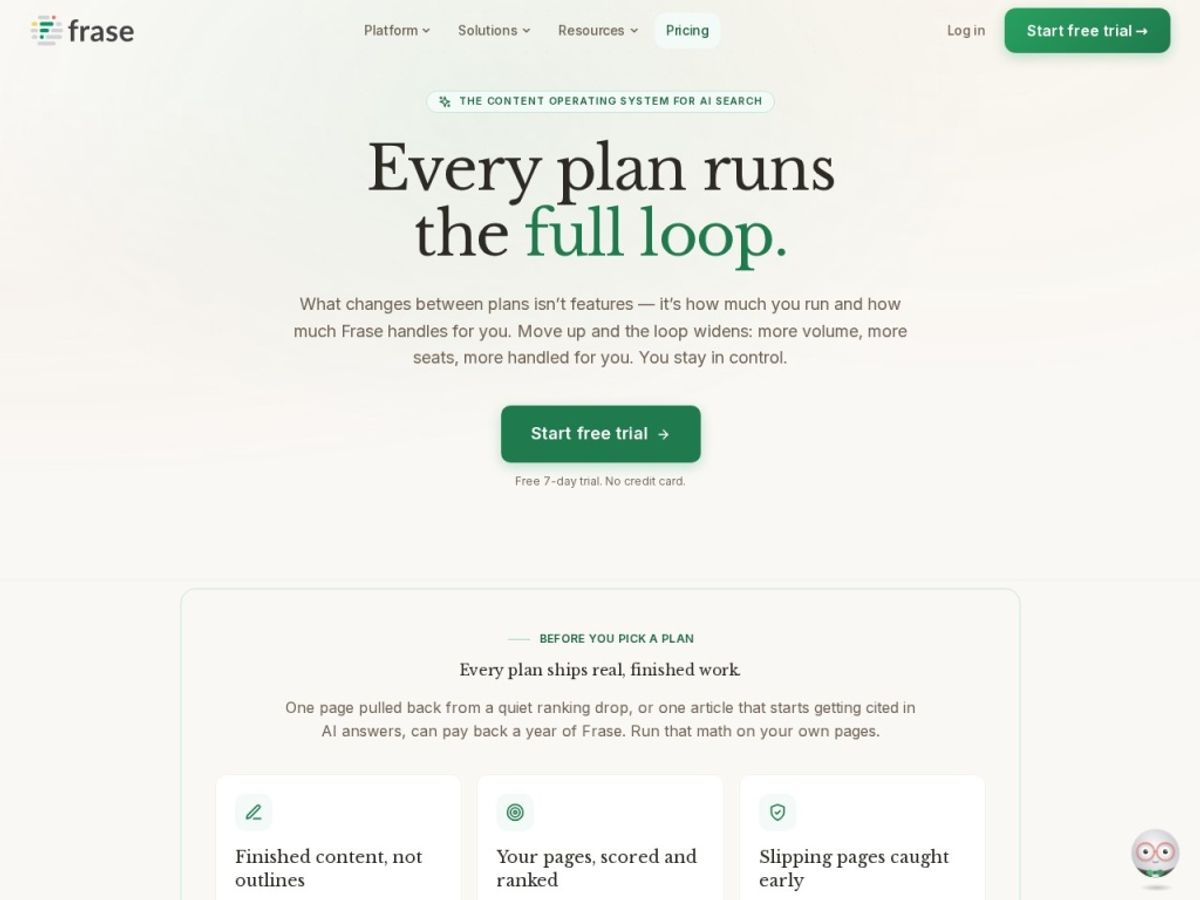
A quick and honest caveat: Frase has changed its pricing structure and plan names more than once over the past couple of years — older reviews (and some third-party listing sites) still reference legacy “Solo,” “Basic,” and “Team” tiers with different prices. Always confirm current numbers on Frase’s own pricing page before you buy, since add-on rates and usage caps in particular tend to move. Here’s what we found as of mid-2026, mapped roughly onto the tier names most readers search for.
Free trial
Frase offers a 7-day free trial with no credit card required. You get the mid-tier feature set (content calendar, AI writing, AI visibility monitoring on ChatGPT and Google AI) but with capped usage — a handful of articles, audit pages, and AI prompts, and up to three seats. It’s enough to run one or two real briefs through the system and judge the research quality for yourself, which is exactly what we’d recommend doing before committing to a paid plan.
Basic/Solo
The entry-level plan (the closest current equivalent to the old “Solo” or “Basic” naming) runs roughly in the high-$30s to just under $50 per month depending on monthly vs. annual billing, with annual plans typically discounted by around 20%. Expect one seat, one site, and a modest monthly cap on articles and audited pages — enough for a solo blogger or freelancer publishing a few pieces a month, but tight if you’re running a busier content calendar.
Team
The mid-tier and higher “team” plans scale up seats, connected sites/domains, and monthly article and audit allowances substantially, typically landing somewhere between roughly $100 and $300 per month depending on billing cycle and tier. These plans add collaboration features like a shared content calendar, internal linking suggestions, and expanded AI-visibility tracking across more AI engines. Extra seats are usually available as a flat per-seat add-on rather than forcing a full tier upgrade.
Pro Add-On
Above the standard team tiers, Frase offers an Enterprise option with custom, quote-based pricing — white-label reporting, a branded client portal, SSO/SAML, a dedicated account manager, and expanded API access. On the mid-tier plans, “pro” add-ons typically take the form of pay-as-you-go capacity: extra articles, audit pages, and AI prompts billed per unit once you exceed your monthly cap, so you’re not forced into a full plan upgrade just to finish a busy month. Pricing on all of this is a moving target, so treat the numbers above as directional and verify the current rate card before checkout. Check current Frase pricing.
How to get the best value
A few things we learned from actually using the paid caps rather than just reading about them. First, run your free trial against a keyword you already know well — that makes it much easier to judge whether the SERP research and content score are actually accurate, rather than just impressive-looking. Second, don’t over-buy seats up front; Frase’s per-seat add-on pricing on the mid tiers means you can start lean and add people as your content calendar actually grows. Third, if you’re publishing consistently, the annual billing discount (roughly 20% off the monthly rate on every paid tier) pays for itself within a few months — it’s one of the easiest savings to capture if you’re already committed to the tool. Finally, keep an eye on your monthly article and audit-page caps; it’s easy to burn through them faster than expected once you start using Frase for both new content and auditing older pages that have started to slip.
Watch: Frase in action
If you’d rather see the interface move before committing to a trial, a couple of independent walkthroughs are worth watching. The first covers a general review and tutorial of Frase’s SEO and AI writing workflow; the second is a beginner-focused walkthrough of the keyword research and content strategy side of the tool.
Frase vs alternatives
Frase isn’t the only tool doing SERP-driven content research, and it’s worth knowing where it wins and where it doesn’t. Surfer SEO leans harder into granular on-page optimization scoring and has a more polished technical audit layer, but it generally costs more once you add the modules most teams actually want. Clearscope is the simplest of the three to hand to a non-technical writer — its scoring UI is famously clean — but its per-report pricing model gets expensive fast if you’re publishing at volume.
| Tool | Best for | Standout strength | Free option |
|---|---|---|---|
| Frase | Solo SEOs & small content teams | Fast SERP research + content scoring in one workspace | 7-day free trial |
| Surfer SEO | Teams wanting deep on-page audits | Granular optimization scoring & technical add-ons | No free trial; money-back guarantee |
| Clearscope | Teams with non-technical writers | Clean, writer-friendly scoring interface | No free tier; demo only |
Our verdict: if budget matters and you want research plus a usable content score without a steep learning curve, Frase is the more practical starting point. If your team is already deep into technical SEO workflows and wants tighter audit tooling, Surfer is worth the premium. If you’re mainly handing briefs to freelance writers who don’t want to learn a complex interface, Clearscope’s simplicity can justify its higher per-report cost.
Output quality & value
Judged purely on research quality, Frase punches above its price point. The SERP scraping is fast, the question extraction genuinely surfaces things a manual search would miss, and the content score is a legitimately useful editorial guardrail rather than a gimmick. For the cost of the entry-level plan, you’re getting research tooling that used to require either a much more expensive SEO suite or an hour of manual competitor analysis per article.
Where the value proposition gets more nuanced is the AI writer. It’s fine as a starting point — a way to beat blank-page syndrome — but it is not a substitute for a skilled writer or a thorough editing pass. If you’re budgeting Frase as a “content research and briefing tool with a bonus drafting assistant,” the price holds up well against the competition. If you’re hoping it replaces your writing team outright, you’ll be disappointed, and that gap between marketing promise and daily reality is the single biggest thing to set expectations around before you buy.
Who should use it — and who should not
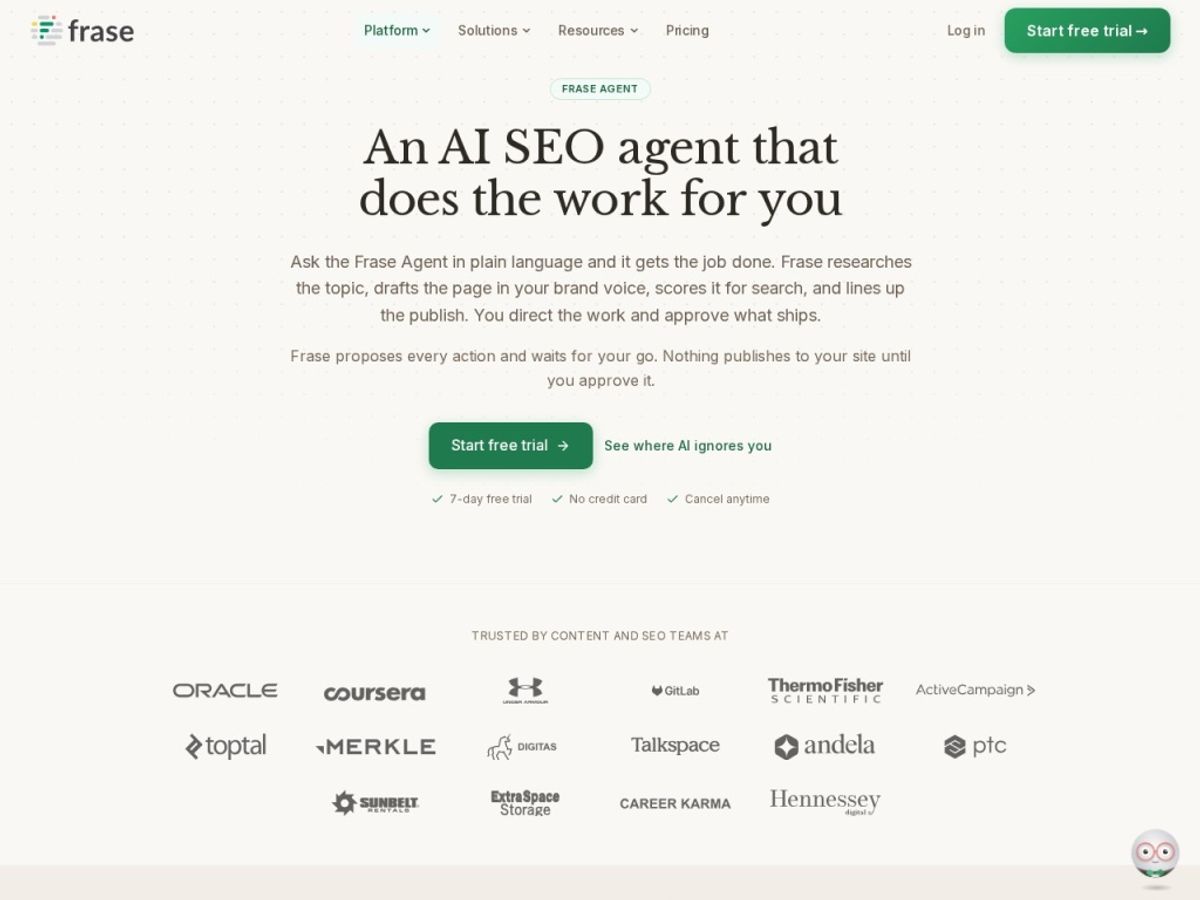
Frase makes the most sense for solo SEOs, in-house content marketers, and small agencies who need to brief and audit content faster without paying for a full enterprise SEO platform. If your bottleneck is “I don’t know what to tell my writer to cover” or “I don’t know which of my old posts to fix first,” Frase solves both problems directly and does it at a price that’s easy to justify against the time saved.
It’s a weaker fit if you need deep technical SEO auditing (crawl errors, backlink analysis, site architecture) as your primary use case — that’s simply out of scope, and you’ll want a dedicated technical SEO tool alongside it regardless of which content tool you pick. It’s also not the right choice if you’re expecting fully autonomous, publish-ready AI writing with no human review; every serious test of Frase’s output, including ours, has landed on the same conclusion — it drafts, it doesn’t finish.
Honest limits
Two things kept us from scoring this higher. First, the entry-tier usage caps are tight enough that active publishers will likely outgrow the base plan within a month or two, which changes the effective price you should be budgeting for. Second, support and billing experiences are inconsistent across review platforms — strong on G2, noticeably rockier on some independent review sites — so it’s worth going in with reasonable expectations about response times if you hit an account issue.
Frase discount codes & deals
We didn’t find, and won’t fabricate, any secret coupon codes for Frase — treat any “50% off Frase” code you see floating around forums with skepticism. The one discount that’s real and consistently available is the standard annual billing discount, which runs around 20% off the monthly rate on every paid tier. If you’re reasonably confident you’ll stick with Frase past a couple of months, paying annually through the trial or signup flow is the legitimate way to save. Get the current Frase deal.
Frequently asked questions
Is Frase good for beginners?
Yes. The interface is more approachable than most enterprise SEO suites, and the guided brief-to-draft workflow gives new users a clear starting point rather than a blank dashboard.
Does Frase replace a human writer?
No. The AI writer produces usable first drafts, but in our testing every draft needed editing for tone, accuracy, and repetition before it was publish-ready.
What’s the difference between Frase and Surfer SEO?
Surfer generally offers deeper on-page and technical optimization scoring, while Frase leans harder into SERP research, question extraction, and briefing speed. Surfer also tends to cost more once you add its optional modules.
Can I cancel my Frase subscription anytime?
Frase plans are billed monthly or annually, and you can generally cancel or downgrade through your account settings; downgrades typically take effect at the next billing cycle rather than immediately. Confirm current cancellation terms on Frase’s site before subscribing.
Does Frase integrate with WordPress and Google Search Console?
Yes. Frase can publish directly to WordPress (along with Webflow, Sanity, and Wix), and connecting Google Search Console lets you see real query, click, and impression data alongside your content scores.
Is there a Frase free trial?
Yes, Frase offers a 7-day free trial with no credit card required, though usage (articles, audit pages, AI prompts, and seats) is capped during the trial period.
Is Frase worth it compared to doing SERP research manually?
For most content teams, yes — the time saved on research and briefing alone tends to justify the entry-level plan cost within the first few articles, assuming you still budget editing time for the AI-assisted draft.
How to get great results with any SEO content tool
Start with a keyword you understand. Run your first few briefs on topics you already know well, so you can tell quickly whether the tool’s research and scoring are actually accurate rather than just plausible-looking.
Treat AI drafts as raw material, not final copy. Every AI-assisted writing tool, Frase included, needs a human editing pass for accuracy, tone, and originality before anything goes live.
Don’t chase the score at the expense of readability. A perfect content score on a paragraph nobody wants to read still won’t rank or convert — use the score as a guide, not the goal.
Reuse your research across formats. A single solid brief can feed a blog post, a social thread, and an email — don’t let good research get used once and thrown away.
Revisit old content, not just new drafts. Some of the highest-ROI work with any optimization tool is re-scoring and updating posts that have started slipping in rankings, rather than only using it for net-new content.



