

If you have spent any time in developer forums, self-hosting subreddits, or startup Slack channels over the last few years, you have almost certainly seen the name Hetzner come up — usually followed by someone marvelling at how little they pay for their servers. Hetzner Online is a German hosting company that has quietly become one of the most talked-about infrastructure providers in the world, largely by doing one thing extremely well: offering serious compute and storage at prices that make the big hyperscalers look almost comical by comparison.
This is an honest, hands-on assessment aimed at developers, technical founders, and self-hosters who want the real trade-offs. We cover the product range, pricing, performance, support, and where Hetzner is the obvious choice — and where it is not. You can Check Hetzner directly.
AnalyzeBench Score: 8.7 / 10
Best for: Developers, self-hosters, and cost-conscious startups who want maximum price-to-performance, are comfortable managing their own servers, and whose users are primarily in Europe (or who do not mind a limited set of global regions).
What we loved:
- Price-to-performance that is genuinely hard to beat anywhere in the industry.
- A broad catalogue that spans cloud VPS, powerful dedicated servers, and an auction marketplace for bargain hardware.
- Owned-and-operated European data centers with strong GDPR posture and ISO/IEC 27001 certification.
- Clean, fast console plus a developer-friendly REST API, CLI, and first-party Terraform and Ansible support.
- Generous included traffic and very low egress costs compared to AWS, Azure, and Google Cloud.
Watch out for:
- An EU-centric footprint — only a handful of regions, with some plan types restricted to Europe.
- Mandatory identity verification (KYC) for new accounts that can occasionally be slow or fiddly.
- Ticket and email support only; no phone hotline or live chat for cloud customers.
- Unmanaged by default — you are responsible for your own OS, security, and updates.
What makes Hetzner different
Most cloud providers compete on breadth: hundreds of managed services, dozens of regions, and marketing built around “everything in one place.” Hetzner takes almost the opposite approach. It is a vertically integrated infrastructure company that owns its data center parks, designs its own cooling and hardware layouts, and passes the resulting efficiency straight through to customers as lower prices. The company is headquartered in Germany, has served a customer base that now numbers well over 400,000, and has built its reputation on being the place where you get more raw resources for your money than almost anywhere else.
That difference shows up in the numbers. Where a hyperscaler might charge a premium for a small virtual machine and then bill you heavily for outbound traffic, Hetzner tends to offer two to three times the CPU and RAM at a comparable price point, bundle in a large monthly traffic allowance, and charge only modest fees for anything beyond it. For workloads where you are paying for compute rather than a specific managed service you cannot get elsewhere, the savings can be dramatic over a year.
The trade-off for that value is philosophical: Hetzner assumes you know what you are doing. The servers are unmanaged, the support is efficient rather than hand-holding, and the region list is deliberately compact. If that sounds like a fair deal, Hetzner is often the single best value in the market. If you want a provider that manages everything for you, it is a different conversation — one we return to at the end of this review.
The core products
Hetzner’s catalogue is broader than many people realise. It is not just a cheap VPS shop; it spans several distinct product families that together cover most infrastructure needs.
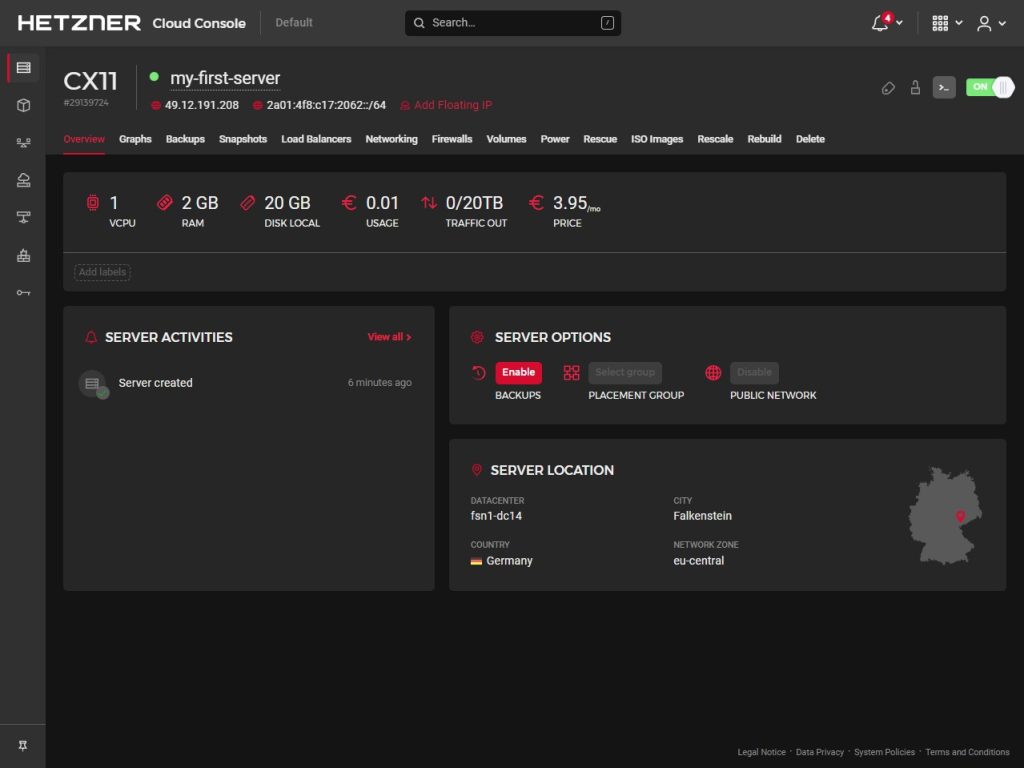
Cloud servers (VPS): The flagship for most readers. These are virtual machines you spin up in seconds from the Hetzner Console or API, billed by the hour up to a monthly cap. They come in both shared-vCPU and dedicated-vCPU flavours, and — notably — in both x86 (Intel/AMD) and ARM (Ampere Altra) architectures.
Dedicated root servers: For workloads that need an entire physical machine, Hetzner offers several lines: the EX-Line and AX-Line (AMD-powered) for general and high-performance compute, the ARM-based RX-Line, the storage-focused SX-Line, GPU servers for AI and rendering workloads, and Dell-branded DX-Line hardware. There is also the famous Server Auction (Serverbörse), a live marketplace of already-provisioned dedicated servers offered at reduced prices — a genuine bargain hunter’s paradise.
Storage: Hetzner offers S3-compatible Object Storage, the self-managed Storage Box for backups and archives, and Storage Share, a hosted Nextcloud-based solution for storing and sharing files. Cloud Volumes let you attach expandable block storage to any cloud server.
Networking and services: Load Balancers, private Networks, stateful Firewalls (included at no extra cost), Floating IPs, free DNS management, domain registration, and SSL certificates round out the platform. Everything essential can be automated through the API.
Plans & pricing
Pricing is Hetzner’s headline act, so it deserves a careful look. A key caveat first: Hetzner adjusted its prices in 2026, and pricing varies by region and currency, so treat the figures below as approximate reference points rather than exact quotes. Always confirm the current rate on their site before you buy — you can Check Hetzner for the live pricing calculator.
Cloud servers
The cloud line-up breaks into a few tiers. The CX series (cost-optimized, shared Intel/AMD vCPUs) is the entry point and is aimed at test environments and light workloads; it is available in the European locations. The CAX series runs on ARM-based Ampere Altra processors, also shared and EU-located, and tends to offer the best raw price-to-performance for compatible workloads — an entry ARM instance with a couple of vCPUs and several gigabytes of RAM has historically sat at just a few euros per month. The CPX series uses AMD EPYC shared vCPUs and is available globally, including the US and Singapore regions. At the top, the CCX series provides dedicated vCPUs with no noisy-neighbour effect, starting from roughly the low-teens of euros per month and scaling up for high-traffic production workloads.
Across the board, cloud servers include a large monthly traffic allowance and stateful firewalls at no extra charge, with additional traffic priced very low. Block storage Volumes and Load Balancers are billed separately but remain inexpensive.
Dedicated servers
Dedicated root servers carry a small one-time setup fee on some lines plus a monthly rate that is still remarkably competitive for the hardware involved. The AX-Line pairs modern AMD Ryzen and EPYC CPUs with generous RAM and NVMe storage; the SX-Line is built around large hard-disk arrays for storage-heavy use; and the GPU-Line targets AI and rendering. The single most interesting option for value hunters is the Server Auction, where previously configured machines are offered at a discount and prices tick down until someone claims them — it is frequently the cheapest way to rent real dedicated hardware anywhere.
Storage
Object Storage is billed on a capacity-plus-traffic basis and is S3-compatible, making it a drop-in target for backups and static assets. Storage Boxes are sold in fixed capacity tiers (ranging from a few hundred gigabytes up to many terabytes) at a flat monthly price, which makes them one of the cheapest ways to hold large backups. Storage Share adds a managed Nextcloud layer on top for teams that want file sync and sharing without running the software themselves.
How to get started
Getting up and running on Hetzner is straightforward, though the identity-verification step is worth planning for. Here is the typical flow:
- Create an account. Sign up with your email and complete the initial registration. New customers are asked to pass an identity-verification (KYC) check — this is Hetzner’s defence against fraud given how cheap the servers are, and it may involve submitting an ID document. Approval is often quick but can occasionally take longer, so do not sign up five minutes before you need a live server.
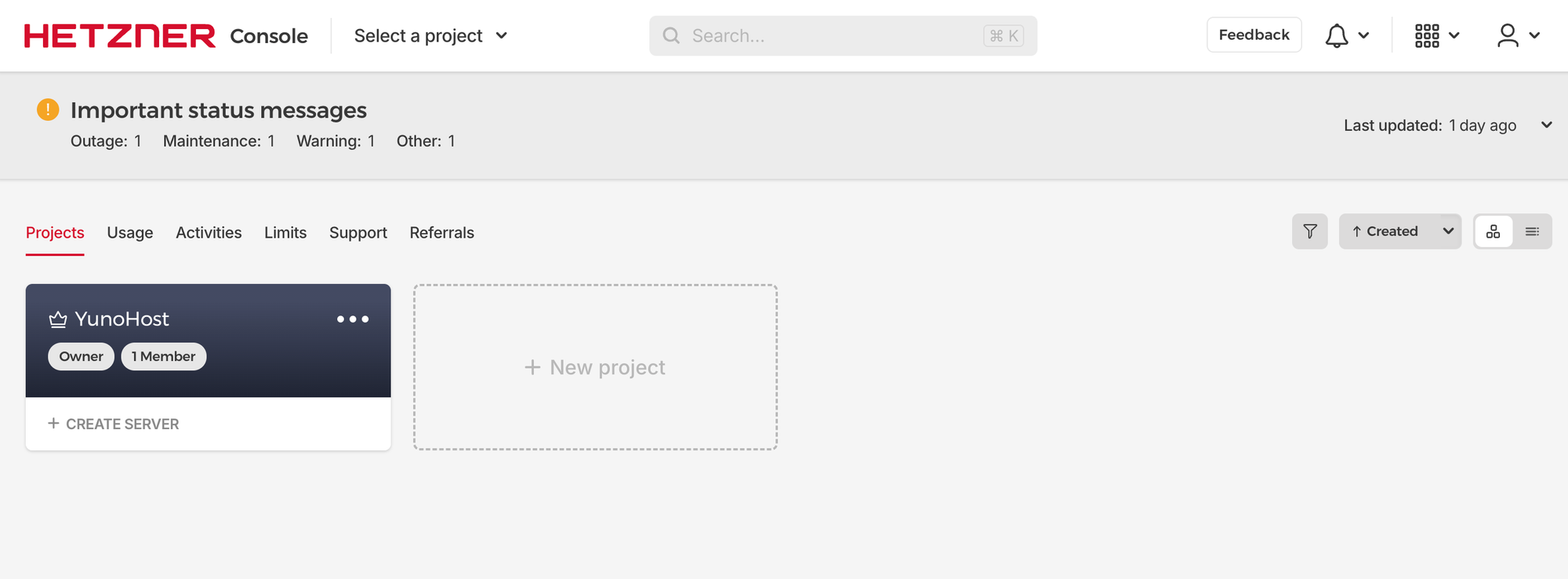
- Open the Cloud Console. Once verified, log in to the Hetzner Console, create a project, and you are ready to deploy.
- Pick a server. Choose a location, an image (Ubuntu, Debian, Fedora, and other distributions are offered), and a plan — shared or dedicated, x86 or ARM. Add SSH keys during setup so you can log in securely straight away.
- Deploy and connect. The instance provisions in seconds. Connect over SSH, or use one of the free one-click apps (Docker, WordPress, Nextcloud, GitLab, Coolify, and more) to skip manual installation.
- Automate if needed. Wire up the REST API, the hcloud CLI, or Terraform and Ansible to manage everything as code. This is where Hetzner feels genuinely modern.
If you want to walk through the console yourself, you can Check Hetzner and follow their documentation, which is clear and well-maintained.
Watch: Hetzner in action
Sometimes it helps to see the console and deployment flow before you commit. The walkthrough below covers deploying a cloud server, logging in, and working with volumes, load balancers, and networks — a good overview of the day-to-day experience.
Hetzner vs alternatives
No provider is the right answer for everyone. Here is how Hetzner stacks up against two of the most common alternatives people weigh it against: Contabo, another value-focused European host, and DigitalOcean, the developer-friendly cloud with a broader global footprint.
| Factor | Hetzner | Contabo | DigitalOcean |
|---|---|---|---|
| Price-to-performance | Excellent | Very strong on raw specs | Higher priced |
| Network & provisioning speed | Fast, seconds to deploy | Slower provisioning at times | Fast, polished |
| Global regions | Limited (EU, US, Singapore) | More locations, mixed quality | Broad global coverage |
| API, CLI & IaC | Strong (REST, CLI, Terraform) | Basic | Excellent, mature ecosystem |
| Managed services | Minimal (unmanaged focus) | Minimal | Managed DBs, Kubernetes, apps |
| Support style | Ticket/email, efficient | Ticket, variable | Ticket plus docs, developer-first |
The pattern is clear: Hetzner wins decisively on value and hardware quality, Contabo sometimes offers even more raw resources but with less polish and less consistent networking, and DigitalOcean charges more but gives you a richer set of managed services and a wider region map. Your choice depends on whether you are optimising for cost, convenience, or reach.
Performance, support & value
On performance, Hetzner has an excellent reputation. Its NVMe-backed cloud servers feel snappy, and independent benchmarks consistently place its instances at or near the top of price-adjusted performance charts. The ARM-based Ampere instances are a particular highlight, offering meaningfully better efficiency than comparable x86 options for workloads that run cleanly on ARM. The company also publishes a 99.9% uptime SLA for its cloud, and real-world monitoring by third parties has generally shown uptime comfortably in that range.
Support is the area where expectations need calibrating. Hetzner provides ticket and email support, and it has expanded to 24/7 email coverage for exceptional cases, but there is no phone hotline or live chat for cloud customers. When you do get a response, it is usually competent and to the point — this is support that assumes technical literacy rather than walking you through basics.
On value, Hetzner is difficult to argue with. Between the low base prices, the generous included traffic, the free firewalls, and the auction marketplace for dedicated hardware, the total cost of running infrastructure here is frequently a fraction of what the hyperscalers charge — often the deciding factor for bootstrapped teams and side projects that need to watch every euro.
Who should use it — and who should not
You should strongly consider Hetzner if: you are a developer, self-hoster, or lean startup; you are comfortable administering your own Linux servers; your audience is primarily in Europe, or a European or US region works fine for you; and you want the lowest sensible price for real compute and storage. It is also excellent for CI/CD runners, game servers, staging environments, personal cloud setups, and anything where you would otherwise be over-paying a hyperscaler for plain compute.
You should look elsewhere if: you need a wide global footprint with low latency on every continent; you rely heavily on managed databases, serverless functions, or a large catalogue of first-party managed services; you require phone support or a formal enterprise support contract with guaranteed human response times; or you simply do not have the time or skills to manage servers yourself and would rather pay a premium for a fully managed platform.
Honest limits
To keep this review balanced, here are the constraints worth being clear-eyed about. First, the region footprint is genuinely limited — Germany, Finland, the United States, and Singapore. That covers a lot of use cases, but a truly global, latency-sensitive audience is not one of them. Second, some plan types (the cost-optimized CX and ARM CAX shared instances) are restricted to European locations, so if you need ARM in the US you will have fewer choices. Third, the KYC verification process, while sensible, is an extra hurdle and has occasionally frustrated users when automated checks misfire. Fourth, everything is unmanaged by default; there is no hand-holding if you misconfigure a firewall or forget to patch your OS. Finally, prices — while still very low — did rise in 2026, so the gap versus competitors, though large, is not quite as extreme as it once was. None of these are dealbreakers for the target audience, but you should go in knowing them.
Hetzner deals
Hetzner’s pricing is already aggressive, so the “deal” here is less about coupon codes and more about picking the right product for your workload — the ARM cloud instances for efficiency, the Server Auction for cheap dedicated hardware, and the fixed-price Storage Boxes for backups. Because rates and available configurations change, the best move is to check the current line-up and pricing calculator directly. Ready to see today’s plans and spin up a server? Check Hetzner and compare the options for yourself.
Frequently asked questions
Is Hetzner good for beginners?
It can be, but with a caveat: the console is clean and the one-click apps make deployment easy, yet the servers are unmanaged. If you are new to Linux administration you will be learning as you go. Beginners who are willing to follow tutorials do well; those who want everything handled for them may prefer a managed platform.
Why does Hetzner ask for my ID?
Because its prices are so low, Hetzner attracts fraud and abuse, so it runs an identity-verification (KYC) check on new accounts. This may involve submitting a passport or ID document. It is a legitimate anti-fraud measure, though it does add a step to signing up.
Does Hetzner have US data centers?
Yes. Alongside its European sites in Germany and Finland, Hetzner operates data centers in Ashburn, Virginia, and Hillsboro, Oregon, plus a location in Singapore. US latency from those regions is workable for most applications, though a purely US audience with strict latency needs might still prefer a US-native provider.
Is Hetzner cheaper than AWS or DigitalOcean?
Generally, yes — often substantially. For plain compute and storage, Hetzner typically offers more resources per euro and much cheaper egress traffic than the major hyperscalers, and it usually undercuts DigitalOcean too. What you give up is the breadth of managed services those platforms provide.
Are Hetzner servers managed or unmanaged?
Cloud and dedicated servers are unmanaged by default: you control the operating system, security, and updates. Hetzner does offer separate managed server and web hosting products if you want them to handle the technical layer, but the flagship cloud is self-managed.
What is the Server Auction?
The Server Auction (Serverbörse) is a marketplace of already-provisioned dedicated servers offered at reduced prices. Configurations are fixed and prices decline over time until claimed, making it one of the cheapest ways to rent real dedicated hardware.
Can I use Hetzner with Terraform and Kubernetes?
Yes. Hetzner provides a developer-friendly REST API, an hcloud CLI, and first-party integrations for Terraform and Ansible, and its networking primitives are commonly used to run Kubernetes clusters. Automation is one of the platform’s strengths.
Background: managed vs unmanaged cloud, explained
Because so much of the Hetzner decision hinges on this distinction, it is worth understanding clearly — and it applies to any provider, not just this one. An unmanaged cloud server hands you a bare virtual or physical machine with an operating system installed and little else. You are responsible for everything above that line: securing the server, configuring the firewall, installing and updating software, taking backups, and responding when something breaks. In exchange, you get lower prices, full control, and no vendor lock-in. Hetzner’s flagship cloud sits firmly in this camp.
A managed platform, by contrast, takes over much of that operational burden. That can mean anything from a fully managed database that handles patching, backups, and failover for you, to a managed application platform where you simply push code and the provider runs the servers invisibly. You pay more — sometimes considerably more — but you trade money for time and reduced operational risk. This model suits teams without dedicated infrastructure skills, or those who would rather spend their hours building product than administering servers.
Neither model is inherently better; the right choice depends on your team. If you have the skills and want maximum value, unmanaged infrastructure like Hetzner’s is a superb deal. If your time is better spent elsewhere, a managed platform may earn its premium. Many teams blend the two — running cost-sensitive workloads on unmanaged servers while paying for a managed database where the stakes are highest. Whatever you decide, understanding the trade-off is the key to not over-paying or under-provisioning. And if the unmanaged, high-value approach fits how you work, it is easy to Check Hetzner and start small.



