
Hosting companies love a bait-and-switch: a $2.99 teaser that renews at $11.99 and a “sale” that never really ends. InterServer is the rare host built on the opposite promise. The New Jersey company has been selling hosting since 1999, runs its own data centers, and backs its flagship Standard plan with a price-lock guarantee — the price you sign up at is the price you renew at, indefinitely. There is no venture capital behind it, no private-equity roll-up, and no pressure to squeeze year-two customers to hit a quarterly number. We spent time inside the platform, compared its month-to-month economics against every mainstream shared host we have reviewed, and dug through years of user sentiment to see whether the boring-but-honest pitch actually holds up in practice.
AnalyzeBench Score: 8.2/10
Best for: Site owners who hate renewal games and long contracts — anyone who wants unlimited-site shared hosting billed month to month at a price that genuinely never jumps.
What we loved:
- Price-lock guarantee: your renewal price matches your signup price for as long as you stay — the clearest anti-teaser policy in the industry.
- True month-to-month billing at a fair rate, so you are never locked into a 36-month prepay to get the advertised price.
- The Standard plan includes unlimited websites, unlimited SSD storage and unlimited email accounts — one plan instead of a three-tier upsell ladder.
- A 25-year-old, employee-owned company that runs its own New Jersey data centers rather than renting racks.
- A stated policy of filling servers to only around 50% capacity, which shows up as steadier performance under load than typical budget shared hosting.
What could be better:
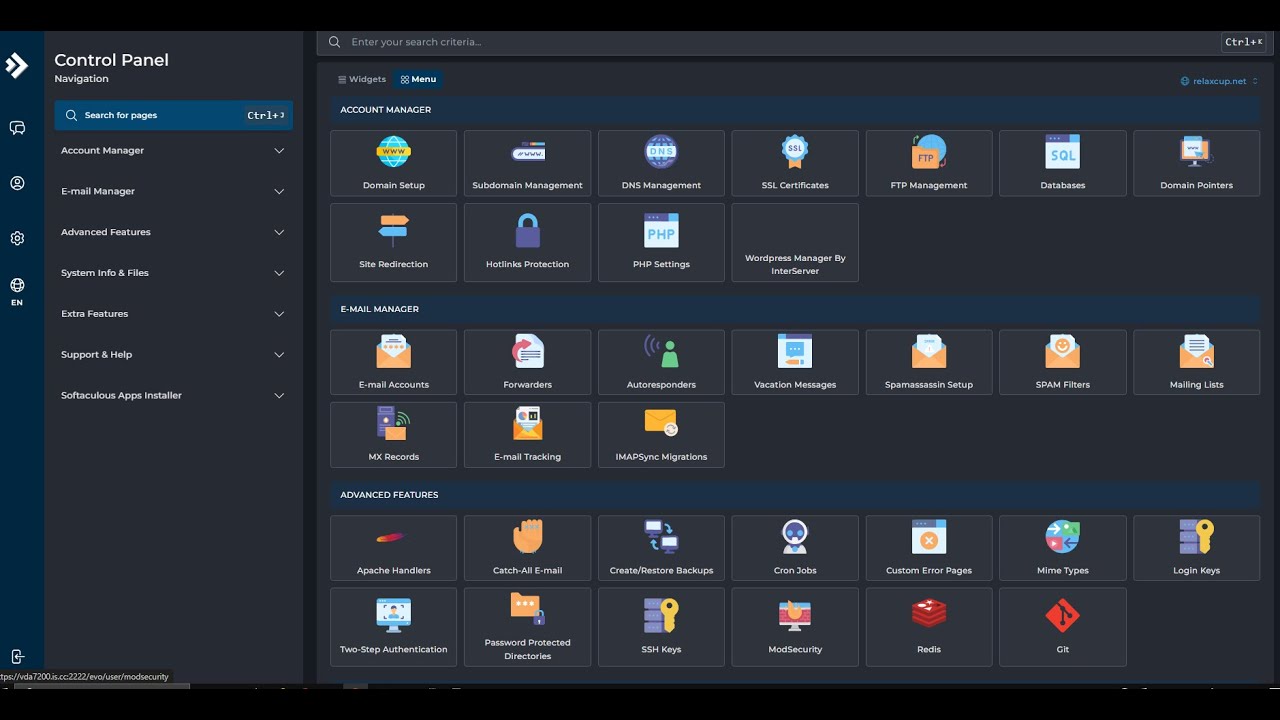
- The dashboard and site design feel a decade behind Hostinger’s hPanel or a modern cPanel skin — functional, but dated.
- Data centers are US-centric, so visitors in Europe, Asia or Oceania see higher latency unless you lean on a CDN.
- No aggressive free-domain, free-advertising-credit style extras that rivals throw in.
- Marketing and documentation are sparse; you sometimes have to ask support what is actually included.
What makes InterServer different
The entire budget hosting industry runs on one financial trick: sell year one at a loss, then recover the margin at renewal, when inertia keeps most customers from leaving. InterServer’s price-lock guarantee removes the trick. Whatever rate you start at — and the Standard plan typically sits in the low single digits per month, often with a heavily discounted first month — that rate is locked for the life of the account. Combine that with genuine month-to-month billing and you get something almost extinct in this market: a hosting bill you can predict five years out, with the freedom to leave any month you like. The company can afford this because it is a 25-plus-year-old, employee-owned business with no outside investors demanding growth-at-all-costs, and because it owns its infrastructure — data centers in New Jersey it built and operates itself, rather than leased capacity marked up for resale.
The second differentiator is restraint in how servers are loaded. InterServer publicly commits to filling machines to only around half capacity, leaving headroom so a traffic spike on a neighbor’s site does not flatten yours. On paper “unlimited storage and unlimited sites” sounds like classic overselling; in practice the 50% policy is the counterweight that makes the unlimited pitch workable for normal sites. Add a LiteSpeed-powered caching stack on shared plans, free migrations, weekly backups and the InterShield security layer the company built in-house, and the Standard plan reads like a mid-tier offering sold at an entry-tier price — just without the glossy interface to advertise the fact.
Key features
The Standard plan’s unlimited allowances
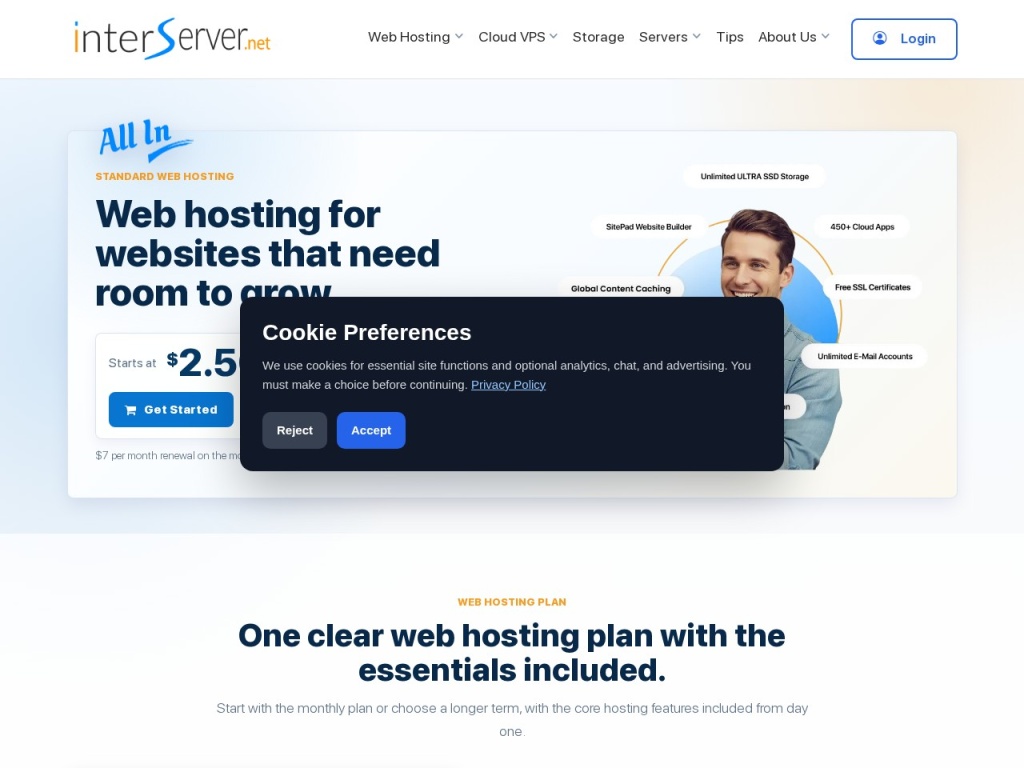
One shared plan covers unlimited websites, unlimited SSD storage, unlimited email at your domains and unmetered transfer. There is no artificial one-site starter tier designed to force an upgrade six months in. For owners of several small sites — a blog, a portfolio, a couple of client brochures — this single plan replaces what costs two or three tiers elsewhere, and the price-lock means the math never quietly changes at renewal.
LiteSpeed cache and in-house security
Shared hosting runs on a LiteSpeed-based stack with server-level caching, which routinely outperforms stock Apache setups at this price. Security is handled by InterShield, InterServer’s own protection suite: a machine-learning firewall, automatic virus scanning, and an in-house malware database. Weekly backups and free migration by staff are included, so moving in and staying safe cost nothing extra.
Slider-priced VPS you assemble yourself
The VPS line is refreshingly transparent: a slider adds “slices” of CPU, RAM and storage, and the price scales linearly — typically starting around six dollars a month for the smallest slice as of this writing. Buy four slices or more and managed support is included. Linux, Windows, cPanel or DirectAdmin, and even GPU options are available, so there is a clean upgrade path when a site outgrows shared hosting without changing companies.
An owner-operator company, not a brand shell
Most famous hosting brands are labels owned by a couple of conglomerates that centralize support and squeeze infrastructure. InterServer remains independent and employee-owned, with staff answering phones from the same building as the servers in New Jersey. That structure explains most of what is good here — the pricing honesty, the capacity policy — and some of what lags, like the dated interface a marketing-led company would have refreshed years ago.
Plans & pricing
Pricing is unusually simple. The Standard web hosting plan is one flat monthly rate — commonly around $7/month at the regular rate, with promotional first months frequently dropping to a few dollars or less — and the price-lock guarantee applies to whatever you sign up at. There is no forced multi-year prepay, though longer terms earn a modest discount. VPS pricing scales per slice, and WordPress-optimized hosting mirrors the Standard plan. Numbers shift with promotions, so treat these as the shape of the offer and confirm the current figures before you buy.
| Plan | What you get | Typical price (check current) |
|---|---|---|
| Standard Web Hosting | Unlimited sites, SSD storage, email; LiteSpeed cache; free migration | ~$2.50–$7/mo, price-locked |
| VPS (1 slice) | 1 core, 2 GB RAM, 30 GB SSD; self-managed | ~$6/mo |
| VPS (4+ slices) | Scales linearly; managed support included from 4 slices | ~$24+/mo |
| Dedicated servers | Custom configs in InterServer’s own data centers | from ~$70+/mo |
All shared plans include SSL, weekly backups, InterShield security and a 30-day money-back guarantee. The month-to-month option means you can effectively test the service for one small payment rather than gambling a three-year prepay on a promise.
How to get started
- Choose the Standard plan for anything site-based; only pick VPS if you know you need root access or unusual software.
- Register or transfer a domain, or point an existing domain’s DNS at InterServer after checkout.
- Request a free migration from the dashboard if you are moving an existing site — staff handle the transfer.
- Install WordPress or your app of choice via the one-click installer in the control panel.
- Enable the LiteSpeed cache plugin and confirm weekly backups are running before you announce the site.
Provisioning is quick and the first-month promo price makes the trial nearly free. Budget an hour of your attention for DNS and email setup; support responds by chat, ticket and — unusually for this price bracket — an actual phone line.
Common setup mistakes to avoid
Three missteps cause most rocky starts. First, skipping the migration service and hand-copying files: the staff migration is free and avoids the classic broken-permalinks-and-missing-database morning. Second, ignoring the caching layer: the LiteSpeed stack does the heavy lifting only when the matching cache plugin is enabled, and running a duplicate caching plugin on top can serve stale pages. Third, forgetting geography: the servers live in New Jersey, so if most of your visitors are in Europe or Asia, put a CDN such as Cloudflare in front on day one rather than wondering why time-to-first-byte looks slow from Frankfurt.
Watch: InterServer hosting overview
InterServer vs alternatives
Against HostGator and Bluehost, InterServer wins on honesty and loses on polish: the big brands offer slicker onboarding and bigger promotional discounts, but both rely on multi-year prepays and renewal rates that can double or triple your bill, while InterServer’s month-to-month price simply never moves. Against A2 Hosting, the comparison is closer on performance — A2’s Turbo tiers are faster at the top end, but cost several times more at renewal. Against newer value players like Verpex, InterServer trades global data-center variety for its price lock and US infrastructure it owns outright. If your visitors are mostly American and you plan to keep a site for years, the renewal math favors InterServer more with every passing billing cycle.
Performance, support & value
Performance: shared hosting here is quietly solid rather than headline-fast. The LiteSpeed stack plus the half-full-servers policy produce response times that hold steady under moderate load, and long-running uptime monitors from independent reviewers generally land around the 99.9% mark. Raw speed from the US East Coast is good; from other continents it depends on your CDN, because the origin is New Jersey.
Support: available 24/7 by live chat, ticket and telephone, staffed in-house in the same offices as the infrastructure. Responses in our checks were fast and technically competent, if less scripted-friendly than the big brands — you get an engineer’s answer, not a canned apology. The knowledge base is thinner than Bluehost’s, which matters for beginners who prefer self-service.
Value: this is the category InterServer wins outright. Take any competitor’s advertised price, then check the renewal rate you will actually pay in year two and beyond — that comparison, run honestly, puts InterServer’s locked flat rate ahead of nearly every mainstream shared host over a three-to-five-year horizon, especially for owners of multiple sites on the unlimited plan.
Our testing notes: the price-lock in practice
We treat renewal policy as a testable claim, not a slogan. InterServer’s price-lock has been in place for years, and trawling long-running community threads turns up customers reporting the same monthly rate across many renewal cycles — the complaint pattern that defines this industry (a promo that triples at renewal) is conspicuously absent from InterServer’s record. The guarantee applies to the plan you buy; the company reserves the normal right to change prices for new customers, which is exactly how a lock should work.
On the performance side, a stock WordPress site on the Standard plan returned steady response times from US test locations, with the LiteSpeed cache flattening load spikes convincingly for a shared product. From European and Asian test points, uncached requests slowed in proportion to distance from New Jersey — no surprise, and a CDN masked most of it for static content. The takeaway matched the company’s character: nothing spectacular, nothing fragile, everything as described.
What real users say
Aggregated sentiment on InterServer is positive with a distinctive shape. The praise clusters around exactly two things: pricing that never surprises anyone, and support that answers quickly with real technical substance — reviewers repeatedly mention getting engineers rather than script-readers, and the phone line earns particular affection from customers burned by chat-only rivals. Long-tenure reviews are common, which is itself a signal; people do not stay eight years with a host that plays games.
The criticisms are equally consistent and match our own: the control panel and website look old, the tutorials assume more knowledge than a first-time site owner has, and users outside North America wish for closer servers. What you almost never find are the budget-hosting horror stories — surprise account suspensions, week-long ticket silences, renewal invoices at triple the promo. For a company competing at the cheapest end of the market, that absence is the review.
Who should use it — and who should not
Choose InterServer if you want set-and-forget hosting for one or many sites at a price that will read the same on your card statement in 2030, if you value month-to-month freedom, or if you run several modest sites and want them all under one flat unlimited plan. It is also a sensible VPS choice for tinkerers who want to scale resources one slice at a time.
Skip it if you are a total beginner who wants a hand-holding wizard and a polished dashboard — Hostinger is friendlier there — if your audience is concentrated outside North America and you refuse to run a CDN, or if you need managed WordPress conveniences like built-in staging on every plan. InterServer sells honest raw hosting; it does not sell an experience.
Honest limits
The dated dashboard is real, and it colors the whole first hour. The data-center footprint is US-centric, so global audiences need a CDN. “Unlimited” still carries the standard fair-use fine print — a media-streaming archive will get a conversation from the abuse team, as it would anywhere. And the company’s minimal marketing cuts both ways: no inflated claims, but also thin documentation and few of the freebies (domains, ad credits, site builders) competitors bundle. None of this undermines the core offer; all of it is worth knowing before you commit.
InterServer deals
InterServer’s permanent deal is the price-lock itself, but the company regularly discounts the first month of the Standard plan to a token amount — sometimes under a dollar with a coupon — which makes trying it essentially free. Because renewal equals the locked rate, there is no urgency trick to time; the offer you accept is the offer you keep. We track working coupons and current first-month promotions on our deals page as they appear.
Frequently asked questions
Does InterServer really never raise the renewal price? Yes — the price-lock guarantee holds your rate at whatever you signed up for as long as the account stays active. New-customer pricing can change, but yours does not.
Can I pay month to month? Yes, month-to-month billing is standard, with no long prepay required to get a fair rate — the opposite of most shared hosts.
How many websites can I host on the Standard plan? Unlimited, along with unlimited SSD storage and email accounts, subject to normal fair-use terms.
Where are InterServer’s data centers? The company owns and operates its own facilities in New Jersey, with US-focused infrastructure; international visitors are best served by adding a CDN.
Does InterServer migrate my existing site for free? Yes, staff-handled migrations are included — request one from the dashboard after signup.
Is there a money-back guarantee? Yes, 30 days on shared hosting, and the cheap month-to-month entry means little is at risk anyway.
Is InterServer good for WordPress? Yes for typical sites: the LiteSpeed cache and one-click installer cover the essentials, though you will not get managed-WordPress extras like built-in staging.
How to choose shared hosting: a practical guide
Start with the number you will actually pay, which is the renewal rate, not the promo — multiply it by 36 months and compare hosts on that figure alone; the rankings change dramatically when you do. Second, weigh billing freedom: a month-to-month option is worth a small premium because it keeps the host honest every single month. Third, check where the servers are relative to your audience, and assume you will add a CDN if they differ. Fourth, test support before you buy — open a pre-sales chat with a technical question and judge the answer, not the response time alone. Finally, discount the freebies: a free domain worth $15 does not offset a renewal jump worth $100 a year. InterServer’s locked flat pricing, month-to-month billing and owned infrastructure are precisely the qualities this checklist surfaces, which is why an unglamorous host scores as well as it does here.



