
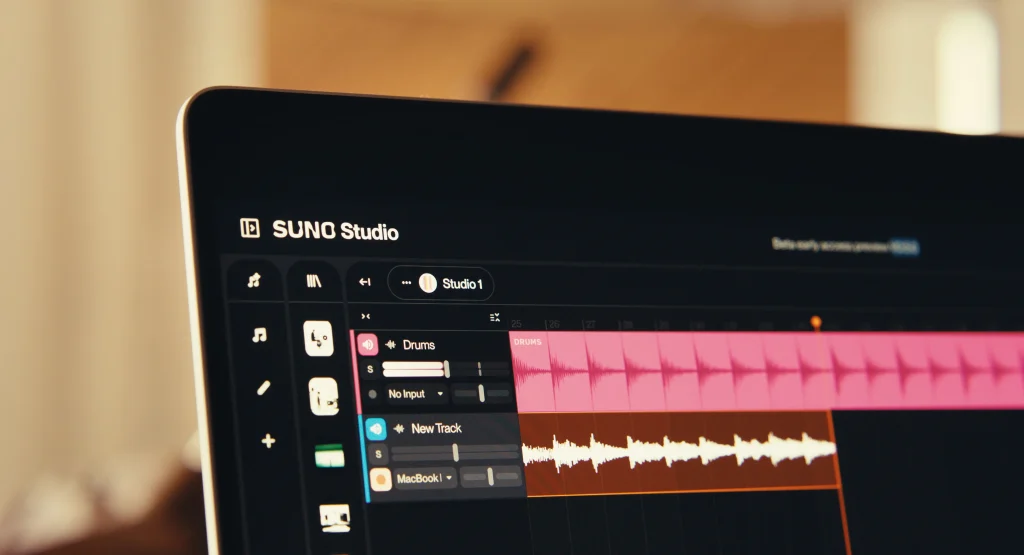
Suno turned “type a prompt, get a song” from party trick into production tool. The current v5.5 flagship generates full tracks — vocals with natural vibrato, breath and phrasing that finally shed the robotic AI signature — and its new personal-voice feature builds a custom vocal model from 60–90 seconds of your own audio. With 100M+ users and a Warner Music licensing deal alongside ongoing UMG/Sony lawsuits, Suno sits at the exact centre of music's AI reckoning.
Pricing is approachable: Free tier for experimenting, Pro at $10/month (2,500 credits), Premier at $30/month (10,000 credits) — with the honest caveat that heavy editing and stem regeneration burn credits fast; polished single tracks can consume $40-equivalent in credits per creator reports.
Our verdict: Suno is the best consumer AI music generator available — v5.5 vocals genuinely impress, the workflow is instant, and commercial rights come with paid tiers — as long as you understand the credit math and the unsettled copyright landscape. Score: 8.6 / 10.
→ Try Suno — see current pricing

What Suno does and who it serves
Type a style-and-topic prompt (or full custom lyrics), pick a genre direction, and Suno composes, arranges, sings and mixes a complete track in under a minute. The audience map: content creators needing background music without licensing anxiety, marketers building jingles and ad beds, songwriters sketching demos at idea-speed, and the hobbyist wave making birthday songs and inside jokes into bangers. Professional producers use it as sketchpad rather than final master — the stems export supports that workflow.
v5.5 and the personal voice era
The v5 generation solved AI music's vocal problem — the human phrasing reviewers keep flagging as the leap — and v5.5's custom voice models shift the pitch from “make a song” to “make MY song”: upload a minute of your voice, and the engine sings your lyrics as you. Editing depth grew alongside: section rewriting, stem separation, extendable arrangements, cover-style remixing of your own uploads.

Pricing and the credit reality
| Plan | Price | Credits/mo |
|---|---|---|
| Free | $0 | Daily trickle, non-commercial |
| Pro | $10 (~$8 annual) | 2,500 |
| Premier | $30 (~$24 annual) | 10,000 |
The generation itself is cheap; the iteration is not — regenerating sections, splitting stems and polishing burns the allowance, and serious single-track workflows land closer to $40-in-credits than the sticker implies. Budget Pro for casual output, Premier for weekly production.
The copyright picture, honestly
Three facts coexist: paid tiers grant commercial-use rights to your generations; the US Copyright Office holds that fully-AI works cannot themselves be copyrighted (your Suno song is usable but not registrable as yours); and the training-data lawsuits (UMG, Sony active; Warner settled into licensing) leave the foundation contested with a pivotal fair-use ruling pending. Practical translation: monetise on platforms per their AI policies, keep human-authorship layers (your lyrics, your edits) documented, and watch the ruling — the terms could shift.
Suno vs alternatives
Against Udio: Suno's post-v5 vocals lead the human-ness race per reviewer consensus, and its editing suite runs deeper. Against stock-music libraries: infinite customisation versus legal simplicity — different risk profiles. Against hiring musicians: different universe; Suno is the sketch-and-content tier, not the artistry replacement its critics fear or its hype claims.
Pros, cons and limits
Pros: best-in-class vocals; instant full arrangements; personal voice cloning; stems and section editing; commercial rights on paid tiers; Warner licensing legitimacy; huge style range.
Cons: credit burn on serious editing; copyright registrability void; lawsuit overhang; genre depth varies (mainstream styles outperform niche ones); mixing ceiling below human producers.
Suno deals
Annual billing cuts ~20%; promos cycle — check current listings before subscribing, and start Free to learn the credit rhythm before paying.
Inside the Suno workflow: from text box to finished track
The core loop deserves a slower walkthrough, because it explains both the magic and the ceiling. You start with either a simple description ("melancholic Vietnamese indie ballad, female vocal, rainy night") or Custom Mode, where lyrics and style prompt are separated. Suno generates two candidate clips per run, each a full arrangement: intro, verses, chorus, instrumentation, mixed vocal. From there the real work is iterative — Extend continues a promising track past the initial window, Cover re-skins your melody in a new genre, Replace Section rewrites the weak bridge without touching the chorus you love, and Personas save a vocal identity so track eight sounds like the same "artist" as track one.

The craft skill that separates casual output from playlist-ready results is prompt structure. Genre plus era plus mood plus instrumentation plus vocal descriptor consistently outperforms vague adjectives. Square-bracket meta tags inside lyrics — [Verse], [Chorus], [Bridge], [Guitar solo] — give the model an arrangement map, and the difference in song structure is audible immediately. Users who treat the lyrics box as a screenplay rather than a poem get verses that build, choruses that lift and outros that actually end rather than fade into mush.
Feature anatomy: what each tier actually unlocks
The free tier's 50 daily credits translate to roughly ten generations — enough to learn the tool, not enough to finish an EP, and critically, free-tier output carries no commercial rights. Pro at $10/month buys 2,500 monthly credits (~500 songs), commercial use, and priority queue. Premier at $30/month raises the pool to 10,000 credits for production houses and jingle shops running Suno as a rendering farm. The economics are stark against traditional production: a single licensed backing track from a stock library runs $30-80; a session musician demo starts in the hundreds. Pro pays for itself on the first usable track.
| Use case | Traditional cost | Suno cost |
|---|---|---|
| Podcast intro music | $50-200 licensed | ~$0.02 in credits |
| YouTube background bed | $15/mo subscription library | Included in Pro |
| Ad jingle demo | $300-1,500 studio | An afternoon of iterations |

Sound quality: the honest listening test
Blind-testing Suno's v4.5-era output against human productions produces a consistent pattern. On first listen, most casual listeners cannot reliably flag the AI track in pop, lo-fi, EDM and ambient genres — the mix is clean, the vocal is convincing, the structure is right. The tells emerge with attention: consonants occasionally smear, vocal runs repeat signature licks across unrelated tracks, cymbals live in a slightly washed frequency band, and emotional dynamics — the push-pull a human vocalist does with timing — flatten across a full album listen. Genres with dense acoustic detail (jazz trio, fingerstyle guitar, orchestral) expose the model faster than produced pop does.
The practical read: for background beds, content soundtracks, jingles and personal projects, the quality bar is comfortably cleared. For a lead single you want on editorial playlists, Suno output is a demo generator — many artists now draft in Suno, then re-record the winning song with human performance, which may be the tool's most durable professional niche.
The legal landscape you should actually understand
Suno sits mid-litigation: the major labels' suit over training data is unresolved, and the outcome will shape the whole category. What is contractually clear today: paid-tier users own commercial rights to their outputs under Suno's terms, free-tier users do not, and platforms like Spotify and YouTube currently accept AI-generated music with proper disclosure (DistroKid and similar distributors ask you to flag it). The open risks are upstream — if training-data rulings go badly, the terms could shift. The pragmatic hedge used by working creators: treat Suno tracks as work-for-hire assets in client projects with indemnification language, keep provenance records of your prompts and generations, and avoid cloning any identifiable artist's voice or style by name, which Suno blocks anyway.
Suno vs Udio vs stock libraries: the three-way decision
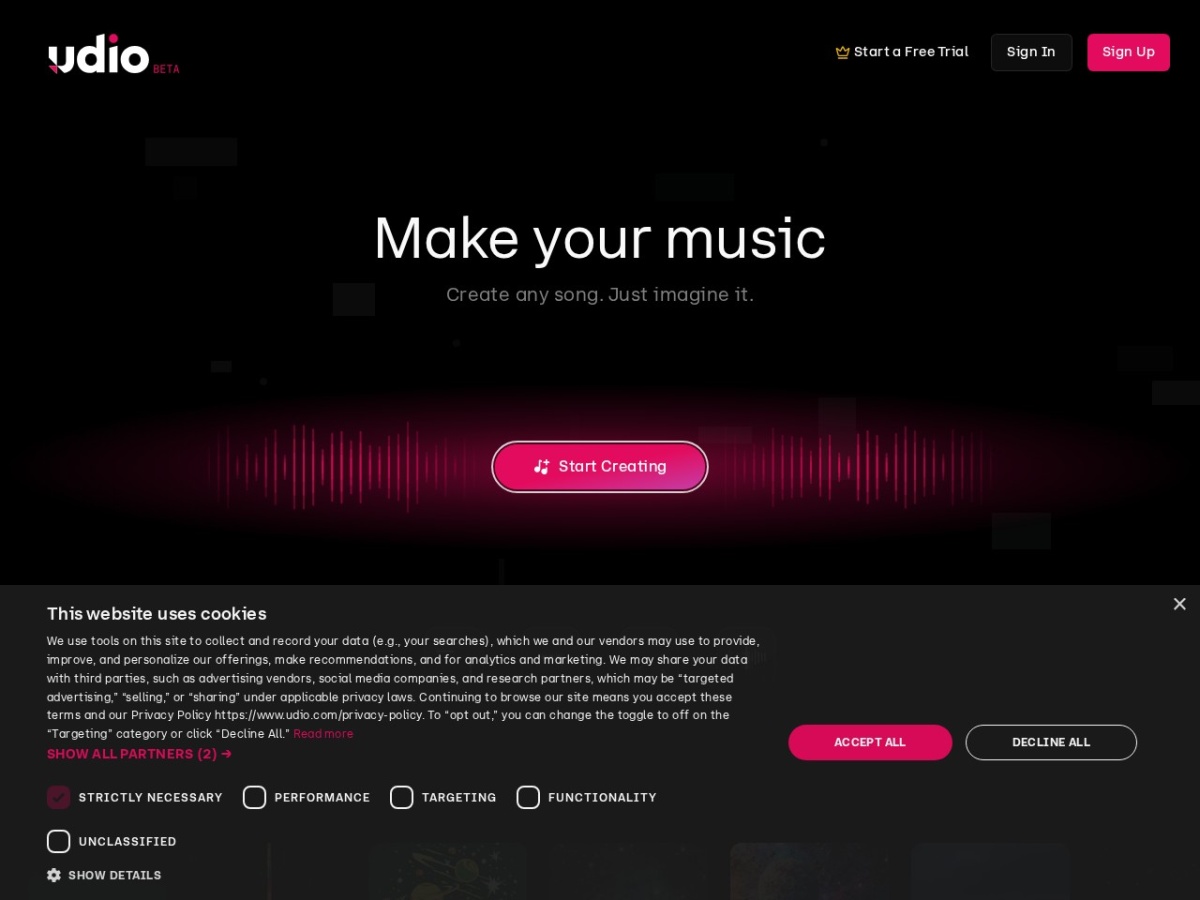
Udio, the closest rival, trades differently: marginally better vocal realism on some genres, slower generation, a fussier editing loop and a smaller feature surface — Suno's Extend/Cover/Persona toolkit is the more complete production environment. Stock libraries (Epidemic Sound, Artlist at $10-17/month) offer human-made certainty and pre-cleared licensing but zero customisation — you search, you settle. Suno inverts that: exact-fit music on demand, with the legal caveats above. Teams producing volume content increasingly run Suno first and fall back to stock when a genre exposes the model.
Common mistakes that waste credits
First: regenerating whole songs when Replace Section would fix the one weak bar — the single biggest credit leak. Second: prompting genre only ("pop song") and hoping; specificity is free and the model rewards it disproportionately. Third: ignoring Personas, then wondering why a ten-track project sounds like ten different bands. Fourth: writing lyrics with dense internal rhyme the model garbles — simpler scansion sings cleaner. Fifth: publishing free-tier output commercially, which violates terms and creates exactly the paper trail you do not want during an industry lawsuit.
A 30-day plan to ship real music with Suno
Week one: burn free credits learning prompt anatomy — same lyric, five genre prompts, study what changes. Week two: upgrade to Pro, define one Persona, draft a five-track concept. Week three: iterate ruthlessly — Extend the keepers, Replace weak sections, Cover one track into an acoustic version for range. Week four: master externally (a single pass through a tool like BandLab mastering tightens the low end noticeably), add disclosure tags, distribute. Creators who follow this arc typically land 3-4 releasable tracks from roughly 150 generations — a hit rate that would have cost four figures in studio time in 2020, and now costs ten dollars and a month of evenings.
Suno for Vietnamese and non-English creators
An under-covered strength: Suno handles Vietnamese lyrics — tones included — far better than most expected, and the same holds across Spanish, Japanese, Korean and Hindi. Pronunciation is not native-perfect; diacritics occasionally collapse into approximations, and fast rap phrasing in tonal languages exposes the seams. But for ballads and mid-tempo pop, Vietnamese-language output is recognisably correct and emotionally plausible, which opens a real lane: local-language content music (intros, TikTok sounds, cafe playlists) that global stock libraries simply do not stock. The technique that helps most is phonetic spacing — breaking long compound phrases across lines so the model breathes where a singer would — and keeping choruses to short, high-vowel words that sing well in any language.
For creators serving the Vietnamese market specifically, the arbitrage is straightforward: local-flavoured background music for brand videos, spa and restaurant ambience playlists, and wedding slideshow soundtracks are all paid services today, fulfilled in hours with a Pro subscription. The disclosure etiquette is the same as English-market work — label AI-generated tracks with distributors — and the cost structure (effectively cents per finished track) leaves margin that human-produced custom music never could at the low end.
Integrating Suno into a content pipeline
The teams getting the most from Suno treat it as infrastructure, not a toy. A YouTube channel producing three videos weekly runs a standing Persona for brand consistency, generates intro/outro/bed variants in one Monday batch, and keeps a rejected-takes folder that becomes B-roll music later. Podcast networks template their prompts — same style string, new episode keyword — so seasonal refreshes take minutes. Agencies quote "custom soundtrack" as a line item, fulfil it with two Suno iterations plus an external mastering pass, and pocket the difference between AI cost and studio-rate perception. None of this requires the API; the web app's workspace organisation and download formats (MP3 and WAV on paid tiers) cover the workflow, and WAV masters drop cleanly into Premiere, CapCut or DaVinci timelines.
The one operational rule worth enforcing: audition on monitors or good headphones before shipping. Suno's mixes flatter phone speakers; low-end mud and cymbal wash reveal themselves on better playback, and a 30-second check prevents publishing a track that falls apart on client AV systems. Combined with the external-mastering habit, this closes most of the audible gap between raw generations and broadcast-usable audio — and it is precisely this last five percent of finishing discipline that separates channels whose AI music goes unnoticed from ones whose comments section calls it out. The tool supplies the song; the pipeline supplies the professionalism, and after a month of reps the whole loop — prompt, iterate, master, ship — compresses to under an hour per finished track, which is the number that ultimately justifies the subscription for anyone producing content at volume rather than chasing a single perfect single.
FAQ
Can I monetise Suno songs?
Paid-tier generations carry commercial-use rights per Suno's terms — platform AI policies and the non-registrable-copyright reality still apply.
How human do vocals really sound?
Post-v5, remarkably: vibrato, breath, phrasing. Blind-test surprise is the standard reviewer reaction.
What is the personal voice feature?
v5.5 builds a custom vocal model from 60–90 seconds of your audio — the engine then sings as you.
Why did my credits vanish?
Editing, stems and regenerations bill beyond initial generation — the workflow cost creators keep flagging.
Is the legal risk mine?
Usage rights are granted but warranties are not; the training-data suits target Suno, not users. Documented human authorship layers are your best hygiene.
The first-week workflow
Day one: Free tier, ten prompts across genres — learn what the engine hears in your words. Day three: custom-lyrics mode, your words on its melodies; the craft gap between prompt-writing and lyric-writing reveals itself. Day five: Pro upgrade if hooked, stems pulled into your editor, the sketch-to-production pipeline tested. Day seven: the honest audit — background-music problem solved instantly, artistry question unresolved as ever, and a subscription decision that finally rests on your actual output rather than the hype. That clarity in seven days is Suno's realest product. Score: 8.6 / 10.
{“@context”:”https://schema.org”,”@type”:”Review”,”name”:”Suno review”,”itemReviewed”:{“@type”:”SoftwareApplication”,”name”:”Suno”,”applicationCategory”:”MultimediaApplication”,”operatingSystem”:”Web”},”reviewRating”:{“@type”:”Rating”,”ratingValue”:”8.6″,”bestRating”:”10″,”worstRating”:”1″},”author”:{“@type”:”Organization”,”name”:”AnalyzeBench”},”publisher”:{“@type”:”Organization”,”name”:”AnalyzeBench”}}



