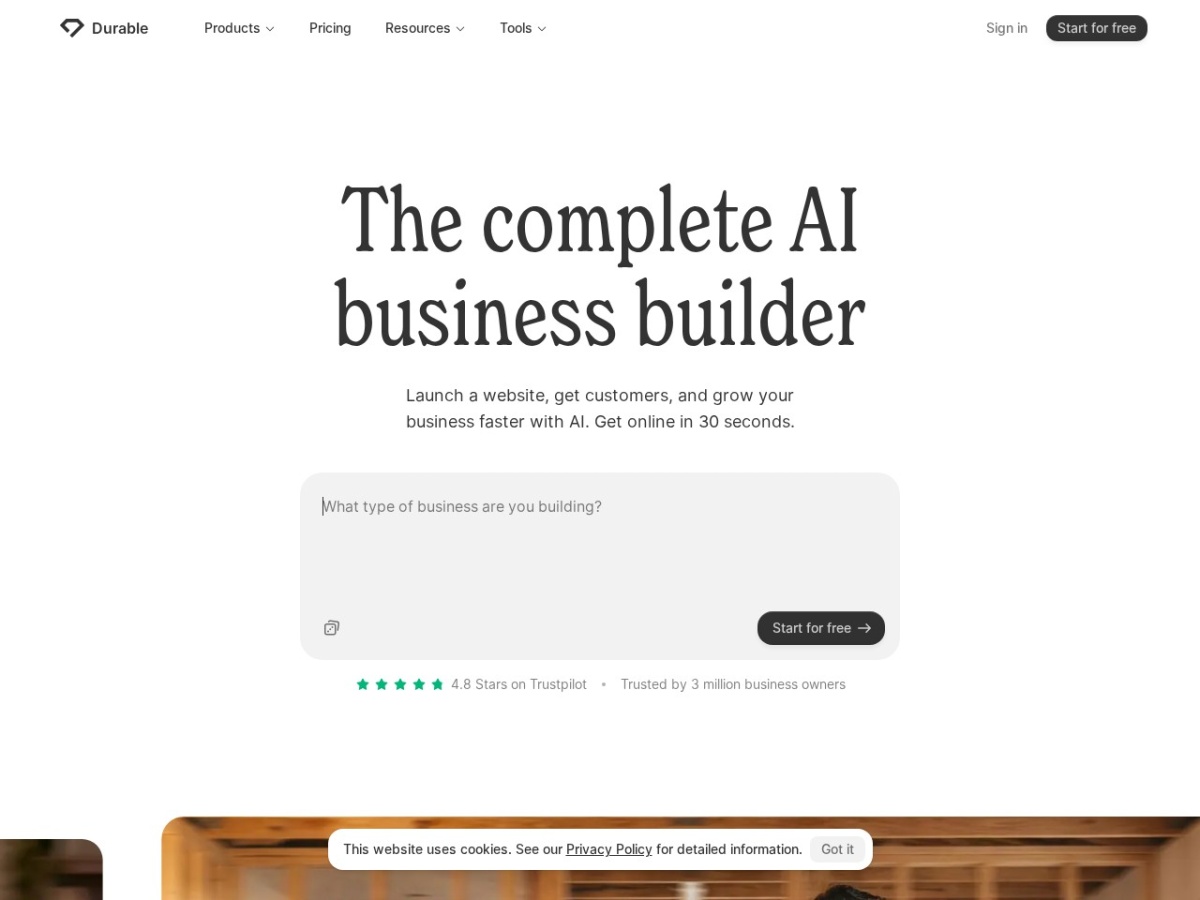
Durable's pitch is a full business website in 30 seconds — and it delivers on the clock. Answer three questions (industry, location, name) and it generates a complete site: copy, images, layout, contact form, done. Behind it sits the actual product: a small-business operating system with CRM, invoicing and marketing tools built in, priced Free, Launch $22–25/month and Grow $85–99/month.
The market answered: 3 million+ businesses generated sites and the Trustpilot average sits at 4.8 — numbers earned from plumbers, cleaners, consultants and landscapers who need to exist online today, not after a web-design project.
Our verdict: the fastest legitimate path from "no website" to "bookable business" for local service companies. Anyone needing distinctive design or real e-commerce hits the ceiling fast — that is Framer or Shopify territory. Score: 8.0 / 10.
→ Try Durable — see current pricing
What makes Durable different
Everyone claims AI site generation; Durable's edge is generating a serviceable one instantly and surrounding it with the boring infrastructure a one-person business actually runs on: a CRM logging every form fill, invoicing that gets you paid, review collection, basic SEO and even AI-written marketing. The site is the door; the operating system is the product.
Pricing
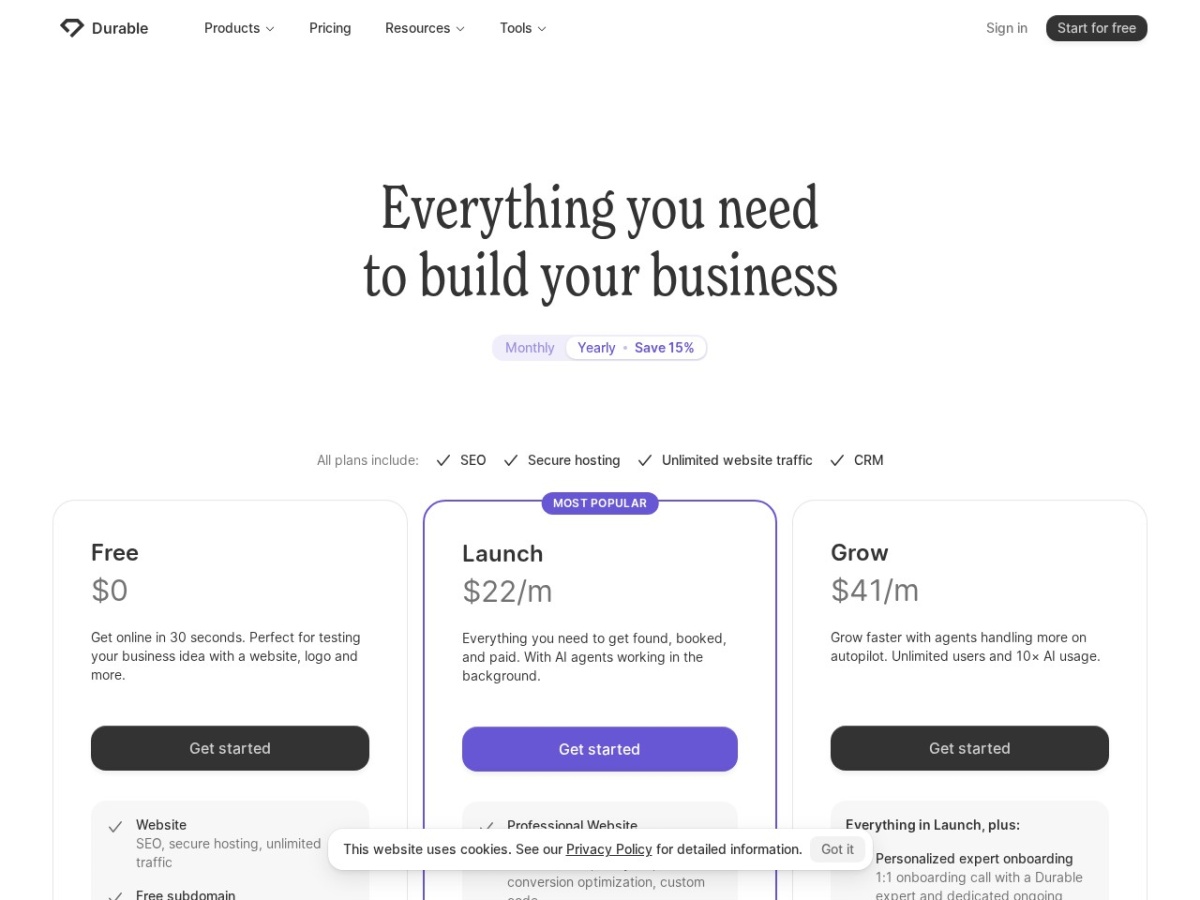
| Plan | Price | Gets you |
|---|---|---|
| Free | $0 | Generated site, Durable subdomain |
| Launch | $22–25/mo | Custom domain, CRM, invoicing, no branding |
| Grow | $85–99/mo | Marketing automation, deeper tools |
Launch is the real plan for most: domain plus operations tooling at less than most builders charge for the site alone.
The 30-second reality check
The generation is real — 30 seconds to a coherent site with industry-appropriate copy and stock imagery. The honest next hour: swap generic photos for your own, rewrite the AI copy's blandest lines, wire the domain. The editor is deliberately simple — section-based, not pixel-based — which is a feature for its audience and a wall for designers.
Durable vs the alternatives
Against Wix/Squarespace: they win on design range, lose badly on speed and bundled CRM/invoicing. Against Framer: different species — Framer is a design tool with AI assists; Durable is a business tool with a site attached. Against WordPress: no maintenance, no plugins, no flexibility — the trade is deliberate. The lane: service businesses whose site is a lead form, not a brand statement.
Pros, cons and limits
Pros: genuinely instant site; CRM + invoicing included; 4.8 Trustpilot at 3M+ businesses; near-zero learning curve; AI marketing copy included.
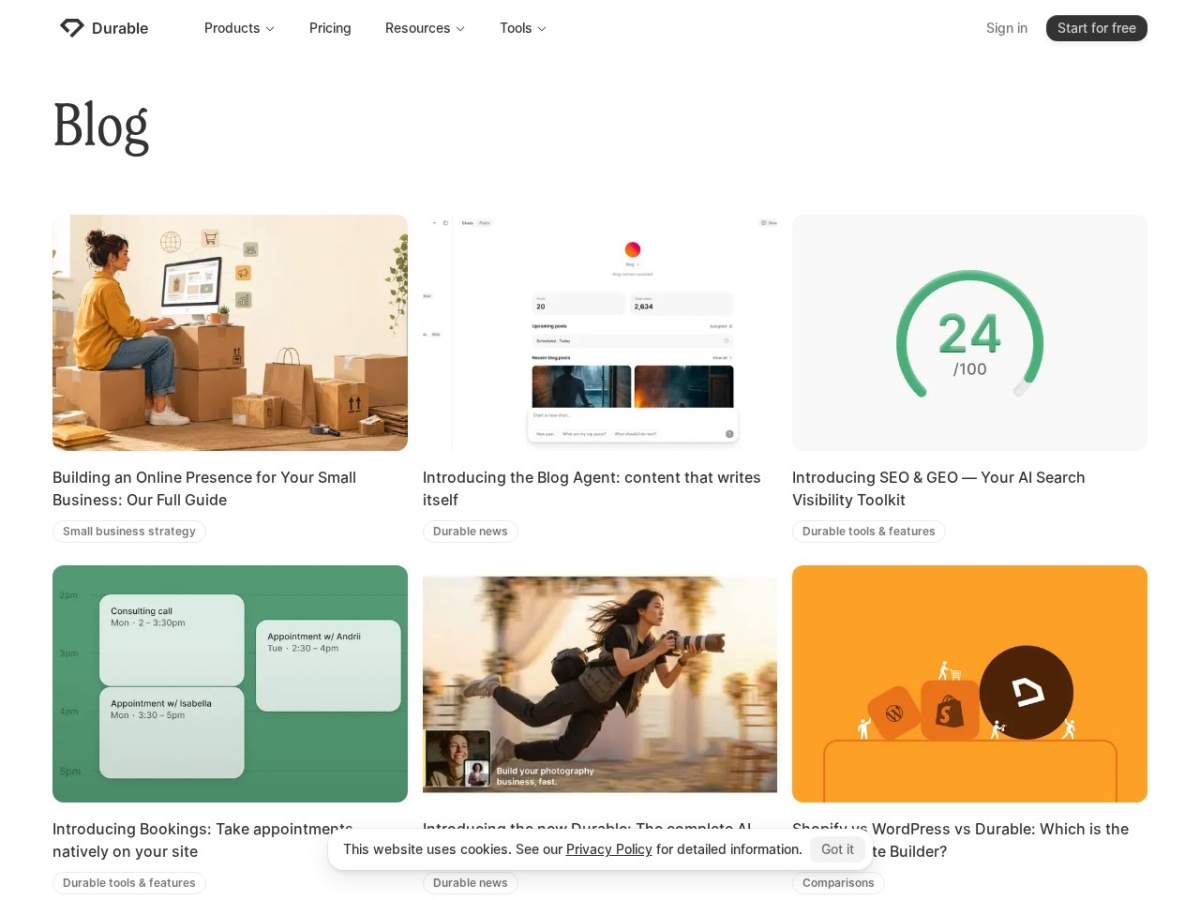
Cons: rigid template feel — sites resemble each other; no real e-commerce; limited design control; AI copy needs a human pass; blog/SEO tooling is basic.
Durable deals
Annual billing trims both paid tiers; the free generation costs nothing but the three answers — the rational first step.
The operating system behind the 30-second site
The generation demo gets the headlines, but Durable's retention comes from the stack underneath, so each piece deserves its audit. The CRM is genuinely solo-operator-shaped: every form fill, invoice recipient and review request lands in one contact list with notes, tags and follow-up reminders — trivially unimpressive to anyone who has used Salesforce, and exactly the difference between chasing leads from a notes app and actually following up, which is the real productivity gap in micro-business. Invoicing covers estimates, invoices, online payment collection and automatic reminders for the unpaid — the awkward money conversation delegated to software, which owners consistently rank the feature they use most. The marketing layer — AI-drafted emails, social posts and Google Business Profile content — produces serviceable-not-brilliant copy whose real value is existence: the difference between a business that posts monthly and one that never posts is measurable in local search, and Durable makes the monthly post a two-minute approval rather than a creative project.
The strategic read: Durable is not competing with website builders so much as with the shoebox of disconnected tools (or nothing at all) that most sub-five-person businesses actually run on. Judged against Wix, it loses design battles; judged against a paper diary, a Zalo inbox and un-invoiced jobs, it is a business-practice upgrade wearing a website's clothes.
Pricing scrutiny: what each tier is really for
| Plan | Price | Who it fits |
|---|---|---|
| Free | $0 | Validating that you want a web presence at all — subdomain, branding on |
| Launch | $22-25/mo | The real product: custom domain, CRM, invoicing, no Durable branding |
| Grow | $85-99/mo | Marketing automation at volume — most solo operators never need it |
The honest tier guidance cuts against upsell logic: Launch is the correct plan for nearly everyone, and the Grow jump only pays when the automated marketing demonstrably books jobs — a threshold most users should test toward, not presume. Against the alternatives' true cost — Wix at comparable monthly rates plus separate invoicing and CRM subscriptions, or WordPress's hosting-plugins-maintenance stack plus the hours — Launch's bundle maths is the quiet argument the 30-second demo never makes.
The template-sameness problem, honestly weighed
The strongest criticism — Durable sites resemble each other — is true and worth decomposing. Structurally, the generated sites share bones: hero, services, testimonials, contact. The editor's section-based customisation changes colours, fonts, images and copy but not fundamental architecture, and a designer will always spot a Durable site. The counter-question is whether the customer choosing a plumber does: conversion in local services runs on proof signals — real photos of real jobs, visible reviews, exact services with prices, a phone number that answers — and a template site carrying strong proof outperforms a bespoke site with stock photos every time. The practical guidance follows: spend your differentiation hour on proof, not layout — replace every stock image with phone photos, wire the review widget to your actual Google reviews, and write service descriptions in the first person. Businesses that do this stop reading as templates regardless of the bones.
SEO reality for local businesses
Durable handles the technical floor competently — clean pages, mobile responsiveness, meta tags, fast loads on its hosting — and the AI will draft location-and-service keyword copy on request. The ceiling is equally real: no advanced schema control, a basic blog engine, and none of the programmatic content tooling that competitive SEO demands. For the actual battlefield of its users — local search — this matters less than the orthodoxy assumes, because local rankings are decided primarily by the Google Business Profile: reviews, categories, photos, response rate. The winning stack for a service business is Durable as the credible destination plus disciplined GBP operation, with the site's job being conversion of the clicks GBP earns. Businesses with genuine content-SEO ambitions — competing across a metro area on informational queries — have outgrown the tool and should hear that plainly rather than blame the builder later.
Who should not buy Durable
The disqualification list saves more regret than the recommendation. E-commerce beyond a couple of pay-links: Shopify territory, full stop. Brand-led businesses — studios, restaurants trading on atmosphere, anyone whose site is the product experience: Framer or a designer. Content publishers planning hundreds of articles: WordPress's ecosystem exists for exactly that. Teams with a developer on staff: the constraints will chafe within a quarter. Regulated industries needing precise legal layouts and document workflows: purpose-built platforms. What remains is Durable's actual market, and it is enormous: the majority of the world's small service businesses, for whom the honest competitor is not another builder but the absence of any web presence at all — and against that competitor, a same-day, $25/month, batteries-included launch is close to an unfair fight.
The 90-day small-business sprint
Month one: the same-day launch protocol — generate, personalise with real photos, connect domain, submit GBP, request reviews from your last ten customers. Month two: operationalise the stack — every job flows through an estimate and invoice, every inquiry gets CRM-logged, the first AI-drafted monthly update goes out. Month three: read the numbers Durable surfaces — where visitors come from, which services get inquiries, invoice payment lag — and make one business decision from each. That final habit is the tool's deepest value: for businesses that never had instrumentation, three months of basic visibility routinely reshapes pricing, service mix and follow-up discipline — improvements worth multiples of the subscription that no website builder, however beautiful, delivers by itself. Score: 8.0 / 10.
Migration paths: arriving at and leaving Durable
Both directions deserve planning notes. Arriving: businesses replacing an old site should map their existing URLs before switching DNS — Durable's redirect handling is basic, and local sites often have years of accumulated links from directories and community pages whose equity is worth preserving; an hour listing old URLs against new sections prevents the silent traffic leak that follows most small-business migrations. Import is manual-but-small: contacts paste into the CRM, images re-upload, and the AI regenerates copy faster than copying the old site's usually-worse text. Leaving: the honest lock-in assessment is moderate — there is no code export in the take-your-site-elsewhere sense, so outgrowing Durable means rebuilding on the next platform. What travels is everything that matters commercially: your domain (always yours), your contact list (CSV export), your reviews (they live on Google, not the site), and your GBP standing. In practice the rebuild cost at the moment of outgrowing — by definition a moment of business success — is a day on the next platform, which is why the lock-in question, while fair, rarely survives contact with the actual economics.
The pattern operators report as ideal: treat Durable as the launch-and-validate platform with a clean conscience, knowing the assets that compound (domain authority, review base, customer list) all outlive the builder choice. Platform anxiety is a luxury of businesses that already exist; Durable's job is getting you to that problem.
The verdict, weighed against three million users
The 4.8 Trustpilot average across a base this large deserves its closing interpretation, because review distributions at scale tell you what a product actually is. The praise clusters around exactly what this review found — speed, the relief of bundled invoicing, support quality — and the complaints cluster around the ceilings this review mapped: design rigidity, e-commerce absence, AI copy blandness. That alignment is the mark of a product that is precisely what it claims, serving precisely whom it claims — rarer in this category than it should be. For its actual customer, the small service business choosing between Durable and nothing, the recommendation is simple: take the free generation today, judge the draft against your current web presence, and let the 30 seconds argue for themselves. Score: 8.0 / 10.
Getting the most from the AI assistant day-to-day
Owners who extract full value from Durable converge on a handful of habits worth listing as a starter routine. Regenerate selectively: the AI rewrites any single section on request, so refreshing a tired services blurb is a ten-second ask rather than a page rebuild — but always personalise its output with one concrete detail (a neighbourhood name, a real turnaround time, an actual price) because specificity is what the generator cannot know and what customers actually trust. Use the review-request automation relentlessly: it is the single highest-ROI feature in the stack, since each review compounds both GBP ranking and site conversion. Let the AI draft the monthly Google post and email, then spend your two minutes making one sentence sound like you. And check the built-in analytics on a fixed weekday — not obsessively, just consistently — because the patterns that matter at micro-business scale (which service page gets inquiries, when calls spike) emerge from regular glances, not dashboards studied once a quarter.
None of this is sophisticated, which is exactly the point and the product's deepest design decision: every feature is shaped for someone whose real job is plumbing or consulting or cleaning, not marketing. The businesses that thrive on Durable are not the ones that master the tool — there is deliberately little to master — but the ones that let its defaults enforce the basic commercial hygiene most micro-businesses skip. As a website builder it is merely good; as a habit system for being findable, credible and paid, it is quietly excellent, and that is the review that matters. Score: 8.0 / 10.
FAQ
Is the 30-second claim real?
Yes for the draft; budget an hour of personalisation before sharing the link. Still same-day versus weeks for traditional builds.
Can I sell products on it?
Payments and invoicing, yes; real product catalogs, carts and inventory, no — that is Shopify's job.
Will my site look like other Durable sites?
Structurally, often. Your photos, reviews and service specifics differentiate more than the template does at this market tier.
Is the built-in CRM serious?
Serious enough for a solo operator — leads, contacts, follow-ups. Growing teams graduate to HubSpot-class tools later.
Durable or Framer?
Service business needing leads this week: Durable. Brand, portfolio or startup needing distinctive design: Framer. The two barely compete.
The same-day launch protocol
Morning: generate, then spend one focused hour replacing stock images with phone photos of real work, rewriting the hero line in your own words, and listing exact services with prices. Afternoon: connect the domain on Launch, submit the site to Google Business Profile, and turn on review requests to your last ten customers. By evening a business that did not exist online at breakfast is findable, bookable and invoicing — which is the entire, honest promise of the product. Score: 8.0 / 10.