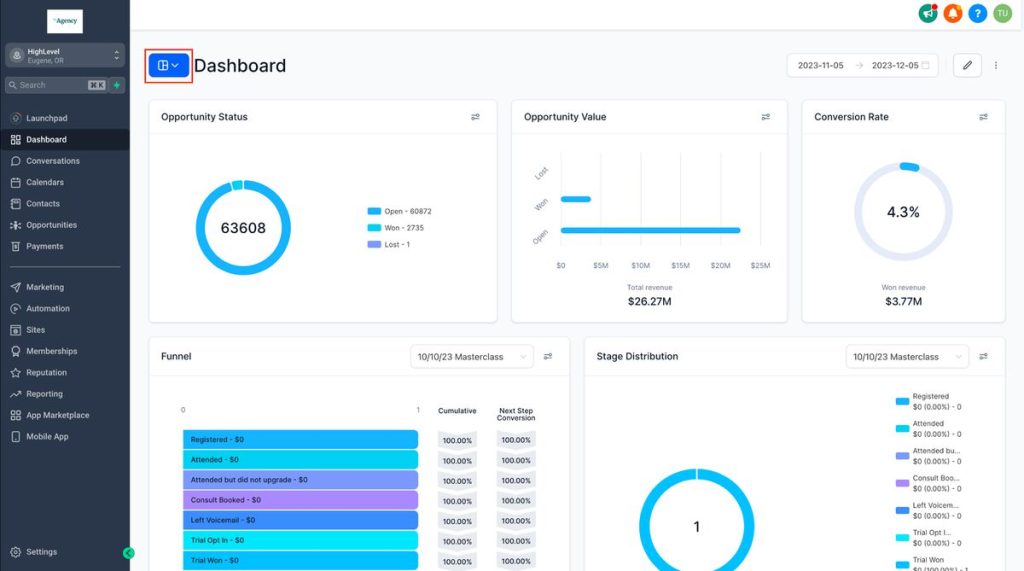
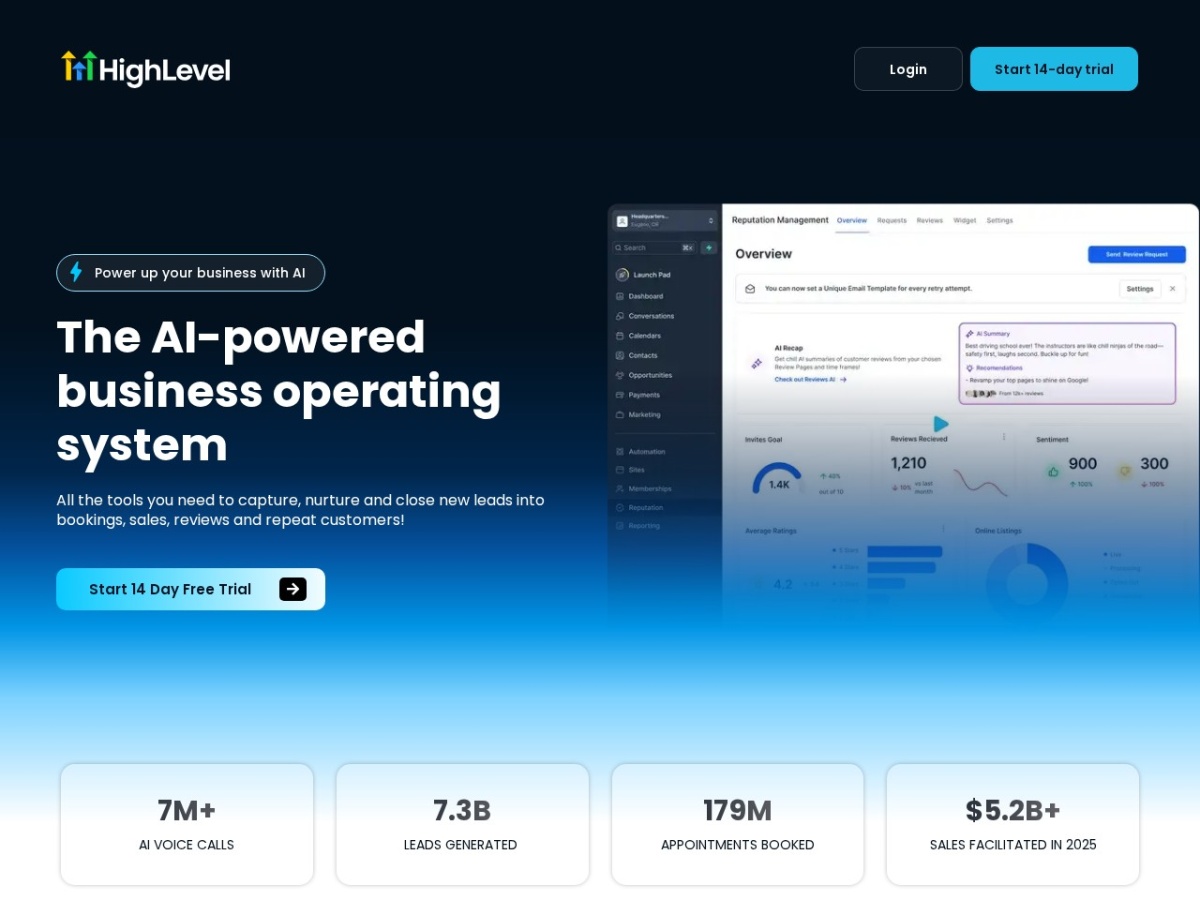
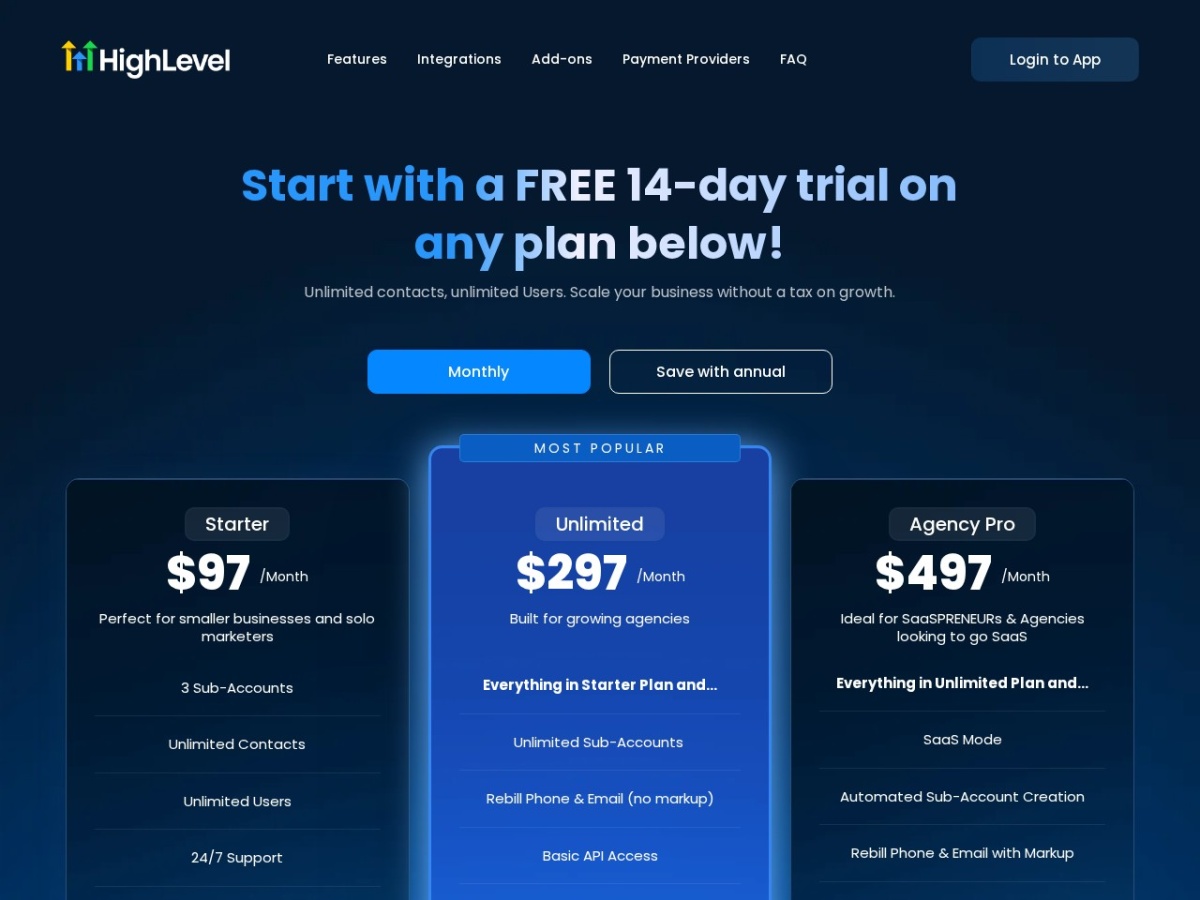
GoHighLevel is the all-in-one that actually means it — built for agencies first, and it shows everywhere. CRM, funnels, websites, email, SMS, calling, calendars, reputation management, social scheduling, courses and now a heavy AI layer, in one subscription: Starter $97/month, Unlimited $297, SaaS Pro $497 (annual billing ~15% less), plus usage-billed email/SMS/voice on top.
The headline act is the SaaS mode: agencies white-label the entire platform and resell it to clients under their own brand at their own prices — which is why GHL's real customer base is not businesses but the agencies who serve them, and why its affiliate and reseller economy is the loudest in software.
Our verdict: for marketing agencies consolidating a client stack — or productising one — nothing matches the leverage per dollar. For a single small business, it is a truck bought for a grocery run: capable, and more platform than most need. Score: 8.3 / 10.
→ Try GoHighLevel — see current pricing
What makes GoHighLevel different
Sub-accounts are the architecture: each client lives in an isolated workspace with its own CRM, funnels, automations and phone numbers, cloned from your template snapshots in minutes — onboarding a new client becomes a deployment, not a project. The unified inbox threads SMS, email, calls, WhatsApp and social DMs per contact. Workflow automation reaches everything native (no Zapier tax between your own tools), and the AI layer — voice agents answering calls, conversation bots booking appointments — ships built-in rather than bolted on.
Pricing
| Plan | Price | The unlock |
|---|---|---|
| Starter | $97/mo | Full features, 3 sub-accounts |
| Unlimited | $297/mo | Unlimited sub-accounts, API, branded desktop app |
| SaaS Pro | $497/mo | White-label resale, rebilling with markup |
→ Get started with GoHighLevel
Usage is metered separately (email ~$0.68/1k sends, SMS ~$0.008/segment, voice ~$0.014/min) and the AI unlimited add-on runs ~$97/sub-account — honest budgeting reads the meter, not just the plan.
The operator experience
The truth every review owes you: GHL is powerful before it is polished. The interface is dense, occasional bugs ship, and the learning curve is measured in weeks — the platform rewards operators who invest in snapshots, naming conventions and testing discipline, and punishes casual configuration. Support is 24/7 and variable; the community (enormous, commercially motivated) often answers faster.
GoHighLevel vs the stack it replaces
The comparison is not against one tool but a stack: CRM (HubSpot starter), funnels (ClickFunnels $97+), email (ActiveCampaign $49+), scheduling (Calendly), reputation (Birdeye), phone (CallRail) — $300-600/month of subscriptions consolidated into $97-297, with native integration instead of Zapier glue. Against HubSpot proper: HubSpot wins polish, reporting depth and enterprise trust; GHL wins price, SMS-first workflows and white-label economics. Against ClickFunnels: funnels are one module here, not the product.
Pros, cons and limits
Pros: genuine all-in-one consolidation; snapshot cloning; white-label SaaS mode; native AI voice/chat agents; usage pricing transparent; relentless shipping cadence.
Cons: UI density and rough edges; real learning curve; usage costs surprise the unprepared; single-business buyers overpay for unused breadth; the affiliate hype machine makes neutral research hard.
GoHighLevel deals
14-day free trial (extended trials common via partners); annual billing ~15% off. Test with one real client workflow before migrating a book of business.
Snapshots: the feature the subscription actually buys
If sub-accounts are the architecture, snapshots are the business model. A snapshot captures an entire configured sub-account — pipelines, funnels, calendars, automation workflows, email/SMS templates, custom fields, tags — as a deployable template. Build the perfect setup for one dental clinic, and every future dental client onboards in twenty minutes with proven machinery instead of weeks of configuration. The compounding is real: agencies iterate their niche snapshot with every client learned lesson, and the snapshot economy (marketplaces selling niche snapshots for $300-3,000) demonstrates the asset value. The strategic consequence deserves emphasis for anyone considering the platform: GHL converts agency service delivery from custom labour into product deployment, which is the actual justification for its price versus point tools — you are not buying software, you are buying a factory for client environments.
The discipline that separates snapshot professionals from hobbyists: version notes, a staging sub-account for testing changes, and ruthless naming conventions — a snapshot with "Workflow 12 (copy) (FINAL v3)" entropy deploys chaos at scale exactly as efficiently as it deploys order.
The AI employee, audited
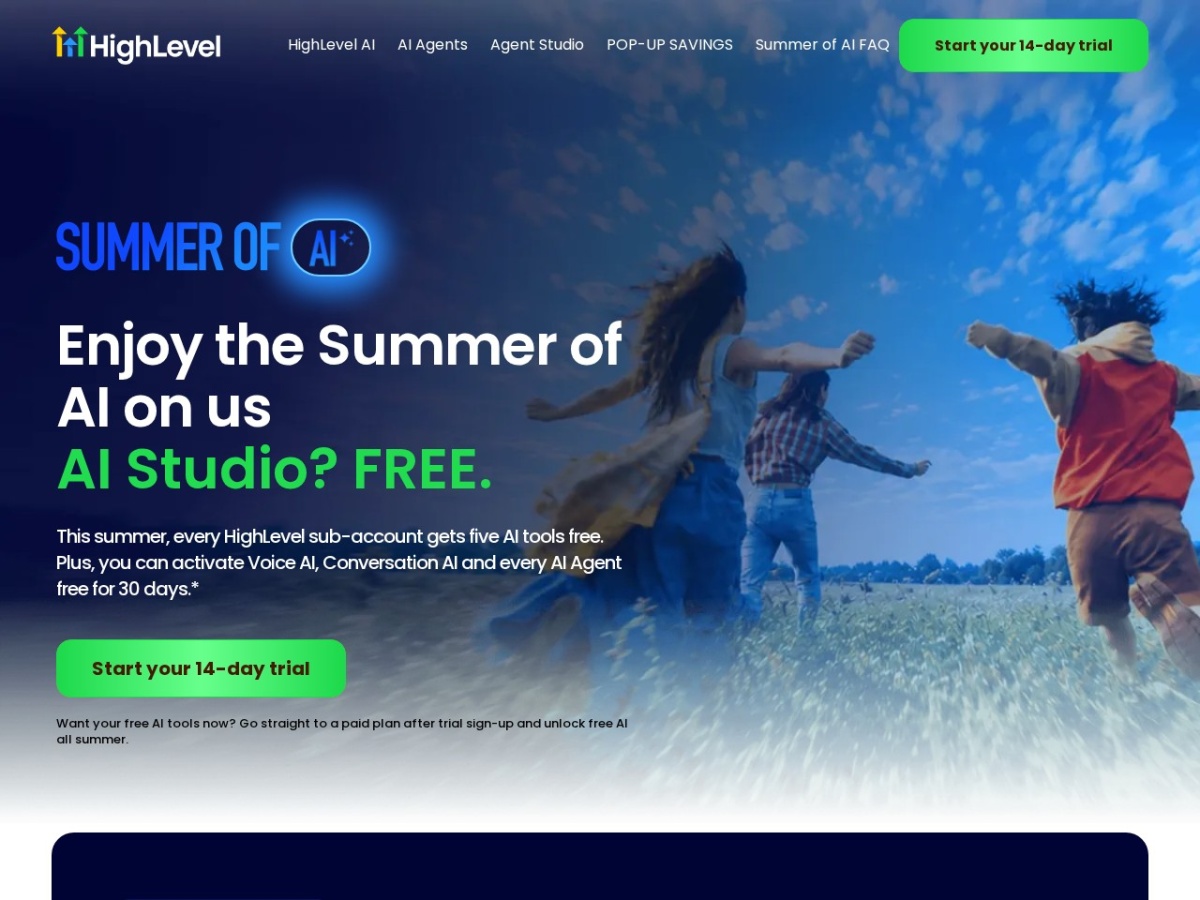
GHL's AI suite — Voice AI answering and booking calls, Conversation AI handling SMS/chat threads, content and workflow AI assists — ships native and bills by usage (or ~$97/sub-account unlimited). Production reports cluster into a consistent verdict. Voice AI on structured missions performs: after-hours answering, appointment booking against real calendars, missed-call recovery, FAQ triage — callers complete bookings at rates that pay the add-on many times over for service businesses bleeding missed calls. Where it strains: nuanced objection handling, emotionally loaded conversations, and callers who refuse the script — the 20% that still needs humans, and the reason the deployment pattern is AI-first-human-escalation rather than replacement. Conversation AI mirrors the pattern in text: superb at speed-to-lead (responding within seconds of a form fill, the metric that moves close rates most), adequate at qualifying, wrong for closing. Configured with honest scope, the AI layer is the strongest new revenue argument in the platform's pitch to agencies: "we answer every call, 24/7" is a sellable sentence.
Usage billing: the real invoice
The plan price is the cover charge; the meter is the bill. Realistic modelling for a 10-client agency: email at ~$0.68/1k sends (a modest 50k/month across clients ≈ $34), SMS at ~$0.008/segment (10k segments ≈ $79 — and multi-segment messages multiply), voice minutes, phone numbers (~$1-3 each monthly), premium workflow actions, and AI usage. A typical mid-activity book runs $100-400/month of usage on top of the $297 plan — still crushing the replaced stack's cost, but the agencies that get surprised are the ones reselling to clients at flat rates without metering. The professional pattern: rebill usage with margin through the SaaS configurator, monitor per-sub-account consumption weekly, and set wallet alerts — the platform provides the meters; reading them is the job.
SaaS mode economics, worked through
The $497 tier's promise deserves a concrete model. You white-label GHL as "YourBrand CRM", price plans at (say) $97/$197/$297, and rebill usage with markup. Fifteen SaaS clients at an average $197 gross $2,955/month against the $497 platform cost plus usage — a software business with 70-80% margins running on someone else's R&D. The honest caveats from operators actually doing it: churn is real when the underlying product's complexity leaks through your brand (your support burden, not GHL's), differentiation demands configured value (niche snapshots, onboarding, training) rather than raw platform resale, and the market of businesses wanting a $197 all-in-one is finite in any local niche. The pattern that works: agencies converting existing service clients to a software-plus-service bundle, where the SaaS fee stabilises revenue between projects. The pattern that fails: cold-selling white-label software with no service layer against GHL's own marketing and a thousand identical resellers.
Learning curve survival guide
The platform's density yields to sequence. Week one: one sub-account, contacts, one pipeline, one calendar — ignore everything else. Week two: the missed-call text-back automation (the highest-ROI five minutes in the platform) and one nurture workflow. Week three: funnel builder for one real offer, connected to the pipeline. Week four: snapshot what works, then — and only then — explore the long tail (memberships, courses, communities, invoicing, social planner). The failure mode is touring features instead of shipping one client outcome; the platform rewards operators who treat it like infrastructure and punishes tourists with option paralysis. Budget honestly: two focused weeks to competence, a quarter to mastery, and the official certifications if the agency positioning benefits from them.
Reputation, reporting and the client-retention machinery
The modules that quietly renew agency contracts deserve their own audit. Reputation management automates the review cycle — post-service SMS requesting a Google review, routing satisfied customers to the public form and unhappy ones to a private feedback channel — and the compounding local-SEO effect of steady review velocity is the most demonstrable ROI line in most local-business engagements. The reporting dashboards close the loop: white-labeled client reports showing calls answered, leads generated, reviews earned and pipeline value make the agency's value visible monthly, which is retention insurance no deliverable-based reporting matches. Combined with call tracking (attribution per campaign number) and the unified conversation history, the platform hands agencies the evidence layer that justifies retainers — arguably worth more than any individual marketing feature, because clients cancel what they cannot see working.
The synthesis after the full tour: GoHighLevel is not the best CRM, funnel builder, email platform or booking tool — it is the best consolidation of adequate versions of all of them, priced so the bundle beats the stack, with white-label economics no rival matches. Agencies and agency-shaped operators should trial it against a real client workflow this month; everyone else should buy it configured from one of them. Score: 8.3 / 10.
GHL for non-agencies: the honest fit test
Because the affiliate machine pushes GHL at everyone, the single-business fit test deserves plain language. A local service business (clinic, gym, contractor, salon) benefits from perhaps six GHL capabilities: missed-call text-back, booking calendar, review automation, a simple pipeline, SMS reminders and a nurture sequence. Configured well, those six justify $97/month against the revenue of even one recovered customer weekly — but configuration is the catch, and the two honest paths are buying it pre-configured from an agency (paying $197-297 for the software-plus-setup bundle) or committing a fortnight of owner time to the learning curve. What a single business should not do is buy raw GHL expecting plug-and-play — the platform assumes an operator, and the gap between its potential and a default install is where the one-star reviews are written. Course creators and coaches sit in a similar calculus: the memberships, communities and email tooling replace a Kajabi-class stack credibly, but only for builders comfortable in dense software; the convenience-priced alternatives exist for a reason.
The final word belongs to the meter: whatever your entry path, watch the usage dashboard for the first sixty days the way you would watch a new employee — the platform's costs, like its value, are activity-shaped, and the operators who thrive on GHL are precisely the ones who read their own numbers. Everything about this platform rewards operators and punishes passengers; price yourself honestly into one category before subscribing. Score: 8.3 / 10.
The GHL community and learning ecosystem
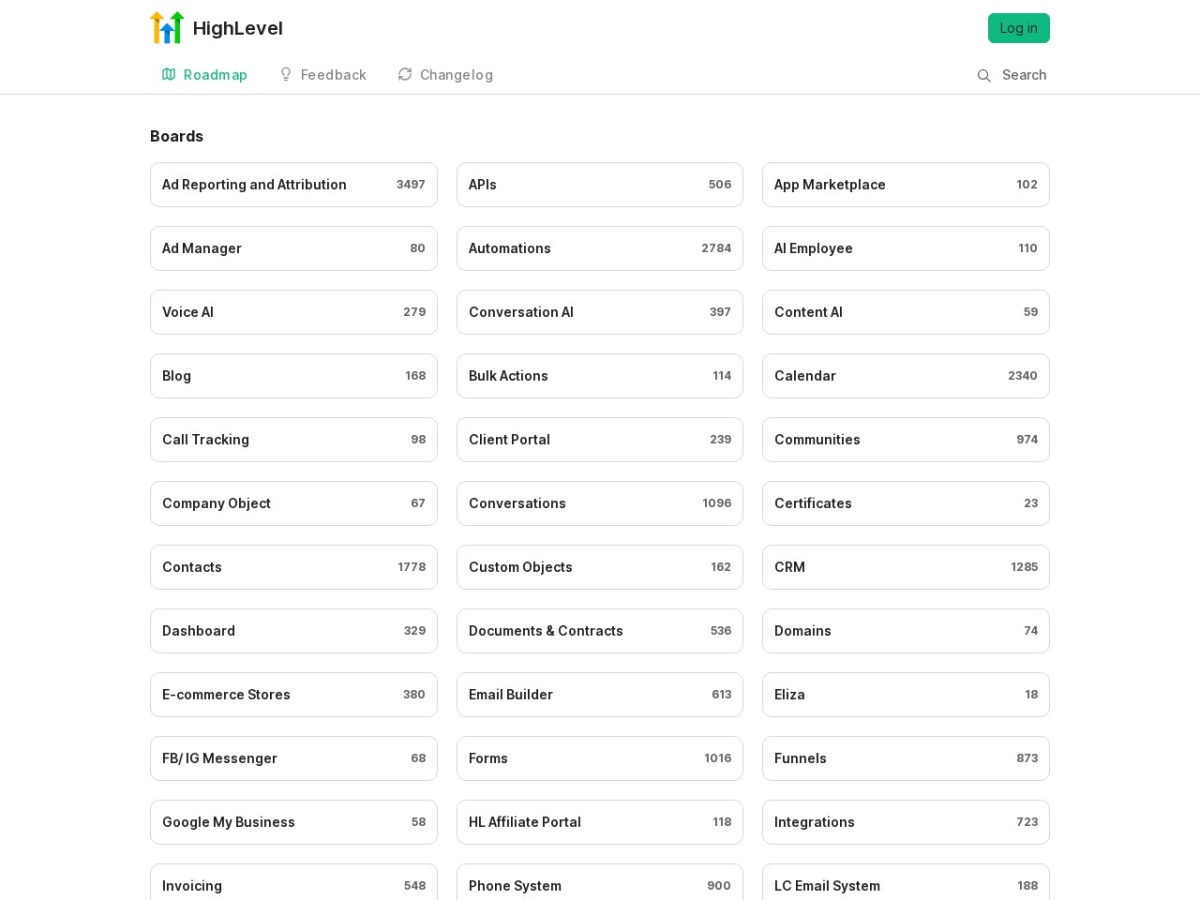
A platform this dense lives or dies by its support periphery, and GHL's is uniquely commercial: the official 24/7 chat and knowledge base cover the documented paths, while the real velocity lives in the Facebook groups and YouTube channels of agency operators whose businesses depend on mastery — thousands of walkthroughs, snapshot teardowns and workflow recipes, updated faster than documentation because their creators sell against currency. The caveat inside the generosity: much community content doubles as affiliate funnel, so triangulate any "best setup" advice against the platform docs before rebuilding your stack around it. The official certification program (admin and advanced tracks) earns its fee for agency positioning — clients buying white-label software respond to credentials — and the ideas board's public roadmap voting gives the community measurable product influence, which partly explains the shipping cadence's alignment with operator needs.
The verdict in one operator's sentence
Strip the feature tour and the platform reduces to a single trade every agency evaluates correctly within a month: GoHighLevel exchanges polish for leverage, and the operators who accept the exchange — investing the fortnight, building the snapshot, reading the meter — run client books at margins the point-tool stack cannot reach, while the operators who wanted software to flatter them churn loudly into the review sections. Price yourself into the first group or skip the subscription; the platform has no middle audience, which is exactly why its economics work for the audience it has. The trial costs fourteen days; the snapshot you build in them is yours either way. Score: 8.3 / 10.
FAQ
Is GHL worth it for one small business?
Usually not directly — buy it through an agency reselling it configured, or choose simpler point tools.
How hard is the migration?
Contacts import cleanly; automations rebuild by hand. Budget a month of parallel running for a serious stack.
Do the AI agents actually work?
For structured jobs — booking, qualifying, FAQ handling — yes, with script discipline. Open-ended sales conversations remain human work.
What is SaaS mode really?
You resell GHL under your brand at your price (e.g. $297 for what costs you $497 flat across unlimited clients) — platform margin becomes agency revenue.
GHL or HubSpot?
Agency economics: GHL. Corporate marketing team with budget: HubSpot. The buyers barely overlap.
The 30-day agency adoption plan
Week one: one sub-account, rebuild your own agency's funnel and follow-up automation — you are client zero. Week two: build the snapshot for your niche (pipeline, calendar, review requests, missed-call text-back — the instant-win automation). Week three: migrate one friendly client, run parallel, document the gaps. Week four: price the offer — tool resale, service wrapper, or both — and onboard the next three clients from your snapshot in an afternoon. The platform's promise is agency leverage; thirty structured days either prove it for your book or save you the migration. Score: 8.3 / 10.