

Every VPN claims it keeps no logs. Almost none can prove it — and exactly one budget provider has had the claim tested in a United States courtroom, twice, with the FBI walking away empty-handed both times. Private Internet Access (PIA) has been selling VPN service since 2010, open-sourced every one of its apps, and now undercuts nearly every big-name rival at around two dollars a month on long plans. That combination — court-proven privacy at a bottom-shelf price — is why PIA keeps appearing in shortlists despite a marketing budget a fraction of its rivals’. We ran the apps across platforms, checked the audit trail, weighed the awkward question of its ownership, and compared it feature-for-feature against the VPNs we have already reviewed.
AnalyzeBench Score: 8.3/10
Best for: Privacy-conscious users on a budget who want evidence rather than promises — and tinkerers who appreciate port forwarding, open-source apps and deep configurability.
What we loved:
- The no-logs policy has been validated in US court proceedings twice and by independent Deloitte audits — the strongest evidence stack of any budget VPN.
- Every app is fully open source, so researchers can inspect exactly what the software does.
- Port forwarding is supported on most servers — a genuinely rare feature that torrenting and self-hosting users need.
- Unlimited simultaneous device connections on a single subscription.
- Multi-year pricing lands around $2/month, among the cheapest credible VPNs anywhere.
What could be better:
- The settings panels expose everything, which overwhelms novices who just want one big connect button.
- Peak speeds trail the fastest rivals — NordVPN’s best servers beat PIA’s in most independent tests.
- Owned by Kape Technologies, a parent with a controversial past that some privacy purists refuse to overlook.
- Dedicated IP addresses cost extra, and streaming unblocking is good rather than flawless.
What makes Private Internet Access different
Trust in a VPN is unfalsifiable by design — you are routing your traffic through someone else’s computers and taking their word about what happens next. PIA is different because its word has been tested under subpoena. In 2016 and again in 2018, US authorities demanded user activity records from the company in criminal investigations, and in both cases PIA could produce nothing, because nothing was logged. No other budget VPN has that paper trail. Since then the company has added the modern trust apparatus on top: independent audits of its no-logs infrastructure by Deloitte, fully open-source applications on every platform, and RAM-only servers that wipe on every reboot. Whatever you think of VPN marketing generally, PIA’s privacy claim is the most evidenced one in its price class.
The second thing that sets PIA apart is who it is built for. Where mainstream VPNs hide their machinery behind one glowing button, PIA exposes it: split tunneling with per-app rules, a configurable kill switch, multi-hop with Shadowsocks or SOCKS5 proxying, adjustable encryption ciphers, custom DNS, and port forwarding on most of its network — a feature torrenters and self-hosters need and almost no major rival still offers. Add unlimited simultaneous connections and apps for everything down to routers and smart TVs, and PIA reads like a power tool sold at a toy’s price. That is precisely its appeal, and precisely its usability problem.

Key features
Court-tested no-logs policy, backed by audits
Two US legal cases produced no usable records, and Deloitte has since audited the server infrastructure against the no-logs claim more than once. The entire network runs on RAM-only servers, so data cannot persist across reboots even by accident. This layered evidence — court, auditor, architecture — is what separates a verified policy from a privacy-page paragraph.
Open-source everything
PIA’s desktop and mobile apps are published under open-source licenses, meaning independent researchers can — and do — inspect the code that handles your traffic. Combined with WireGuard and OpenVPN support, transparent protocol choices and a built-in ad and tracker blocker called MACE, the software stack has nowhere to hide, which is exactly how privacy software should be built.
Port forwarding and power-user networking
Port forwarding is available across most of the server network, enabling faster torrent seeding, remote access to home services and better peer connectivity in some games. Split tunneling lets you route only chosen apps through the VPN, the kill switch is genuinely configurable rather than a single toggle, and automation rules can connect or disconnect by network. Few VPNs at any price offer this toolbox; almost none do at two dollars a month.
Unlimited devices and a huge server map
One subscription covers every device you own, with no connection cap — useful for households drowning in phones, tablets and TVs. The network spans servers in 90-plus countries, including every US state, with 10 Gbps capacity on modern locations. A dedicated IP is available as a paid add-on if you need a stable address that does not trip fraud filters.
Plans & pricing
PIA’s pricing follows the standard VPN pattern: expensive monthly, cheap on commitment. The monthly rate sits near $12, the annual plan drops to a few dollars a month, and the flagship multi-year deal — typically three years plus bonus months — lands around $2/month, frequently with extras like antivirus trials bundled. Exact figures move constantly with promotions, so treat the table below as the shape of the offer and check current numbers before buying.
| Plan | Typical effective monthly price | Notes |
|---|---|---|
| Monthly | ~$11.99/mo | Full features, no commitment |
| 1 year | ~$3–4/mo | Billed upfront annually |
| 3 years + bonus months | ~$2/mo | Cheapest rate; renewal terms may differ — read the checkout page |
| Dedicated IP add-on | ~$3–5/mo extra | Optional; token-based system preserves privacy |
All plans include the same features — unlimited devices, MACE ad blocking, port forwarding — and a 30-day money-back guarantee. One honest caution that applies industry-wide: long promotional terms often renew at higher rates, so diarize your renewal date and renegotiate rather than auto-paying.

How to get started
- Buy the term that matches your commitment level — the three-year rate is the headline deal, but the annual plan is the sane middle ground if you are unsure.
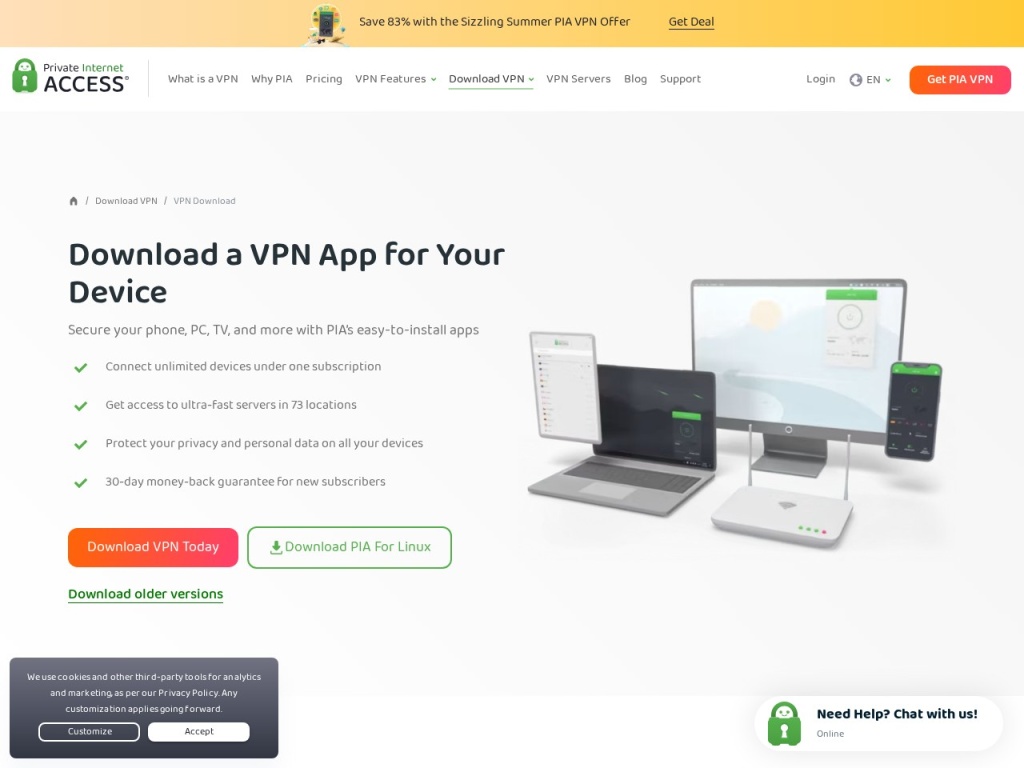
- Download the app for each platform from your account area — Windows, macOS, Linux, iOS, Android, browser extensions and smart-TV builds are all covered.
- Sign in and connect once with defaults (WireGuard, automatic server) to confirm everything works.
- Turn on the kill switch and MACE ad blocking in settings — both are off-by-default choices worth changing immediately.
- Set up split tunneling for apps that misbehave under VPN (banking apps, some streaming boxes) rather than toggling the whole VPN off and on.
Total setup time is a few minutes per device. Power users should also explore the automation rules — for example, auto-connect on untrusted Wi-Fi and stay off on your home network — which remove the human error from VPN discipline.
Common setup mistakes to avoid
The classic PIA mistake is drowning in options and misconfiguring them. Leave the protocol on WireGuard unless something breaks — OpenVPN is slower and mainly useful for restrictive networks. Do not stack PIA’s MACE with a system-wide DNS blocker unless you understand the interaction, or some sites will fail in confusing ways. If torrenting with port forwarding, remember it requires choosing a server that supports it and binding your client to the VPN interface, or you lose the benefit silently. And novices should resist copying “maximum security” settings guides from forums: the defaults plus a kill switch already cover the realistic threat model, and exotic cipher changes mostly just cost speed.
Watch: Private Internet Access review and walkthrough
Private Internet Access vs alternatives
Against its Kape sibling CyberGhost, PIA is the tinkerer’s pick — more configuration, port forwarding, open-source apps — while CyberGhost offers friendlier streaming-optimized menus for the same corporate parentage. Against Surfshark, both offer unlimited devices at rock-bottom multi-year prices; Surfshark counters with faster peak speeds and cleaner apps, PIA with its court-tested logging record. Against Proton VPN, the trade is jurisdiction and ethos versus price — Proton’s Swiss base and foundation-style governance appeal to purists who distrust Kape, but you pay noticeably more. And against NordVPN, PIA loses the raw speed race and some streaming polish while costing roughly half as much on long terms. If your ranking function starts with verified privacy per dollar, PIA wins; if it starts with peak performance, it does not.

Performance, support & value
Speed: on WireGuard, PIA delivers more than enough throughput for 4K streaming and large downloads on nearby servers, and independent tests generally show respectable results — but the same tests consistently place NordVPN and Surfshark ahead at peak. Long-haul connections show more variance than the leaders. For everyday broadband under 500 Mbps, the difference is mostly academic; on gigabit fiber, you will notice it.
Support: 24/7 live chat, a decent knowledge base, and an unusually helpful community of technical users given the open-source culture. Chat agents handle billing and common issues quickly; deeply technical questions sometimes need escalation. Streaming support is honest — agents will tell you which regions currently work rather than promising everything.
Value: this is where the score is earned. Around $2/month on long terms buys a verified no-logs policy, unlimited devices, port forwarding and open-source apps — a bundle whose closest functional equivalents cost two to five times more. Even users who ultimately choose a faster premium VPN should benchmark it against what PIA gives up per dollar saved, because the gap is smaller than the price difference implies.
Security in depth
PIA’s security architecture stacks defenses sensibly. Traffic runs over WireGuard or OpenVPN with modern ciphers; the entire fleet is RAM-only, wiping any residue at reboot; DNS is handled in-tunnel by PIA’s own resolvers to prevent leaks; and the kill switch has an “advanced” mode that blocks all traffic outside the tunnel even when the app is closed. MACE blocks ads, trackers and known-malicious domains at the DNS level. Multi-hop routes traffic through an extra proxy layer for the genuinely paranoid, and the dedicated-IP system uses a token scheme so that even PIA cannot link the static address to your account identity.
Then there is the ownership question, which honesty requires addressing. PIA has been owned since 2019 by Kape Technologies, which also owns CyberGhost and ExpressVPN — and whose predecessor company had a history in ad-injection software that the privacy community has not forgotten. The counterweights are real: the court record and Deloitte audits post-date the acquisition, the apps remain open source, and no credible evidence of logging misconduct has surfaced under Kape. Our view: the evidence supports the no-logs claim regardless of parentage, but users whose threat model includes distrust of consolidated VPN conglomerates have a rational reason to pay more for Proton VPN instead.
What real users say
User sentiment on PIA splits cleanly by user type. Technical users are the enthusiasts: years-long loyalty, praise for port forwarding that “just works”, appreciation for open-source apps and the configurability rivals stripped out. The price earns near-universal approval — long-term subscribers frequently report paying less per month than a coffee costs, and the unlimited-device policy comes up constantly from families who covered every screen in the house on one plan.
The complaints are just as patterned. Novices find the settings intimidating and occasionally break their own connectivity with them. Streaming users report a cat-and-mouse experience with certain platforms — most regions work most of the time, but not with the consistency of the premium leaders. Speed grumbles concentrate among gigabit-fiber users. And in privacy forums, the Kape ownership resurfaces in every thread about PIA, less as a report of anything wrong than as a permanent asterisk. Weighted together, it is the review profile of a power tool: loved by people who read manuals, frustrating to people who do not.
Who should use it — and who should not
Choose PIA if you want the best-evidenced privacy in the budget class, if you torrent or self-host and need port forwarding, if you have many devices, or if you enjoy configuring software to behave exactly as you want. It is the default recommendation for technical users who think two dollars a month should buy substance rather than interface polish.
Skip it if you want a one-button experience with flawless streaming — NordVPN and Surfshark serve that shopper better — if you routinely need every last megabit of a gigabit line, or if Kape ownership is disqualifying under your threat model. PIA rewards attention; users who will never open the settings are paying for capability they will not use.
Honest limits
PIA is not the fastest VPN, and no amount of configuration closes the gap to the leaders’ best servers. The interface, while much improved over the years, still presents novices with more switches than they want. Streaming unblocking is good but not bulletproof, dedicated IPs cost extra, and the parent-company history is a permanent discount on trust for part of the privacy community. None of these change the core verdict — verified privacy at an unmatched price — but each narrows the audience the verdict applies to.

Private Internet Access deals
PIA’s pricing is effectively a permanent sale: the multi-year plan around $2/month is the real price, and seasonal events mostly add bonus months or bundled extras like antivirus rather than deeper cuts. The 30-day money-back guarantee makes the long plan safe to test properly. We track the current best PIA offer alongside its rivals on our deals page, and we note renewal terms there because that is where long VPN deals usually sting.
Frequently asked questions
Has PIA’s no-logs policy really been proven in court? Yes — in two separate US criminal cases, subpoenas for user activity data produced nothing, because no logs existed. Deloitte audits have since verified the infrastructure independently.
Who owns Private Internet Access? Kape Technologies, which also owns CyberGhost and ExpressVPN. The no-logs court record and audits post-date the acquisition, but the ownership remains a sticking point for some privacy advocates.
How many devices can I connect? Unlimited simultaneous connections on one subscription, across all supported platforms.
Does PIA support port forwarding? Yes, on most of its server network — enable it in settings and pick a supporting server. It remains one of the few major VPNs that still offers this.
Is PIA good for streaming? Generally yes for major regions, but with less consistency than the premium leaders; expect occasional server-hopping during platform crackdowns.
Is PIA fast enough for gaming and 4K? Yes on WireGuard to nearby servers; latency and throughput are solid, though peak speeds trail NordVPN and Surfshark in most independent tests.
Is there a money-back guarantee? Yes, 30 days on all plans, which comfortably covers real-world testing.
How to choose a VPN: a practical guide
Start with evidence, not adjectives: prefer providers whose no-logs claims have survived an audit, a court case, or ideally both, because everything else on a VPN’s homepage is unverifiable. Second, match the feature set to your actual use — torrenting needs port forwarding, households need generous device limits, travelers need wide server coverage, streamers need consistently unblocked regions — and refuse to pay for capabilities outside that list. Third, price the commitment honestly: compare effective monthly rates across terms, then check what the plan renews at, because multi-year VPN deals are the industry’s favorite place to hide a doubling. Fourth, weigh jurisdiction and ownership if your threat model warrants it; for most people it does not, but you should decide that consciously. Run our current VPN rankings through that checklist and PIA’s position makes sense: the strongest evidence stack and feature depth per dollar in the budget tier, with speed and simplicity as the deliberate trade-offs.



