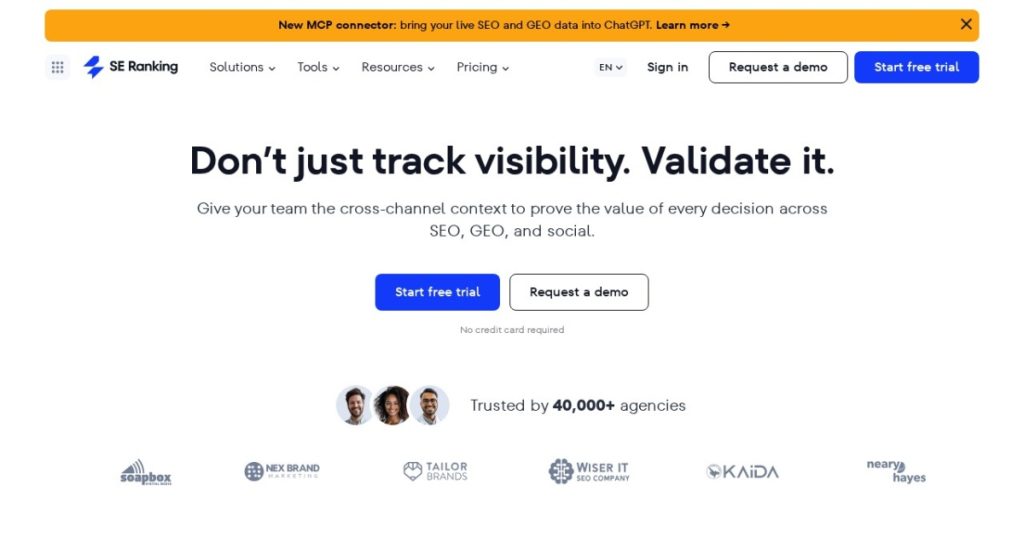
If you have ever priced out a serious SEO stack, you know the sinking feeling: the tools everyone recommends cost more per month than many small sites earn. SE Ranking exists for exactly that moment. It is a genuine all-in-one SEO platform — rank tracking, keyword research, site audits, backlink analysis, competitor research and a content module — sold at a mid-market price that undercuts the household names by half or more. We spent weeks inside the platform, tracked real keyword sets against known positions, ran audits on sites we manage, and compared its data against the premium tools we have already reviewed to find out where the savings are free and where they cost you something.
AnalyzeBench Score: 8.4/10
Best for: Freelancers, in-house marketers and small agencies who need the full SEO toolkit — especially accurate daily rank tracking — without paying Semrush or Ahrefs prices.
What we loved:
- One of the most accurate rank trackers we have tested, with true daily checks, local and mobile tracking, and Google Maps positions.
- Genuinely all-in-one: keyword research, site audit, backlink checker, competitor analysis and reporting live under one login.
- Flexible pricing levers — check frequency and keyword volume — let you tune the bill to what you actually use.
- White-label reporting and a lead-generation widget that make it a quiet favorite among small agencies.
- An API on higher tiers, which is rare at this price point.
What could be better:
- Backlink database is respectable but noticeably smaller than Ahrefs or Semrush, so link audits on big sites miss some referring domains.
- The content marketing module costs extra on most plans rather than being bundled.
- Keyword databases outside the major English-speaking markets are thinner than the premium tools’.
- The interface, while clean, buries a few power features two or three menus deep.
What makes SE Ranking different
Most affordable SEO tools are affordable because they do one thing. SE Ranking’s bet is different: cover the entire workflow — research, tracking, auditing, links, content and reporting — and charge mid-market money for it by letting you scale the parts you actually use. The pricing model is the tell. Instead of a flat tier that assumes everyone needs everything daily, SE Ranking historically lets you choose how often your rankings are checked; opt for every-three-days checks instead of daily and the price drops meaningfully. For a consultant tracking a stable local business, that is free money.
The flagship is the rank tracker, and it earns the billing. Positions update on schedule, local results are tied to a specific city or even ZIP code, mobile and desktop are tracked separately, and Google Maps rankings sit alongside organic ones. In our accuracy spot-checks — comparing reported positions against live incognito searches from matching locations — SE Ranking was consistently within a position of reality, which is as good as this category gets. Around that core, the platform has grown real depth: a crawler-based site audit, a backlink checker with disavow file export, competitor traffic estimates and an AI-assisted content editor. None of it feels like a checkbox feature bolted on to pad a comparison table.
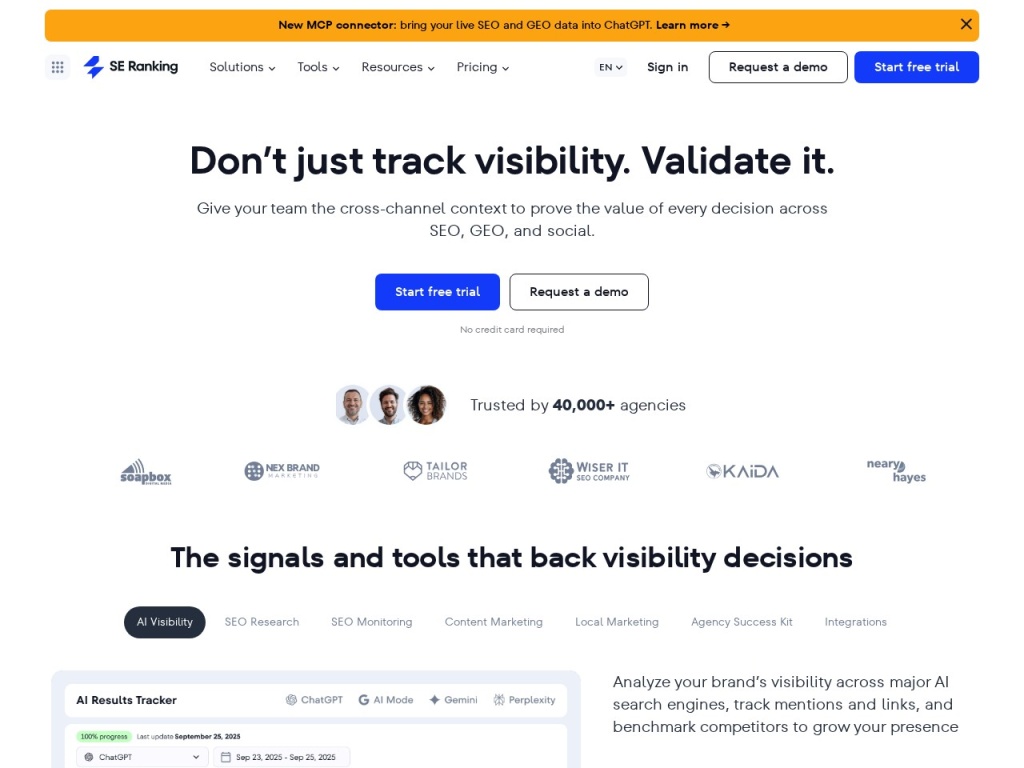
The core modules
Rank Tracker
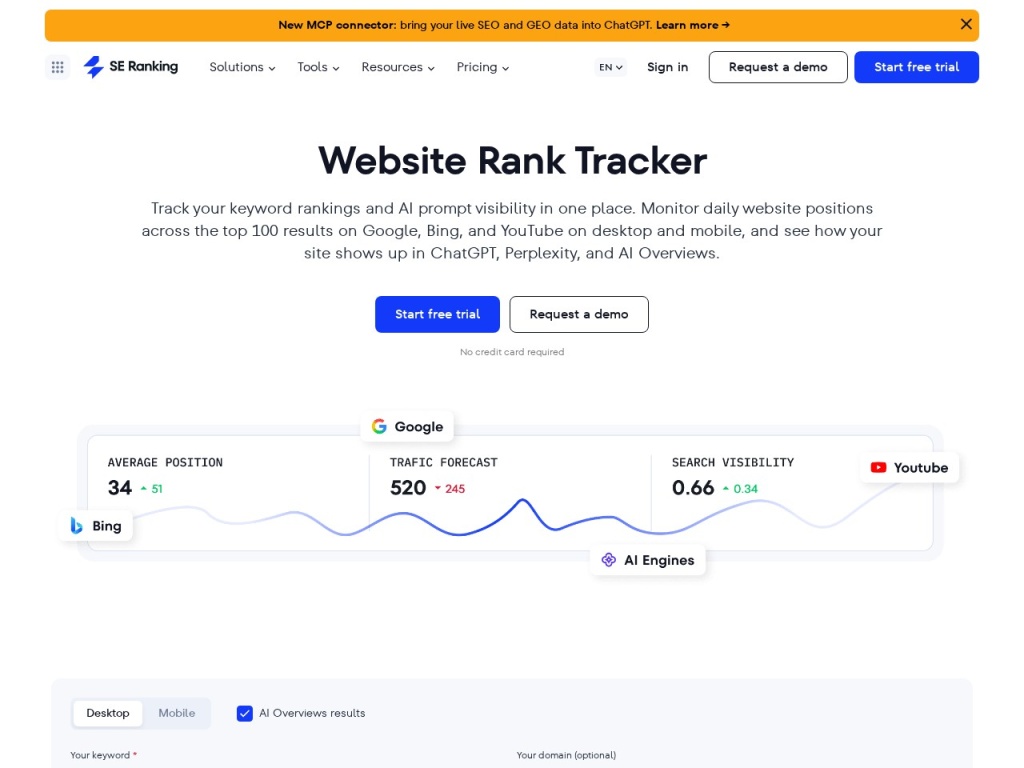
The reason most people sign up. You get daily (or scheduled) position checks across Google, Bing and Yahoo, segmented by location and device, with SERP feature tracking so you can see when a competitor’s featured snippet — not a ranking drop — stole your clicks. Historical data is kept indefinitely on paid plans, and the competitor tab lets you shadow up to several rivals’ positions for every keyword you track.
Keyword Research
The keyword tool covers search volume, difficulty scores, CPC data and SERP analysis across dozens of country databases. Volumes track closely with the industry consensus in US and UK markets. It will not match Semrush’s billions-deep database in long-tail obscurity, but for building a content plan for a normal business, we never found ourselves stuck.
Site Audit
The crawler checks several hundred technical factors — indexability, Core Web Vitals data, duplicate content, broken links, hreflang problems — and grades the site with a health score that trends over time. Scheduled recrawls plus email alerts turn it into passive monitoring: you find out about an accidental noindex before Google fully digests it.
Backlink Checker & Competitor Research
Backlink data comes with the metrics you expect — domain trust, anchor text distribution, dofollow ratios, new-versus-lost timelines — and a monitoring list that alerts you when links you care about disappear. Competitor research estimates any domain’s organic traffic, top pages and paid keywords. Directionally reliable, and more than enough to reverse-engineer a rival’s content strategy.
Content Marketing module
The add-on module bundles an AI writer, a content editor with real-time optimization scoring against the current top ten, idea research and plagiarism checks. It is SE Ranking’s answer to Surfer SEO and the growing field of AI writing tools — competent, integrated, and cheaper than buying a separate subscription, though dedicated tools still go deeper.
Plans & pricing
SE Ranking sells three main tiers — Essential, Pro and Business — differentiated by keyword tracking volume, number of projects, user seats and access to features like the API, white-label reporting and historical data depth. The clever part is the levers: annual billing cuts roughly 20% off, and on some configurations the rank-check frequency slider cuts further. Exact numbers move with promotions and packaging changes, so treat the figures below as the shape of the pricing rather than a quote, and check the current price before you buy.
| Plan | Typical monthly (annual billing) | Best for |
|---|---|---|
| Essential | ~$52–65 | Freelancers and single-site owners; 1 user, limited projects |
| Pro | ~$95–119 | Growing sites and small agencies; more keywords, users and historical data |
| Business | ~$207–259 | Agencies; API access, extended limits, priority support |
The content marketing module and local marketing tools are add-ons on most tiers. There is a free 14-day trial with no credit card required, which is the correct way to evaluate a rank tracker: load your real keywords and compare its numbers against what you know to be true.
How to get started
- Start the free trial and create a project for your primary domain — the setup wizard pulls in suggested keywords automatically.
- Import your real keyword list (CSV or straight from Google Search Console) rather than relying on suggestions; tracking the wrong keywords accurately is still useless.
- Set your tracking locations and devices precisely — a plumber in Austin should track Austin mobile results, not US desktop averages.
- Run the site audit, fix the red-flag issues first, and schedule weekly recrawls.
- Add your top three competitors so the rank tracker and backlink monitor build comparative history from day one.
Total setup time for a typical site is under an hour, and the historical data starts accruing immediately — which matters, because the trend lines are where the value lives.
Common setup mistakes to avoid
Three missteps account for most disappointing first months. Tracking too few keywords: the tool prices by keyword volume, so people get stingy, track only their ten favorites and miss the long-tail movement that actually explains traffic changes — track the full set your plan allows. Ignoring location settings: default national tracking makes a local business’s rankings look worse and noisier than they are; set the city. And skipping Search Console integration: SE Ranking’s numbers become far more useful when clicks and impressions sit next to positions, and the connection takes two minutes.
Watch: SE Ranking walkthrough and honest assessment
Our testing notes: accuracy in practice
A rank tracker has one job, so we tested it the boring way: 60 keywords across two real sites — one national SaaS, one local service business — checked daily for three weeks, then spot-verified against manual incognito searches from matched locations. SE Ranking’s reported positions matched our manual checks within one position more than nine times out of ten, and the misses were the volatile SERPs where two consecutive manual searches disagreed with each other anyway. Local pack tracking for the service business correctly caught a Maps position change within a day.
The audit crawler handled a 4,000-page site in well under an hour and surfaced a real, previously unnoticed problem — a pagination chain quietly canonicalizing to page one. Backlink data was the one place we could measure a clear gap: on a domain with roughly 1,100 referring domains in Ahrefs, SE Ranking surfaced about 70–80% of them. That is plenty for monitoring your own profile’s health, but if forensic link audits are your daily work, the premium databases still justify themselves.
SE Ranking vs alternatives
Against Semrush, the trade is simple: Semrush has deeper databases, a larger link index and a sprawling feature set that extends into PPC and social — at roughly double the price for comparable limits. If you bill clients for that depth, pay for it; if you mostly need tracking, auditing and research, SE Ranking covers 90% of the workflow for half the money. Against Ahrefs, the gap is narrower on research and wider on links — Ahrefs remains the backlink king, and serious link builders should treat it as the specialist tool it is. Against Surfer SEO, there is no real fight because they are complements: Surfer optimizes individual pages; SE Ranking runs the whole program. Plenty of shops run SE Ranking for tracking and audits alongside a dedicated content optimizer or a standalone writer like Jasper.
Accuracy, speed & value
Accuracy: the rank tracker is the equal of anything we have tested, including tools costing three times as much. Keyword volumes are reliable in major markets and merely adequate in smaller ones.
Speed: the interface is responsive, audits run fast, and reports generate in seconds. The one sluggish corner is very large backlink exports, which can queue for a few minutes on the busiest hours.
Value: this is the headline. Add up what the equivalent limits cost at the premium platforms and SE Ranking routinely lands at 40–55% of the bill. For a freelancer, that is the difference between a tool that pays for itself with one client and one that needs three.
Agency features: white label, reporting & API
SE Ranking courts small agencies harder than any competitor at this price, and it shows. Reports are genuinely white-label — your logo, your domain, your colors — and can be scheduled to email clients automatically. The report builder is drag-and-drop, pulls from every module, and produces something you would not be embarrassed to attach an invoice to. A lead generation widget lets you embed a free audit form on your own site, feeding prospect domains straight into the platform.
The API, available on the Business tier, exposes rankings, audit results and backlink data — useful for agencies rolling their own dashboards or piping positions into a data warehouse. Rate limits are workable for portfolio-scale use. The one caveat: user seats are metered, so a ten-person agency should price the seat add-ons into the comparison before declaring victory over Semrush’s pricing.
What real users say
Aggregated review sentiment is strong and consistent. Across G2, Capterra and Trustpilot, SE Ranking holds ratings in the 4.7–4.8 range from thousands of reviewers, and the praise clusters around the same three things our testing found: tracker accuracy, the breadth-for-price ratio, and support that answers quickly and in complete sentences. Agencies specifically call out the white-label reporting as the feature that moved them off pricier platforms.
The recurring criticisms mirror our notes: the backlink index trails the leaders, some keyword databases outside the US and Western Europe feel thin, and users occasionally grumble when features move between tiers during pricing updates. Notably rare are complaints about billing surprises or data outages — the operational hygiene is good.
Who should use it — and who should not
Choose SE Ranking if you are a freelancer, a small agency or an in-house marketer who needs the full SEO workflow — tracking, research, audits, links, reporting — and wants to pay mid-market money for it. It is the best value-per-dollar platform we have tested, and the rank tracker alone justifies the entry tier.
Skip it if your work is backlink forensics at scale (Ahrefs earns its price), if you need the deepest competitive intelligence across dozens of markets (that is Semrush territory), or if all you want is content optimization for articles — a focused tool like Surfer does that one job with more depth.
Honest limits
SE Ranking is honest about being the value option, and the seams show in predictable places. The link index misses a slice of referring domains the premium crawlers catch. Keyword data outside the major markets is serviceable rather than deep. The content module costs extra and, while solid, will not retire a dedicated optimizer for content-heavy shops. And the tier limits — keywords, seats, API — mean genuinely large operations will price themselves back up toward the premium platforms anyway. None of this is disqualifying for the target customer; all of it is worth knowing before you commit a client roster to the platform.
SE Ranking deals
SE Ranking discounts most reliably through annual billing — roughly 20% off — and runs occasional promotions around Black Friday and product launches. Because the pricing levers (keyword volume, check frequency, add-ons) change the bill more than coupons do, configure the plan carefully before hunting codes. We track working offers on our deals page as they appear.
Frequently asked questions
Is SE Ranking’s rank tracker really accurate? In our testing, yes — reported positions matched manual location-matched searches within one position over 90% of the time, which is as good as this category gets.
Does SE Ranking have a free trial? Yes, a 14-day free trial with no credit card required, with access to the core modules so you can validate the data against your own site.
How does SE Ranking compare to Semrush? Semrush has deeper keyword and backlink databases and more adjacent features, at roughly twice the price. SE Ranking covers the core SEO workflow at mid-market cost; see our full Semrush review for the other side.
Is the content marketing module included? On most plans it is a paid add-on. It bundles an AI writer, an optimization editor and plagiarism checks — decent value, but dedicated content tools go deeper.
Does SE Ranking offer white-label reports? Yes — branded, scheduled, client-ready reports are available, and they are a major reason small agencies choose the platform.
Is there an API? Yes, on the Business tier, covering rankings, audit and backlink data with workable rate limits.
Can SE Ranking track local and mobile rankings? Yes — city-level (even ZIP-level) tracking, separate mobile and desktop results, and Google Maps positions are all supported.
How to choose an SEO platform: a practical guide
Start with the job you will do weekly, not the feature list: if that job is checking rankings and reporting to clients, tracker accuracy and report quality outrank database size, and the premium platforms’ extra depth is money spent on features you will open twice. Then count the real units — keywords tracked, projects, user seats, API calls — and price every candidate at your actual volumes, because headline tiers are designed to be outgrown. Third, validate data quality against ground truth during the trial: load keywords whose positions you already know, compare a backlink report against a profile you understand, and distrust any tool you cannot verify. Fourth, decide which specialist gaps you will fill separately — a link-forensics tool, a content optimizer — and budget the stack, not the single subscription. Finally, weigh the switching cost: ranking history does not transfer, so the platform you choose is one you should be prepared to keep for years. SE Ranking’s combination of verifiable tracker accuracy, honest mid-market pricing and agency-grade reporting is precisely what that checklist rewards, which is why it earns an 8.4 and a place on our shortlist for freelancers and small agencies.