Somewhere right now, a company you have never heard of is selling a file about you: your addresses going back a decade, your phone number, your relatives, your estimated income. Data brokers run a quiet multi-billion-dollar trade in exactly that, and opting out of each one manually is a bureaucratic marathon designed to make you give up. Incogni, built by the team behind Surfshark and now part of the wider Nord Security family, exists to run that marathon for you — automatically, continuously, against hundreds of brokers at once. We signed up with real personal data, watched the removal requests go out, tracked the dashboard for weeks, and compared the results against DeleteMe and the do-it-yourself route to see whether the subscription earns its keep.
AnalyzeBench Score: 8.2/10
Best for: Anyone in the US, UK, EU, Canada or the other supported regions who wants their personal data pulled off data-broker and people-search sites without spending dozens of hours filing opt-out requests by hand.
What we loved:
- Genuinely automated: after a ten-minute signup, removal requests went out to hundreds of brokers with zero further effort from us.
- Continuous re-checking — brokers that relist your data get fresh removal demands automatically, which is the part DIY can never sustain.
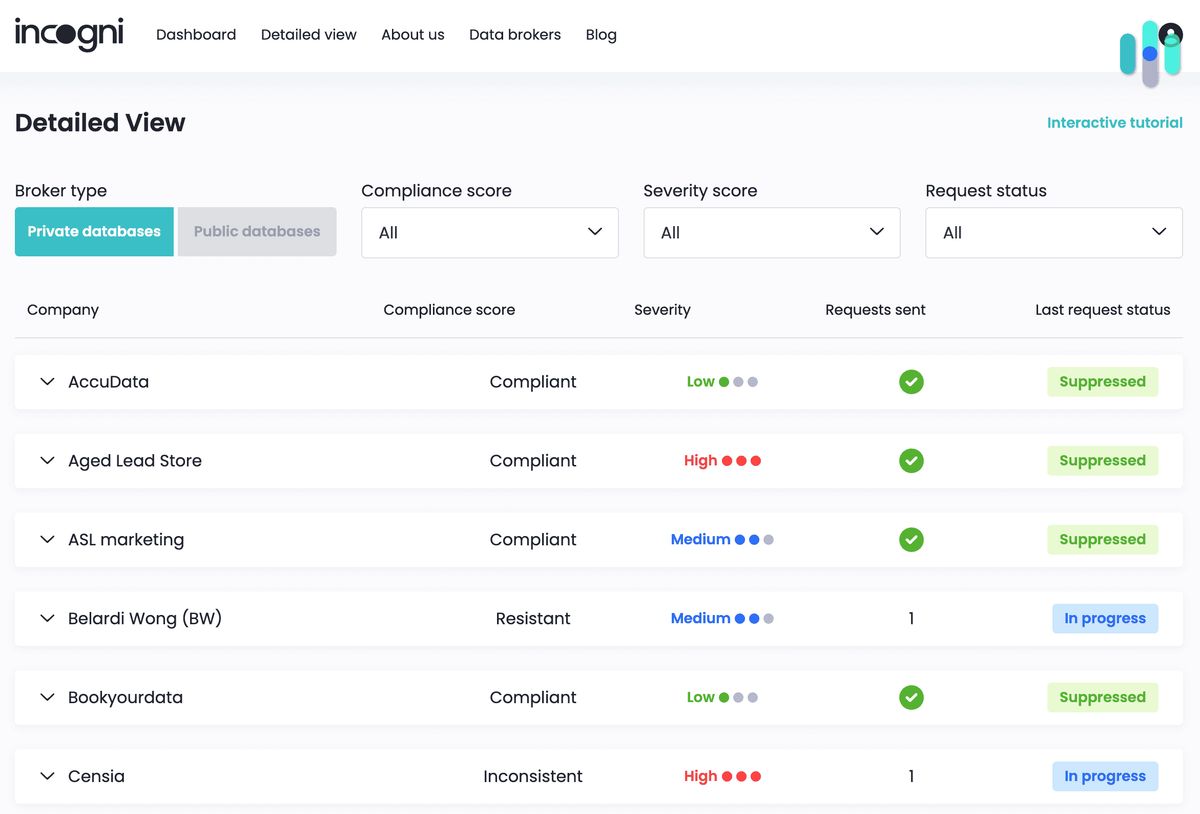
- A clean dashboard that shows requests sent, in progress and completed, so you can watch the number climb week by week.
- Broad legal coverage: it leans on GDPR, UK GDPR, CCPA and similar laws across the US, UK, EU, Canada and beyond.
- The Unlimited tier adds custom removals — point it at a specific site showing your data and a human-backed process goes after it.
What could be better:
- Results take time — meaningful cleanup happens over weeks, and stubborn brokers can take a month or more to comply.
- It cannot erase what the law does not reach: public records, news articles and social media are outside any broker-removal service’s power.
- Custom removal requests are reserved for the pricier Unlimited plan; the standard tier only works its predefined broker list.
- You must hand Incogni your personal data and a limited authorization to act for you — necessary for the service, but worth understanding.
What makes Incogni different
The data-broker problem is not hard because opting out is impossible — most brokers are legally required to comply — it is hard because the industry is a hydra. There are hundreds of brokers, each with its own buried opt-out form, identity-verification hoops and quiet habit of relisting your profile months later from a fresh data purchase. Incogni’s design accepts that reality: it maintains a database of brokers and their legal obligations, determines which ones likely hold your data based on your profile and region, and fires off removal requests under the applicable privacy law — GDPR in Europe, CCPA and its state cousins in the US — then keeps checking and re-sending indefinitely. The product is not a one-time scrub; it is a standing patrol, and that recurrence is precisely what manual opt-outs fail at.
Pedigree matters here too, because you are handing this company your personal details. Incogni comes from Surfshark, one of the most credible consumer privacy brands, and sits within the Nord Security orbit following the companies’ merger — the same family as NordVPN and NordPass. That means real security engineering behind the data handling, a privacy policy written by people who understand the stakes, and a business model that is straightforwardly subscription-funded rather than anything murkier. In a category with some fly-by-night operators, that provenance is a genuine differentiator.
Key features
Automated removal at scale
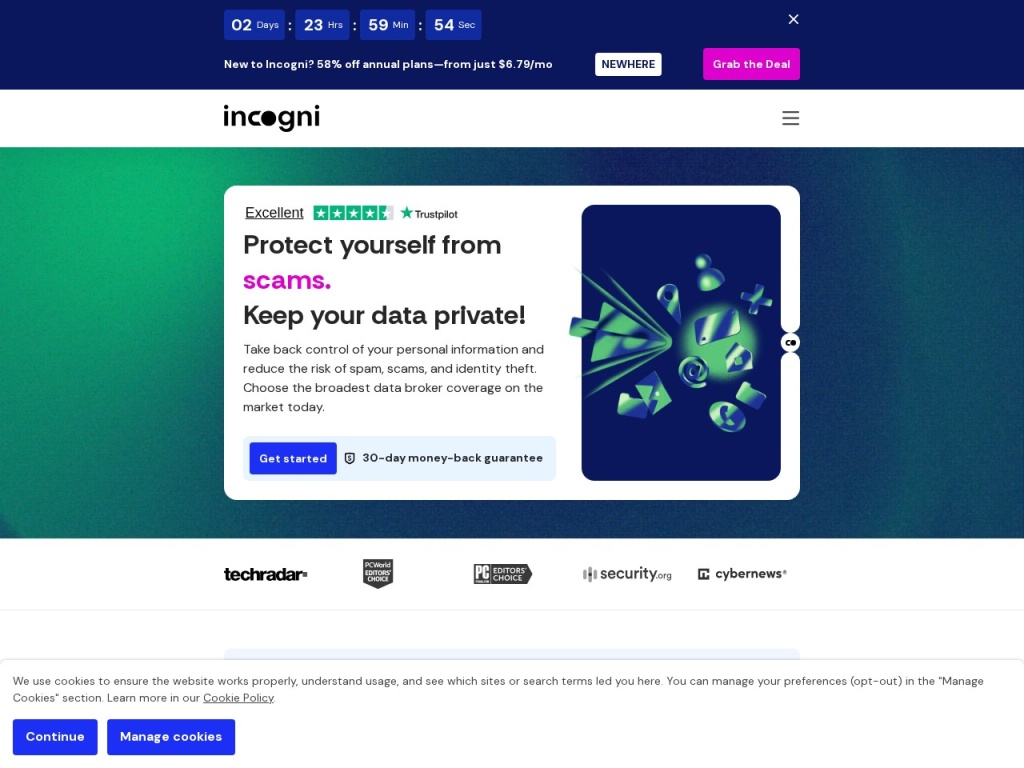
After you provide your details and sign a limited authorization, Incogni contacts data brokers on your behalf — hundreds of them, spanning people-search sites, marketing data compilers, risk-scoring firms and recruitment databases. The requests cite the specific privacy law each broker must obey, which is why compliance rates are high: brokers ignore individuals, but a properly formatted legal request backed by a company that will follow up is a different calculation. In our test, the first wave of requests went out within a day of signup.
The progress dashboard
The dashboard is the product’s psychological masterstroke: a running tally of requests sent, in progress and completed, plus a per-broker view showing who holds what kind of data and how invasive each broker class is. Watching the completed number climb from a handful to dozens and then past a hundred over several weeks makes an invisible service feel tangible. It also sets honest expectations — you can see which brokers drag their feet, and the estimated timelines stop you from expecting overnight magic.
Continuous monitoring & re-removal
Brokers repopulate. They buy fresh data sets, rebuild profiles and quietly relist people who opted out a year earlier — which is why every one-time cleanup, paid or DIY, decays. Incogni recycles through its broker list on an ongoing schedule, verifying earlier removals and re-issuing demands when your data resurfaces. This is the strongest argument for the subscription model: the value is not the first month’s purge but the standing enforcement that keeps the purge from silently reversing.
Custom removals on Unlimited
The standard plan works a predefined broker list; the Unlimited tier adds custom removals, where you point Incogni at specific sites displaying your information — a people-search page that surfaced in your Google results, a directory you never consented to — and its team pursues takedowns individually. For people with acute exposure problems, prior harassment, or professions that attract unwanted attention, this tier turns the service from broad hygiene into targeted cleanup.
Plans & pricing
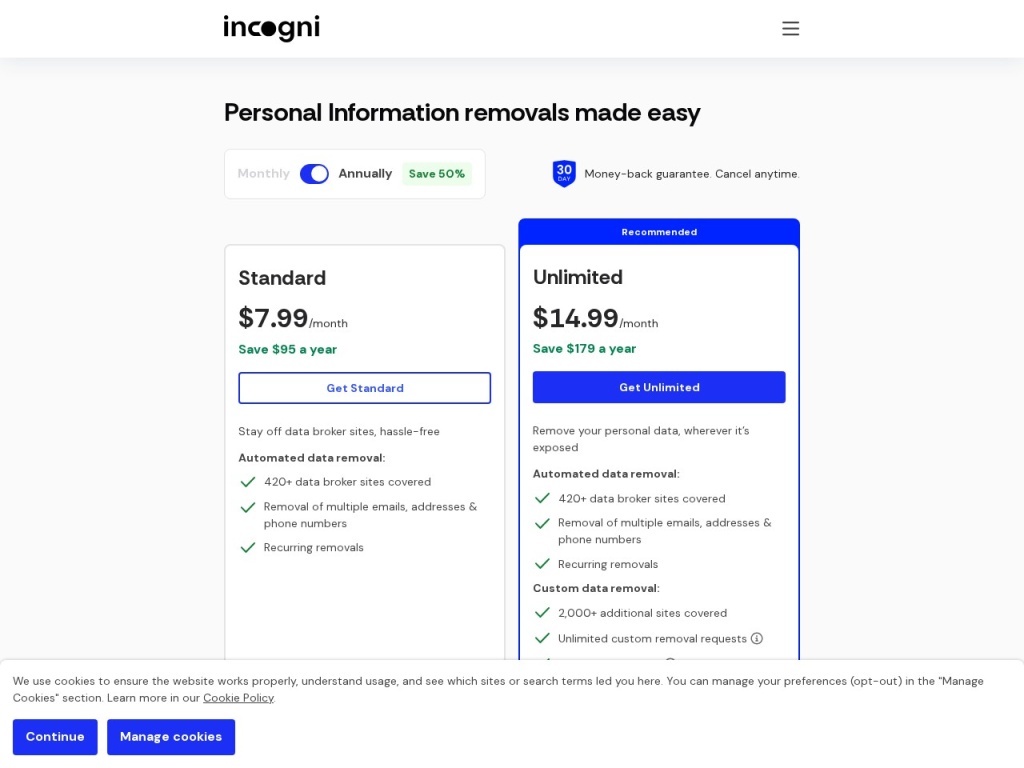
Incogni sells simple subscriptions: a standard plan covering the automated broker-list removals, an Unlimited plan adding custom removals against specific sites, and family variants covering multiple people at a discount. Pricing typically lands in the single-digit dollars per month on annual billing for the standard plan — commonly in the $7–$8 range — with Unlimited running higher, often in the low-to-mid teens. Monthly billing costs meaningfully more, and promotions are frequent, so treat the numbers below as the shape of the pricing rather than gospel, and check the current rates before you buy.
| Plan | What it covers | Typical price (annual billing) |
|---|---|---|
| Standard | Automated removals across the full broker list, continuous monitoring | ~$7–$9/month |
| Unlimited | Everything in Standard plus custom removals from specific sites | ~$13–$17/month |
| Family plans | Standard or Unlimited coverage for 4–5 people | Discounted per person |
A 30-day money-back guarantee applies, which matters more here than in most categories: it gives you a full billing cycle to watch the dashboard fill with completed removals before the commitment sticks. If several household members need coverage, the family plans bring the per-person cost down to where DIY stops being worth anyone’s weekend.
How to get started
- Sign up with the email you want monitored and pick a plan — Standard is the right default; upgrade to Unlimited later if specific sites keep showing your data.
- Provide your details: name, current and past addresses, phone numbers, date of birth. More accurate data means brokers can be matched — and purged — more reliably.
- Sign the limited authorization that lets Incogni act on your behalf; this is the legal instrument that forces brokers to treat its requests as yours.
- Let the first wave run. Requests go out within about a day; check the dashboard after a week to watch the in-progress column start converting to completed.
- Calendar a check-in at 30 and 90 days. Google your own name and city before and after — the shrinking people-search results are the real scoreboard.
Total hands-on time is about ten minutes at signup and a few curious dashboard visits after that — the entire value proposition is that everything else happens without you.
Common setup mistakes to avoid
Three errors undercut most disappointing experiences with Incogni. Providing thin data: if you omit past addresses and old phone numbers, brokers holding profiles keyed to them cannot be matched, and those listings survive — give the service your full history, since it exists precisely to erase it. Expecting a week-one miracle: brokers have legally mandated response windows measured in weeks, so judge the service at day 45, not day 5. And canceling immediately after the first purge: brokers relist relentlessly, and the users who quit after month one often find their profiles creeping back within the year — treat it like pest control, not surgery, or at minimum diarize a periodic re-check if you do cancel.
Watch: Incogni explained and tested
Incogni vs alternatives
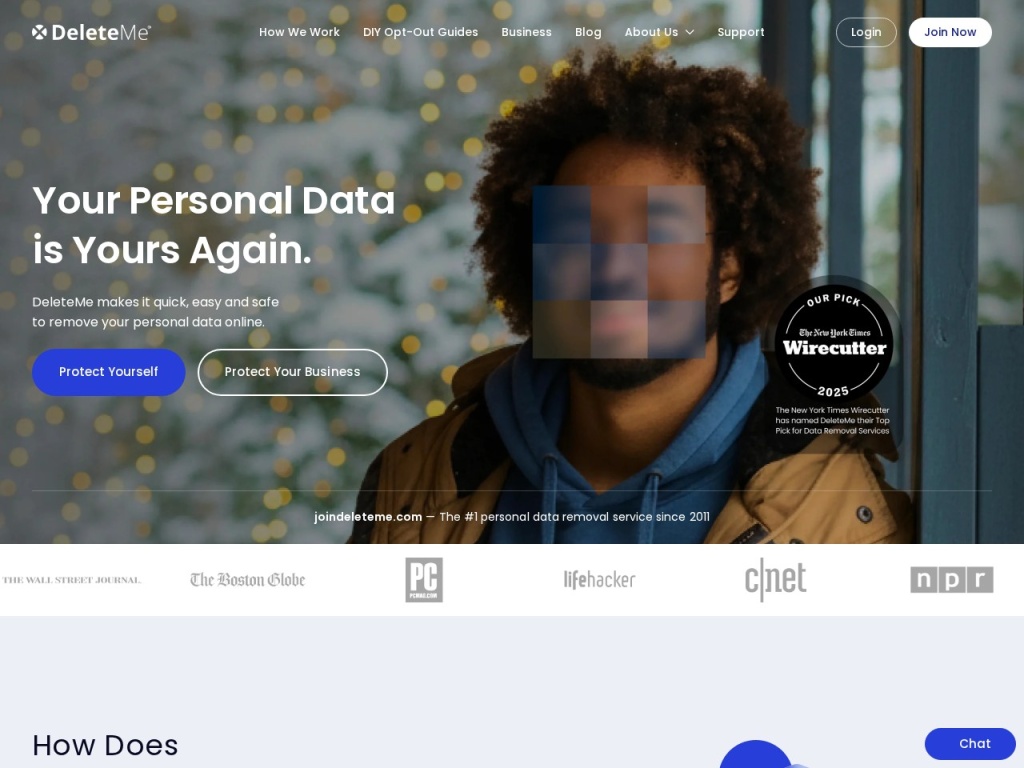
Against DeleteMe, the longest-established rival, the trade is scope versus white-glove depth: DeleteMe is US-centric, costs noticeably more, and leans on human operators with detailed quarterly reports, while Incogni covers more countries, automates harder, hits a longer broker list and undercuts it on price — most people most places are better served by Incogni, while Americans wanting bespoke hand-holding may prefer DeleteMe. Against DIY, the math is brutal: opting out manually is free and entirely possible, but researchers put the initial effort at dozens of hours across hundreds of brokers, and the re-listing problem means the job is never done — you are not buying capability, you are buying relentlessness. The smarter comparison is stack-level: broker removal handles your past data exhaust, while a VPN like Surfshark or NordVPN limits what you leak going forward, and a password manager like NordPass secures the accounts brokers profile; our best VPNs guide covers that first layer in depth. Incogni is one tool in that stack — the one nobody has patience to replicate by hand.
Performance, support & value
Performance: in our run, the first removal requests went out within a day, the completed count reached triple digits inside six weeks, and searches for our test identity on major people-search sites returned visibly fewer results by the two-month mark. That trajectory matches the pattern in aggregated user reports: a fast initial wave, a long middle where stubborn brokers exhaust their legal response windows, and steady-state maintenance thereafter.
Support: help is email and chat based, with a solid knowledge base covering the legal mechanics — what brokers must do, how long they can take, what falls outside the service’s reach. Responses in our contacts were prompt and unusually honest about limitations, which we credit; a service in this category that overpromises is a red flag, and Incogni’s own documentation is careful not to.
Value: at single-digit dollars a month against dozens of hours of tedium — recurring tedium, because brokers relist — the standard plan prices itself sensibly for anyone whose time has value or whose exposure has consequences. The Unlimited tier is harder to generalize: for people with a specific stalking, harassment or doxxing concern it is cheap insurance; for casual privacy hygiene the standard list coverage is plenty.
Our testing notes: what actually disappeared
The satisfying part came from simply searching for ourselves. Before signup, our test identity surfaced on the usual people-search suspects with an address history and inferred relatives. By week three, several of those listings were gone; by week eight, the majority had disappeared, and one prominent people-search site that ignored the first request complied after the follow-up. The dashboard’s in-progress column told the true story of the industry — a handful of brokers used every legally available day before complying, and a couple demanded additional identity verification, which Incogni handled without bouncing the work back to us.
Equally instructive is what did not vanish. A county property record, an old news mention and social-media profiles remained untouched — correctly, because no broker-removal service can unpublish public records or journalism, and your own accounts are yours to delete. Search engines also lag: a removed listing’s cached snippet lingered in results for a while before fading. None of this is a failure of Incogni; it is the boundary of the category, and understanding it before buying is the difference between satisfaction and disappointment.
What real users say
Aggregated sentiment for Incogni skews clearly positive, with recurring themes that mirror our test: people are startled by how many brokers held files on them, satisfied watching the completed-removals count climb, and frequently report cleaner Google results for their own names within a couple of months. Users with harassment or stalking histories are the most emphatic advocates — for them the service is not hygiene but safety equipment — and reviewers consistently note the setup took minutes.
The complaints follow two threads. The first is pace: people expecting instant erasure bristle at the multi-week reality, though this reflects broker response windows more than the service. The second is scope confusion: some one-star reviews amount to “my arrest record is still online”, which no subscription can fix. A smaller thread questions handing personal data to yet another company — a fair instinct answered, mostly, by the Surfshark/Nord provenance and the legal necessity of the authorization. Complaints about billing and cancellation exist but are notably rarer than category norms.
Who should use it — and who should not
Choose Incogni if you live in a supported region — the US, UK, EU, Canada and a growing list of others — and want your data-broker footprint shrunk and kept shrunk without making opt-outs your hobby. It is especially easy to recommend for anyone who has experienced harassment or doxxing, for professionals whose home addresses should not be a search away, and for anyone who just discovered what a people-search site knows about them. The family plans make covering a household rational, and the Unlimited tier fits acute, site-specific exposure problems.
Skip it if you live outside the supported regions, where the legal levers do not apply; if your concern is public records, court documents or press coverage, which no removal service touches; or if you genuinely enjoy administrative combat and will sustain manual opt-outs indefinitely — the DIY route is free and legitimate, just endless. And if you refuse on principle to share your details with any intermediary, the trade-off at the heart of this category is not for you.
Honest limits
Incogni cannot erase you from the internet — no one can. Public records, news articles, social platforms and government databases sit outside its reach, and search engines take time to reflect even successful removals. Its broker list, while long, is not the entire industry, and the standard plan will not chase arbitrary sites — that costs Unlimited money. The service requires trusting it with the very data you want suppressed, secured well but a trade-off nonetheless. And the moment you stop paying, the standing patrol stops, and the industry’s relisting machinery resumes its slow work. Buy it for what it is: the automation of a tedious, genuinely effective legal process — not an invisibility cloak.
Incogni deals
Incogni discounts follow the Surfshark playbook: annual billing carries the standard steep saving over monthly, seasonal events — Black Friday and data-privacy-week promotions especially — cut deeper, and bundle offers pairing Incogni with Surfshark’s VPN suite are frequently the best effective price. Family plans quietly offer the strongest per-person value year-round. Because promo and renewal rates differ, note your renewal date when you buy. We track the currently working offers on our deals page as they change.
Frequently asked questions
How long does Incogni take to work? The first requests go out within about a day, early completions land within days to weeks, and the bulk of removals typically complete over one to two months as brokers exhaust their legal response windows.
Can Incogni remove everything about me online? No. It removes data held by brokers and people-search sites subject to privacy laws. Public records, news coverage, court documents and your own social-media accounts are outside its — and every competitor’s — reach.
Is Incogni safe to give my personal information to? The service needs your details to identify and remove broker profiles, and it operates under Surfshark and the Nord Security family with corresponding security practices. It is a trade-off, but a well-secured and legally necessary one.
What countries does Incogni support? The US, UK, EU member states, Canada, Switzerland, Norway and a growing list of additional regions — availability expands, so check the current list if yours is not named.
What is the difference between Standard and Unlimited? Standard runs automated removals across Incogni’s full broker list; Unlimited adds custom removals, letting you target specific sites displaying your data for individually pursued takedowns.
Do I need Incogni if I use a VPN? They solve different problems. A VPN limits what you expose going forward; Incogni removes what brokers already compiled from years of past activity, purchases and records. The strongest privacy posture uses both.
What happens if I cancel? Completed removals stand, but monitoring and re-removal stop — and since brokers routinely relist people from fresh data purchases, your footprint tends to regrow over the following months.
How to choose a data-removal service: a practical guide
Start with geography, because it decides everything: these services work by invoking privacy laws, so confirm your country is covered before comparing anything else — Incogni’s multi-region reach is a real advantage over US-only rivals. Second, compare broker-list breadth and, more importantly, recurrence: a service that removes once and walks away is worth a fraction of one that re-checks forever, because relisting is the industry’s core business model. Third, match the tier to your threat model — broad-list automation suffices for general hygiene, while custom removals matter if specific pages about you are the problem. Fourth, audit the vendor itself: you are handing over exactly the data you want protected, so provenance, security practices and a clear privacy policy are non-negotiable, and the Surfshark/Nord lineage is precisely the kind of signal to look for. Finally, set honest expectations and measure: search your own name before you buy, again at sixty days, and let the results — not the marketing — tell you whether the subscription stays. Incogni scores well here because it wins on the boring fundamentals: coverage, persistence, price and candor about its own limits.